
30 Other Ways to Say “Great Asset to the Team” (With Examples)
Quick Answer: The strongest all-purpose alternative to “great asset to the team” is “an invaluable asset to the team.” It sounds professional, appreciative, and confident. However, when writing performance reviews, recommendation letters, or personal messages, a complete sentence describing someone’s actual contribution often makes the praise more meaningful and memorable.
Finding the right words to recognize someone’s contribution can make workplace communication more thoughtful and effective. While “great asset to the team” is a positive compliment, repeating it in every performance review, recommendation letter, or professional email can make your writing sound predictable.
If you’re exploring how to say great asset to the team in a more natural way, the best approach is to choose wording that reflects the person’s actual strengths. You might want to highlight their reliability, leadership, collaboration, technical knowledge, or positive influence on colleagues.
This guide covers 35 other ways to say great asset to the team, including professional synonyms, complete sentences for performance reviews, recommendation letter examples, LinkedIn profile phrases, and warm expressions of appreciation. Each alternative includes a tone and usage note, along with a realistic example you can adapt to your situation.
What Does “Great Asset to the Team” Mean?
The great asset to the team meaning is that someone brings valuable skills, knowledge, experience, or personal qualities that help a group work more effectively and achieve its goals. It is a compliment that recognizes an individual’s positive contribution to the people and projects around them.
In simple terms, calling someone a great asset means their presence makes a meaningful difference. They might solve difficult problems, support coworkers, improve processes, deliver excellent results, or create a more productive working environment.
The expression combines two ideas. An asset is something useful or advantageous, while the team represents the group benefiting from that person’s contribution. Therefore, the asset to the team meaning goes beyond simply being a good employee. It suggests that someone’s abilities or actions positively influence collective success.
For example, consider an employee who consistently helps new colleagues understand complicated procedures. Their contribution is valuable because they improve their own performance while helping other people become more effective.
Someone described as a great asset to the team might demonstrate qualities such as:
- Reliability: They consistently complete responsibilities and follow through on commitments.
- Collaboration: They communicate effectively and support other team members.
- Problem-solving: They identify challenges and develop practical solutions.
- Leadership: They encourage others, share knowledge, and take initiative.
- Expertise: They contribute specialized knowledge or skills that benefit the group.
- Positive influence: They improve workplace morale and encourage productive relationships.
The expression is not limited to employees. You can use it to describe a coworker, manager, volunteer, business partner, contractor, or anyone whose contribution benefits a group.
Is “Great Asset to the Team” Professional or Polite to Say?
Yes. “Great asset to the team” is both professional and polite. It is commonly suitable for performance reviews, workplace emails, recommendation letters, employee recognition messages, and professional conversations.
The phrase communicates appreciation without sounding overly personal or informal. It is especially useful when you want to acknowledge someone’s overall value rather than praise one particular achievement.
However, the expression can sometimes sound generic. If you simply write “She is a great asset to the team” without explaining why, the compliment may not communicate much about the person’s actual performance.
Compare these two examples:
General praise: “Michael is a great asset to the team.”
Specific praise: “Michael is a great asset to the team because he consistently resolves complex technical issues and helps junior employees develop their skills.”
The second statement is stronger because it connects the compliment to observable contributions.
For professional writing, consider choosing an alternative that identifies a particular strength. For personal appreciation, a complete sentence that acknowledges someone’s effort often sounds warmer than calling them an asset.
Quick Top Picks: The 8 Best Alternatives at a Glance
If you need a quick replacement, these eight alternatives cover the most common situations. They are selected from the detailed list below, so you can find a ready-to-use explanation and example for each one.
- An invaluable asset to the team: Best for formal recognition and strong professional praise.
- A key contributor: Best for performance reviews and reports.
- You make the team stronger: Best for direct, meaningful employee feedback.
- Any team would be lucky to have her: Best for recommendation letters.
- A proven contributor whose work lifts team performance: Best for LinkedIn and professional profiles.
- A great addition to the team: Best for welcoming new employees.
- We’re lucky to have you on the team: Best for expressing personal appreciation.
- You are appreciated more than you know: Best for warm thank-you messages.
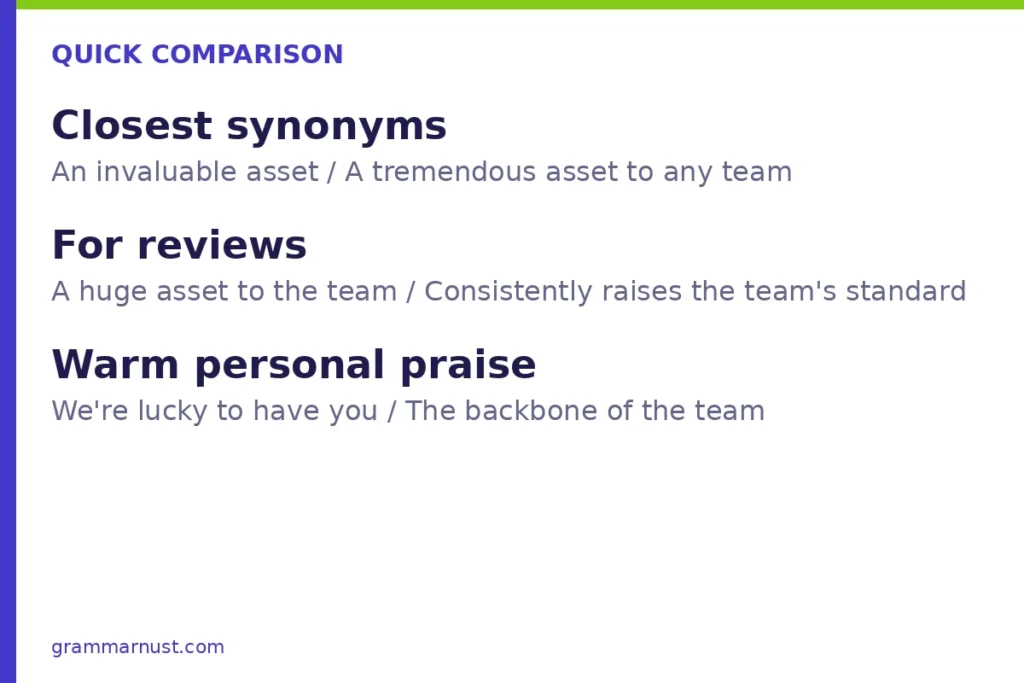
The Closest Synonyms: True “Asset” Equivalents (4 Alternatives)
If you want another way to say valuable asset to the team without changing the basic meaning, these four expressions are particularly suitable. They retain the idea that someone brings considerable value to a group or organization.
When looking for a great asset to the team synonym, remember that the best choice depends on the strength of the contribution you want to recognize. These expressions also cover several valuable asset to the team synonyms without relying on repetitive adjective changes. Each one works in a slightly different professional context.
1. An Invaluable Asset to the Team
Tone: Highly appreciative, professional, and confident.
This is the strongest all-purpose replacement for the original phrase. “Invaluable” suggests that someone’s contribution is exceptionally important and difficult to replace. It works particularly well in annual performance reviews, formal recognition, and recommendation letters.
Example: “Sarah has become an invaluable asset to the team through her excellent leadership, consistent performance, and willingness to support colleagues during challenging projects.”
2. A Tremendous Asset to the Team
Tone: Enthusiastic, positive, and professional.
This expression emphasizes the considerable value someone brings to a group. It is a good choice when you want to communicate strong appreciation without making the wording sound overly formal. Use it when someone has made a noticeable contribution to a successful project or improved the team’s overall performance.
Example: “David has been a tremendous asset to the team, particularly during the recent transition to our new customer management system.”
3. A Real Asset to Any Team
Tone: Genuine, complimentary, and versatile.
This alternative emphasizes that someone’s abilities and attitude would benefit more than just their current workplace. It is useful when discussing transferable skills, professional character, and a person’s ability to work effectively with different groups.
Example: “Her ability to understand complex challenges and bring people together makes her a real asset to any team.”
4. A Great Asset to the Company
Tone: Formal, positive, and organization-focused.
This is an effective alternative when you want to recognize someone’s contribution beyond their immediate department. It highlights the person’s broader value to the organization, including their influence on company goals, productivity, and workplace culture.
Example: “James has been a great asset to the company, consistently improving internal processes and helping different departments work together more efficiently.”
Short Labels for Reviews and Reports (6 Alternatives)
Sometimes a short professional label is more appropriate than a complete sentence. These expressions work well in employee evaluations, project summaries, team reports, and recognition documents.
However, short labels should support a larger explanation rather than replace meaningful feedback. When writing great asset to the team examples for a performance review, identify the person’s contribution and explain how it benefits the group. The asset to the team examples below show how to turn each label into a realistic review statement with supporting evidence.
If you are also recognizing someone’s accuracy and careful work in the same review, consider adding a relevant compliment from our guide to other ways to say “attention to detail”.
5. A Key Contributor
Tone: Professional, direct, and results-oriented.
This label describes someone whose work plays an important role in achieving team objectives. It is particularly useful when recognizing measurable contributions, successful projects, or consistent progress toward business goals.
Example: “Emily has been a key contributor to the department’s success, completing major project milestones ahead of schedule and helping the team maintain its delivery targets.”
6. An Integral Part of the Team
Tone: Respectful, appreciative, and collaborative.
This expression highlights someone whose participation and contributions are closely connected to the team’s success. It works especially well for employees who share knowledge, support colleagues, and help maintain effective working relationships.
Example: “Robert is an integral part of the team, providing consistent technical guidance and helping new employees become comfortable with their responsibilities.”
7. Our Go-To Person
Tone: Friendly, confident, and appreciative.
Use this phrase for someone colleagues regularly approach when they need advice, assistance, or specialized knowledge. It is less formal than some alternatives but can be particularly meaningful when recognizing an employee’s expertise and dependability.
Example: “Jessica has become our go-to person for resolving customer account issues because she understands the system and always provides practical solutions.”
8. A True Team Player
Tone: Warm, professional, and encouraging.
This expression emphasizes cooperation, communication, and a willingness to help others. It is particularly appropriate for someone who contributes to shared goals rather than focusing exclusively on individual achievements.
Example: “Daniel is a true team player who regularly shares his knowledge, supports coworkers during busy periods, and helps maintain a positive working environment.”
9. The Backbone of the Team
Tone: Strong, appreciative, and personal.
This metaphor describes someone whose reliability and consistent effort help keep the group functioning effectively. It is especially suitable for employees who handle essential responsibilities behind the scenes and provide dependable support during demanding periods.
Example: “Maria is the backbone of the team, ensuring daily operations run smoothly and stepping in whenever unexpected challenges arise.”
10. A Credit to the Team
Tone: Respectful, formal, and complimentary.
Calling someone a credit to the team means their behavior, performance, or accomplishments reflect positively on the entire group. It works well in formal recognition, employee evaluations, and professional references.
Example: “Thomas is a credit to the team, consistently demonstrating professionalism, sound judgment, and respect for both colleagues and clients.”
Full Sentences for Performance Reviews and Feedback (6 Alternatives)
Complete sentences often communicate appreciation more effectively than short labels. They allow you to explain exactly how an employee improves the team’s performance, supports coworkers, or contributes to a successful working environment.
These alternatives are written so you can adapt them directly for annual reviews, manager feedback, employee recognition, and professional emails. When deciding how to describe someone as a great asset to the team, focus on what the person actually does rather than relying entirely on general compliments.
11. You Make the Team Stronger
Tone: Direct, encouraging, and sincere.
This is a natural way to recognize someone’s positive influence on the group. It communicates that the employee contributes more than individual results and helps improve the team’s collective abilities.
Example: “You make the team stronger through your willingness to share knowledge, solve problems, and support colleagues whenever additional help is needed.”
12. Your Work Lifts the Whole Team
Tone: Appreciative, motivating, and collaborative.
This expression recognizes the wider impact of someone’s individual effort. It is especially suitable for employees whose work improves productivity, encourages coworkers, or helps the entire group deliver better results.
Example: “Your work lifts the whole team, particularly through the thoughtful solutions you develop and the support you provide during challenging deadlines.”
13. You Consistently Raise the Standard for All of Us
Tone: Strong, professional, and achievement-focused.
Use this sentence when someone regularly demonstrates high-quality work and encourages others to improve. It is particularly effective in reviews for employees who set positive examples through their professionalism, initiative, and commitment to excellence.
Example: “You consistently raise the standard for all of us by producing accurate work, identifying opportunities for improvement, and encouraging the team to maintain high expectations.”
14. The Team Is Better Because You’re on It
Tone: Warm, genuine, and personally appreciative.
This alternative communicates that someone’s presence has made a meaningful difference. It is suitable for direct employee feedback, recognition conversations, and messages celebrating a colleague’s contribution.
Example: “The team is better because you’re on it, and your patience, creativity, and willingness to help others have made a noticeable difference this year.”
15. You Bring Out the Best in Your Teammates
Tone: Encouraging, thoughtful, and leadership-focused.
This sentence recognizes someone who positively influences the performance and confidence of others. It is especially appropriate for mentors, experienced employees, managers, and colleagues who encourage cooperation and professional development.
Example: “You bring out the best in your teammates by sharing constructive feedback, recognizing their strengths, and helping everyone feel confident about contributing ideas.”
16. Your Reliability Makes Everyone’s Job Easier
Tone: Practical, sincere, and appreciative.
This expression is ideal for recognizing dependability and consistent follow-through. It highlights how someone’s work helps coworkers manage responsibilities more effectively and reduces unnecessary complications.
Example: “Your reliability makes everyone’s job easier because you consistently meet deadlines, communicate changes early, and follow through on every commitment.”
For Recommendation Letters and References (5 Alternatives)
Recommendation letters require language that communicates confidence in someone’s professional abilities. Instead of simply calling a person a great asset, explain why another employer, manager, or organization would benefit from working with them.
The following alternatives are suitable for employment references, professional recommendations, academic recommendations, and formal endorsements. They are written as complete sentences that can be adapted to the person being recommended.
17. Any Team Would Be Lucky to Have Her
Tone: Strong, personal, and highly supportive.
This expression is an excellent way to finish a recommendation by communicating genuine confidence in someone’s abilities. It suggests that the person’s contribution would benefit a future employer, not just their current colleagues.
Example: “Her professionalism, problem-solving abilities, and commitment to collaborative work make her an exceptional colleague, and any team would be lucky to have her.”
18. He Would Be an Asset to Any Organisation That Hires Him
Tone: Formal, confident, and persuasive.
This sentence communicates that someone’s skills and experience are valuable across different workplaces. It works well in employment references and recommendation letters. For American English documents, use the spelling “organization” rather than “organisation.”
Example: “With his strong technical background, excellent communication skills, and dependable approach to problem-solving, he would be an asset to any organization that hires him.”
19. She Leaves Every Team Better Than She Found It
Tone: Meaningful, memorable, and complimentary.
This is a particularly strong recommendation for someone who improves workplace processes, relationships, and team performance. It suggests that the person’s positive influence continues even after they move on to another opportunity.
Example: “She leaves every team better than she found it, consistently introducing practical improvements and helping colleagues develop the confidence to take on new responsibilities.”
20. He Is a Credit to Both His Team and the Wider Company
Tone: Formal, respectful, and organization-focused.
This expression recognizes someone’s contribution at both the team and company levels. It is useful when recommending a person whose professionalism and performance reflect positively on the wider organization.
Example: “He is a credit to both his team and the wider company, demonstrating outstanding judgment, accountability, and a consistent commitment to high-quality work.”
21. Any Manager Would Be Glad to Have Him on Their Team
Tone: Supportive, confident, and professional.
This alternative is useful when you want to emphasize someone’s value from a management perspective. It suggests that the individual is dependable, capable, and able to contribute positively without requiring constant supervision.
Example: “His ability to take initiative, communicate clearly, and deliver dependable results makes him someone any manager would be glad to have on their team.”
For LinkedIn, Resumes and Profiles (4 Alternatives)
Professional profiles require concise wording that communicates value without sounding like an exaggerated personal advertisement. When describing someone on LinkedIn or in a resume, focus on their professional reputation, collaboration, and influence on team outcomes.
These four alternatives use profile-style language and are suitable for LinkedIn endorsements, professional summaries, colleague recommendations, and career biographies. Adjust the pronouns and details to match the individual.
22. A Proven Contributor Whose Work Lifts Team Performance
Tone: Professional, results-oriented, and confident.
This phrase is particularly useful for describing an experienced employee who has consistently contributed to successful projects. It connects the individual’s work with the performance of the wider team rather than focusing only on personal achievements.
Example: “A proven contributor whose work lifts team performance through practical problem-solving, effective communication, and a consistent focus on shared objectives.”
23. Known for Strengthening Every Project She Joins
Tone: Positive, polished, and achievement-focused.
This expression is suitable for someone who brings useful expertise and organization to different projects. It highlights a consistent pattern of positive contributions and works well in a LinkedIn recommendation or professional biography.
Example: “Known for strengthening every project she joins, she combines thoughtful planning, technical expertise, and a collaborative approach to deliver meaningful results.”
24. A Collaborative Professional Whose Work Consistently Improves Team Outcomes
Tone: Formal, descriptive, and professional.
This alternative emphasizes both interpersonal skills and practical contributions. It is a strong option for a resume summary, professional profile, or recommendation where teamwork and measurable results are important qualities.
Example: “A collaborative professional whose work consistently improves team outcomes through clear communication, effective coordination, and a strong commitment to shared goals.”
25. Recognised by Colleagues as the Person Who Makes Teams More Effective
Tone: Credible, appreciative, and reputation-focused.
This expression works well in a LinkedIn endorsement or professional recommendation when the person is known for helping others work more efficiently. It emphasizes positive recognition from coworkers rather than relying only on self-description.
Example: “Recognised by colleagues as the person who makes teams more effective, she brings practical knowledge, thoughtful guidance, and a dependable approach to every project.”
“Addition” Phrasing and Company Variants (5 Alternatives)
Sometimes the best expression is not about describing someone as an existing team’s most important contributor. Instead, you want to recognize the positive difference they have made since joining.
The phrase great addition to the team is particularly appropriate for welcoming new employees, recognizing internal transfers, and acknowledging people who have recently joined a department.
If you are searching for a great addition to the team synonym, consider the specific setting. A department-focused expression works well for internal moves, while a company-focused alternative recognizes a person’s contribution to the wider organization. The following options also provide another way to say good addition to the team and show how to say great addition to the team naturally.
26. A Great Addition to the Team
Tone: Welcoming, positive, and professional.
This is the most natural choice when recognizing someone who has recently joined a group and is already making a positive contribution. It communicates that the person’s skills, personality, or experience complement the existing team.
Example: “Since joining the department, Olivia has been a great addition to the team, bringing fresh ideas and a thoughtful approach to collaborative projects.”
27. A Wonderful Addition to the Department
Tone: Warm, appreciative, and workplace-friendly.
This variation is particularly suitable when welcoming someone into a specific department rather than the entire company. It recognizes the person’s contribution to a smaller working group and is useful for internal announcements and welcome messages.
Example: “We’re delighted to welcome Marcus, who has already become a wonderful addition to the department through his experience and willingness to support his new colleagues.”
28. A Welcome Addition to the Company
Tone: Professional, friendly, and inclusive.
This expression is ideal for company-wide introductions and onboarding announcements. It communicates that an employee’s arrival is appreciated and that their abilities are expected to benefit the organization as a whole.
Example: “We’re pleased to welcome Rachel, whose background in customer relations and commitment to excellent service make her a welcome addition to the company.”
29. A Fantastic Addition to the Organisation
Tone: Enthusiastic, appreciative, and professional.
This phrase expresses stronger excitement about someone’s arrival. It works well for internal announcements, professional introductions, and recognition messages. In US English, use “organization” as the standard spelling.
Example: “His extensive industry experience and positive attitude make him a fantastic addition to the organization and an excellent resource for the wider team.”
30. An Excellent Addition to the Staff
Tone: Formal, respectful, and welcoming.
This alternative is particularly appropriate for schools, nonprofit organizations, healthcare facilities, and other workplaces that commonly refer to their employees collectively as staff. It communicates appreciation for someone’s professional abilities and contribution to the workforce.
Example: “Her teaching experience, patience, and dedication to student development make her an excellent addition to the staff.”
Warm Personal Praise (5 Alternatives)
Not every compliment needs to sound like a performance review. When thanking a colleague or recognizing someone’s everyday support, warm and personal language often communicates appreciation more effectively than formal workplace terminology.
These alternatives are suitable for thank-you notes, farewell messages, team celebrations, personal conversations, and employee appreciation messages. They focus on the human value someone brings to the workplace, not just their professional output.
If you want to explain how much a colleague’s support or effort matters to you, our guide to other ways to say “it means a lot to me” offers additional expressions for personal appreciation.
31. We’re Lucky to Have You on the Team
Tone: Warm, sincere, and encouraging.
This is a natural way to tell someone that their contribution is genuinely valued. It works particularly well in a personal thank-you message, team celebration, or direct conversation with a colleague who regularly goes out of their way to help others.
Example: “We’re lucky to have you on the team because your positive attitude, patience, and willingness to help make every project easier for everyone.”
32. The Team Wouldn’t Be the Same Without You
Tone: Heartfelt, personal, and appreciative.
This expression recognizes that someone’s presence has become an important part of the team’s working relationships and culture. It is particularly suitable for farewell messages, work anniversaries, and personal recognition.
Example: “The team wouldn’t be the same without you; your encouragement, humor, and constant support have made this workplace a better place for all of us.”
33. We’re So Glad You Joined Us
Tone: Friendly, welcoming, and genuine.
This phrase is ideal for welcoming a new employee or acknowledging someone who has recently become part of a group. It expresses appreciation without sounding like a formal evaluation of their performance.
Example: “We’re so glad you joined us because you’ve brought fresh perspectives, great energy, and a wonderful sense of collaboration to the department.”
34. Having You Here Makes the Hard Days Easier
Tone: Personal, thoughtful, and heartfelt.
This is an excellent alternative when someone provides emotional support, encouragement, or practical assistance during stressful periods. It recognizes the human side of teamwork and communicates that their presence matters beyond completed tasks.
Example: “Having you here makes the hard days easier, and I truly appreciate the encouragement and kindness you show everyone around you.”
35. You Are Appreciated More Than You Know
Tone: Sincere, emotional, and deeply appreciative.
This expression is particularly useful when thanking someone whose contributions may not always receive public recognition. It acknowledges the value of their everyday effort and makes a thoughtful closing line for a personal message or appreciation note.
Example: “You are appreciated more than you know, and I hope you understand how much your dedication and support mean to everyone on this team.”
Which One Should You Use? A Quick Guide
The best alternative depends on the document you are writing and the kind of contribution you want to recognize. A performance review should be specific and evidence-based, while a welcome message should sound friendly and encouraging.
Use this table to select an appropriate expression for five common workplace situations.
| Situation or Document | Best Phrase | Why It Works |
|---|---|---|
| Performance review | You consistently raise the standard for all of us. | Highlights quality, consistent performance, and positive influence on coworkers. |
| Recommendation letter | Any team would be lucky to have her. | Communicates strong confidence in the person’s abilities and future contributions. |
| LinkedIn endorsement | A proven contributor whose work lifts team performance. | Connects professional strengths with broader team outcomes. |
| Welcome message for a new joiner | We’re so glad you joined us. | Sounds friendly and welcoming without making premature claims about performance. |
| Thank-you note to a teammate | We’re lucky to have you on the team. | Expresses genuine appreciation and recognizes the person’s personal contribution. |
One useful tip: Match the strength of your wording to the evidence. Use “a key contributor” for someone who regularly supports important work, and reserve “an invaluable asset” for someone whose contribution has been particularly significant.
Mistakes to Avoid When Describing Someone as a Great Asset
Positive workplace feedback should sound genuine, specific, and appropriate for the person receiving it. Even a compliment with good intentions can lose its impact when the wording is repetitive or exaggerated.
Here are four common mistakes to avoid when choosing an alternative.
Pasting the Same Label Into Every Performance Review
Using “a valuable team member” or “a great asset to the team” in every employee evaluation can make your feedback sound like a copied template. Different people contribute in different ways, so their recognition should reflect their individual strengths.
For example, recognize one employee’s problem-solving abilities, another person’s mentoring skills, and someone else’s consistent delivery. Specific praise feels more personal and provides clearer information about performance.
Calling Someone an “Asset” in a Face-to-Face Thank-You
The word “asset” is perfectly professional, but it can sound impersonal in a personal conversation. If a colleague has helped you through a difficult project or supported you during a stressful period, warmer language may be more appropriate.
Instead of saying “You’re a great asset to the team,” consider saying “We’re lucky to have you on the team” or “Having you here makes the hard days easier.” These alternatives recognize the person rather than focusing only on their workplace value.
Giving a Label Without an Evidence Sentence
Calling someone a key contributor or an invaluable team member is positive, but the reader may wonder what makes the person deserving of that description.
Whenever possible, follow the compliment with a concrete example. Mention a successful project, an improvement they introduced, a responsibility they handled, or the way they supported colleagues. This makes your feedback more credible and useful.
Stacking Superlatives Until the Praise Sounds Inflated
Using too many powerful adjectives in one sentence can make your compliment sound exaggerated. For example, describing someone as an “absolutely incredible, extraordinary, invaluable, and irreplaceable team member” may feel less sincere than a simpler statement.
Choose one strong expression and support it with a genuine example. Clear, believable praise is generally more effective than a long list of superlatives.
Whether you need another word for great asset to the team for a review, a reference or a quick thank-you, the strongest choice names what the person actually does — reliability, problem-solving, mentoring or results — instead of repeating the same label for everyone.

Frequently Asked Questions
What does “great asset to the team” mean?
“Great asset to the team” describes someone whose skills, experience, attitude, or contributions provide significant value to a group. It means the person’s presence helps the team perform better, solve problems, achieve objectives, or maintain positive working relationships. It is commonly used as a compliment in professional feedback and workplace recognition.
How do I say “great asset to the team” in a performance review?
In a performance review, use a specific sentence such as “Your contributions have strengthened the team and consistently improved our project outcomes.” You can also say “You are an invaluable member of the team.” Whenever possible, include evidence, such as successful projects, mentoring, improved processes, or consistently meeting important deadlines.
What is another word for a great asset to the team?
Useful alternatives include “a key contributor,” “an integral part of the team,” “a true team player,” “the backbone of the team,” and “an invaluable asset.” Choose a phrase based on the quality you want to highlight. For example, “key contributor” emphasizes results, while “true team player” emphasizes collaboration.
How do I write that someone is an asset to the company, not just the team?
Use organization-focused wording such as “She is an invaluable asset to the company” or “His expertise makes a significant contribution to the organization’s success.” You can also mention how the person’s work benefits multiple departments, improves business processes, supports company objectives, or strengthens relationships with clients and partners.
What can I write in a recommendation letter instead of “great asset to the team”?
Consider writing “Any team would be lucky to have her,” “She leaves every team better than she found it,” or “He would be an asset to any organization that hires him.” These expressions communicate confidence in the person’s abilities. Strengthen your recommendation by mentioning specific achievements, professional qualities, and examples of successful collaboration.
Is “great asset to the team” too cliché for a resume or LinkedIn profile?
It is not incorrect, but it can sound generic when used without supporting details. On a resume or LinkedIn profile, phrases such as “a proven contributor whose work lifts team performance” or “a collaborative professional who improves team outcomes” can be more descriptive. Whenever possible, support these statements with relevant achievements and measurable results.
Conclusion
Choosing the right words to recognize someone’s contribution makes professional communication more meaningful. Whether you are preparing a performance review, writing a recommendation letter, updating a LinkedIn profile, or thanking a colleague, there are many other ways to say great asset to the team.
Use “an invaluable asset to the team” for strong professional praise, a complete sentence for meaningful performance feedback, and a warmer expression such as “We’re lucky to have you on the team” for personal appreciation. Most importantly, connect your compliment to the person’s actual contributions so your words feel genuine, specific, and deserved.