30 Other Ways to Say “With That Being Said” (With Examples)
Quick answer: However is the cleanest one-word replacement for “with that being said” when you want to introduce a contrasting idea, qualify a previous statement, or present another perspective.
If you are searching for other ways to say with that being said, the best alternative depends on what you want your next sentence to communicate. Some expressions introduce a direct contrast, while others acknowledge an earlier point, summarize an argument, or move a conversation forward.
Knowing what to say instead of that being said can make your writing sound more natural, confident, and professional. Whether you need what to use instead of with that being said in an academic essay, things to say instead of with that being said in everyday conversation, or words to use instead of with that being said in a business email, choosing the right transition matters.
This guide covers 35 alternatives, organized by meaning, tone, and purpose. It also explains which expressions are genuine contrast equivalents and which are better suited to summaries or topic changes. These distinctions will help you choose with that being said alternatives that preserve your intended meaning instead of simply replacing one phrase with another.
What Does “With That Being Said” Mean?
The expression “with that being said” introduces a statement that acknowledges, qualifies, or contrasts with something mentioned immediately before it. It tells readers that the previous point is understood, but another consideration deserves attention.
The that being said meaning is generally similar to “despite that” or “even so.” It creates a transition between two related ideas, often when the second statement introduces an exception, limitation, different perspective, or qualification.
For example:
“The restaurant has excellent reviews. With that being said, its prices are higher than average.”
The first sentence highlights the restaurant’s positive reputation. The second introduces a limitation. The transition connects the two ideas without suggesting that the positive reviews are unimportant.
This is the essential that being said transition meaning: recognize the previous point while introducing another consideration. The expression does not automatically indicate that the next sentence is a consequence, conclusion, or summary.
When checking how that being said in a sentence functions, look at the relationship between the two statements. If the second statement contrasts with or qualifies the first, a contrast transition is appropriate. If it simply summarizes or follows logically from the first, a different transition may be more accurate.
That Being Said or That Said: Which Is Correct?
Both “that being said” and “that said” are acceptable English expressions. “That said” is the shorter, more concise version and is widely used in professional writing, journalism, and everyday communication.
“Having said that” is another established alternative. It performs a similar function by acknowledging the previous statement before introducing a qualification.
For example:
- “The proposal is expensive. That said, it offers excellent long-term value.”
- “The proposal is expensive. Having said that, it offers excellent long-term value.”
- “The proposal is expensive. With that being said, it offers excellent long-term value.”
All three constructions are understandable and grammatically acceptable. The shorter version is often preferable when you want to avoid unnecessary words.
That Being Said vs However
“That being said” and “however” can introduce contrasting ideas, but they differ in length, tone, and sentence structure.
However is a concise, neutral transition that clearly signals contrast. “That being said” is longer and often sounds more conversational because it explicitly acknowledges the preceding statement.
Compare these examples:
- However: “The software is affordable. However, it lacks several advanced features.”
- That being said: “The software is affordable. With that being said, it lacks several advanced features.”
The meaning is similar, but the first version is more direct. In academic papers, reports, and business writing, “however” is frequently the cleaner choice. In informal explanations or spoken discussions, “that being said” can sound more conversational.
For a dictionary explanation of its contrasting use, see Merriam-Webster’s definition of however.
Is “With That Being Said” Professional or Polite to Say?
Yes. “With that being said” is grammatically correct and can be appropriate in professional communication. It is not inherently rude, disrespectful, or unprofessional. However, it can sound wordy or repetitive when used too frequently.
In business emails, reports, presentations, and academic writing, shorter transitions often communicate the same relationship more efficiently. A direct transition also helps readers understand whether you are introducing a disagreement, limitation, recommendation, or alternative perspective.
For example, instead of writing:
“We appreciate your feedback. With that being said, we cannot approve the requested changes.”
You could write:
“We appreciate your feedback. However, we cannot approve the requested changes.”
The second version is shorter and communicates the contrast clearly without sounding unnecessarily harsh.
The best professional transition is not always the most formal-sounding one. It is the expression that accurately connects your ideas while maintaining an appropriate tone.
Quick Top Picks: The 8 Best Alternatives at a Glance
If you need a quick replacement, these eight expressions cover several common writing situations. Each one appears again in the detailed alternatives below.
- However: Best overall replacement for a clear, direct contrast.
- That Said: Best concise alternative for professional and conversational writing.
- Nevertheless: Best for emphasizing that something remains true despite an obstacle.
- On the Other Hand: Best for introducing another perspective or side of an issue.
- Despite This: Best for acknowledging a difficulty before presenting a contrasting point.
- Then Again: Best for reconsidering an earlier statement in casual conversation.
- With This in Mind: Best for moving from information to a practical recommendation.
- On That Note: Best for connecting one related point to the next.
True Contrast Equivalents: The Closest Matches
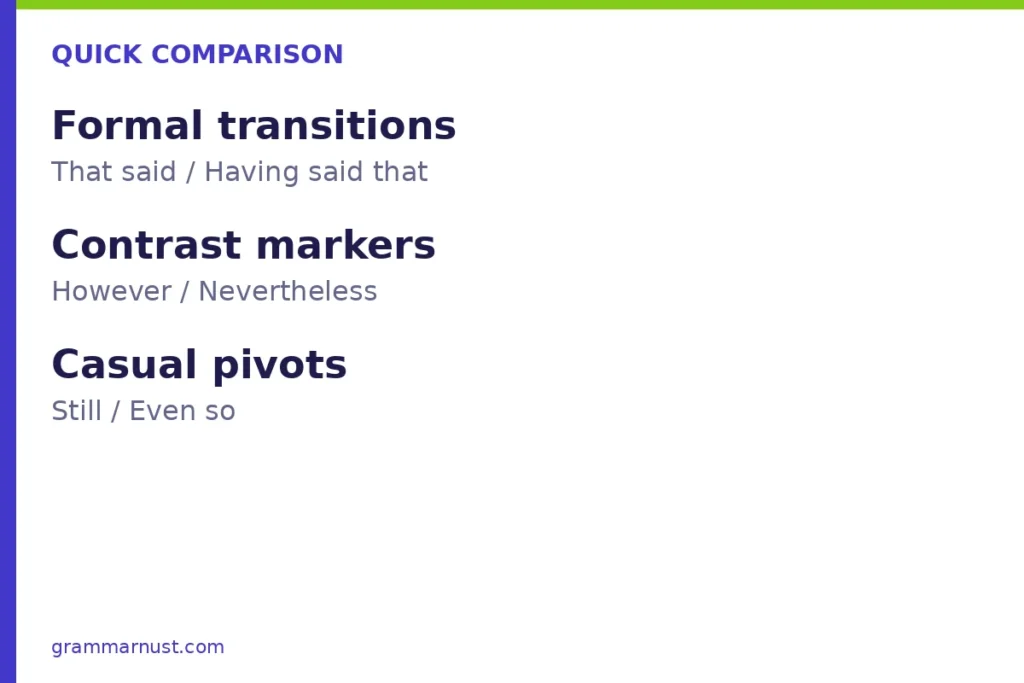
These nine expressions are the closest functional alternatives when the next sentence contrasts with, qualifies, or challenges the previous statement. They are particularly useful when you want to preserve the original transition’s meaning without changing the relationship between your ideas.
1. However
Usage and register: “However” is the most versatile and direct that being said synonym. It works in academic papers, professional emails, reports, presentations, and everyday writing. Use it when your next statement introduces a clear contrast or limitation.
Example: “The new system is affordable and easy to operate. However, it requires regular maintenance.”
Unlike longer transitional expressions, “however” communicates the change in direction with just one word. It is an excellent choice when clarity and conciseness are your priorities.
2. That Said
Usage and register: This is a shorter, natural alternative that acknowledges the preceding statement before introducing another consideration. It works well in professional emails, articles, presentations, and everyday conversations.
Example: “The training program is demanding. That said, it provides valuable practical experience.”
“That said” is especially useful when the previous point remains valid but does not tell the whole story. It sounds less formal than some traditional academic transitions while remaining appropriate for most professional settings.
3. Having Said That
Usage and register: This expression introduces a qualification after recognizing the validity of an earlier statement. It is suitable for conversational professional writing, discussions, and explanatory articles.
Example: “The apartment is slightly smaller than expected. Having said that, its location is excellent.”
It has a reflective tone and can make a disagreement feel less abrupt. However, avoid using it repeatedly in the same document because it can become predictable.
4. Nevertheless
Usage and register: “Nevertheless” is a formal alternative that emphasizes that a previous difficulty or limitation does not change the point that follows. It is particularly effective in academic writing, research discussions, and business reports.
Example: “The initial results were disappointing. Nevertheless, the research team continued its investigation.”
This expression often sounds stronger than “however” because it emphasizes persistence despite an obstacle. Use it when the second statement remains valid even after acknowledging the first.
5. Nonetheless
Usage and register: “Nonetheless” is a polished, formal transition that introduces a contrasting statement while maintaining a logical connection to the preceding idea. It is appropriate for professional reports, essays, and analytical writing.
Example: “The project encountered several setbacks. Nonetheless, the team completed the essential work on schedule.”
It is very similar to “nevertheless” and can often replace it without changing the sentence’s meaning. Choose either expression when you want to emphasize that an earlier difficulty does not prevent the next statement from being true.
6. Even So
Usage and register: “Even so” acknowledges an earlier fact or difficulty while emphasizing that the following point remains valid. It is natural in both spoken English and informal professional writing.
Example: “The journey takes nearly three hours. Even so, the destination is worth visiting.”
This phrase is particularly useful when the second statement responds to an obstacle or disadvantage. It sounds less formal than “nevertheless” but remains clear and effective.
7. Still
Usage and register: “Still” is a short, flexible transition that introduces a qualification or contrasting consideration. It works especially well in conversational writing, blog posts, and straightforward professional communication.
Example: “The instructions are brief. Still, they explain everything a new employee needs to know.”
Because it is simple and familiar, “still” can make your writing sound less formal and more natural. Use it when the contrast is easy to understand without additional explanation.
8. All the Same
Usage and register: This expression introduces a point that remains true despite a previously mentioned concern, inconvenience, or disadvantage. It is appropriate for conversational writing and moderately formal discussions.
Example: “The hotel is farther from downtown. All the same, its excellent service makes it worth considering.”
“All the same” emphasizes that the second point stands despite the first. It is particularly useful when explaining why a drawback does not completely change your opinion or decision.
9. Be That as It May
Usage and register: This is a formal, somewhat old-fashioned expression used to acknowledge a previous argument before presenting a point that remains important. It is more common in formal discussions than everyday conversation.
Example: “The proposal has received considerable criticism. Be that as it may, the board must make a final decision.”
Use this phrase sparingly. It can sound authoritative, but its traditional tone may feel unnecessarily elaborate in a modern business email or casual article.
Formal Alternatives for Business and Academic Writing
When looking for a that being said synonym formal enough for academic or professional communication, consider the precise relationship between your statements. Some expressions below communicate direct contrast, while others introduce an alternative perspective or move from information toward a decision.
Understanding how to say with that being said professionally means choosing a transition that fits your message rather than automatically replacing the original phrase with the longest or most sophisticated expression.
10. On the Other Hand
Usage and register: This expression introduces another side of an issue, especially when comparing two positions, advantages, or disadvantages. It is suitable for business reports, academic discussions, and professional presentations.
Example: “The first software package costs less. On the other hand, the second includes better customer support.”
It works best when the preceding sentence presents one perspective and the next sentence introduces a meaningful alternative. It is not always interchangeable with “however” because it often suggests a comparison between two sides.
11. Conversely
Usage and register: “Conversely” introduces an opposing or inverse relationship between two statements. It is particularly useful in analytical writing, research papers, and formal comparisons.
Example: “Urban areas generally have greater access to public transportation. Conversely, rural communities may have fewer transportation options.”
Use this expression when the second statement represents an opposing condition or situation. It is not a universal replacement for “with that being said” because it requires a meaningful contrast or reversal.
12. In Contrast
Usage and register: This phrase directly highlights a difference between two ideas, situations, or outcomes. It works well in academic essays, analytical reports, research writing, and formal presentations.
Example: “The first department experienced significant growth. In contrast, the second department maintained relatively stable performance.”
“In contrast” is especially useful when presenting comparisons backed by evidence. It tells readers that the next statement should be understood in relation to the preceding one.
13. Despite This
Usage and register: “Despite this” introduces a statement that remains valid even after acknowledging a problem, limitation, or unfavorable circumstance. It is appropriate for professional reports, academic writing, and formal explanations.
Example: “The application process took longer than expected. Despite this, every candidate completed the required steps.”
This phrase creates a clear relationship between an obstacle and what happens or remains true afterward. It is especially useful when you want to emphasize persistence or an unexpected outcome.
14. That Notwithstanding
Usage and register: This is a highly formal construction that means despite the previously mentioned point. It is more appropriate for legal, administrative, or specialized formal writing than ordinary conversation.
Example: “The report contains several limitations. That notwithstanding, its findings provide a useful starting point for further research.”
Although grammatically acceptable, the phrase can sound stiff. In most general business communication, a shorter expression will be easier for readers to understand.
15. With This in Mind
Usage and register: This expression acknowledges previously discussed information before introducing a recommendation, decision, or practical next step. It is particularly useful in business emails, proposals, presentations, and instructional writing.
Example: “Customer feedback highlights several recurring problems. With this in mind, we recommend updating the support process.”
Unlike a direct contrast transition, it does not necessarily introduce disagreement. It connects earlier information to a thoughtful action or recommendation. Choose it when that is the actual relationship between your ideas.
16. In Light of That
Usage and register: “In light of that” introduces a conclusion, recommendation, or decision based on information already discussed. It is suitable for formal emails, business reports, and academic explanations.
Example: “The latest inspection identified several safety concerns. In light of that, management postponed the opening.”
This expression is particularly effective when the next statement is influenced by the previous information. It signals that the earlier facts should be considered before understanding the decision.
17. Having Considered That
Usage and register: This phrase communicates that a particular issue has been acknowledged and evaluated before presenting a decision or alternative. It works best in formal discussions, business proposals, and carefully structured explanations.
Example: “The initial investment is relatively high. Having considered that, the committee approved a smaller pilot program.”
It emphasizes deliberate evaluation rather than direct contradiction. Use it when you want to show that a decision takes an earlier concern into account.
For more polished wording in corrective business emails, you can also explore these other ways to say “Please Disregard My Previous Email”.
Casual and Spoken Alternatives
In everyday conversations, speeches, and informal messages, a long transition can sound unnecessarily formal. These expressions provide more relaxed ways to acknowledge another perspective, reconsider an earlier point, or redirect the discussion.
18. On the Flip Side
Usage and register: This casual expression introduces the opposite side of a situation, often highlighting an advantage or disadvantage that has not yet been discussed. It works well in conversations, blog posts, and informal presentations.
Example: “The house needs some repairs. On the flip side, it is located in a fantastic neighborhood.”
It has a friendly, approachable tone. Use it when discussing two sides of a decision rather than when writing a formal research paper or legal document.
19. Then Again
Usage and register: “Then again” introduces a second thought or reconsideration of something previously mentioned. It is especially natural in spoken English, informal writing, and personal discussions.
Example: “I thought about taking the earlier flight. Then again, the later one would give me more time to prepare.”
This expression often suggests that the speaker is reconsidering an opinion. It is more reflective than a straightforward contrast and works best when the second thought adds a different consideration.
20. Anyway
Usage and register: “Anyway” is an informal transition used to return to a main point, move past a minor issue, or redirect a conversation. It is particularly common in everyday speech and casual messages.
Example: “We have discussed the possible delays. Anyway, let’s return to the original schedule.”
It is not a direct substitute when a strong contrast is needed. Instead, use it when you want to move the discussion forward without spending more time on the previous detail.
21. In Any Case
Usage and register: This expression shifts attention toward the main point regardless of previously discussed details. It is appropriate for casual conversations, explanatory writing, and moderately formal communication.
Example: “The meeting might begin a few minutes late. In any case, please have your presentation ready.”
It communicates that the next statement remains relevant regardless of the preceding circumstances. It is especially useful when minor details should not distract from the main message.
22. At the Same Time
Usage and register: “At the same time” introduces another consideration that exists alongside the previous point. It is useful in conversations, presentations, business discussions, and balanced explanations.
Example: “The design is visually appealing. At the same time, it remains practical and easy to maintain.”
This phrase is best when two ideas can both be true. It does not necessarily indicate disagreement, making it useful for acknowledging complexity without dismissing the first statement.
23. At the End of the Day
Usage and register: This conversational expression introduces an overall judgment or the most important practical consideration. It is common in spoken English, informal discussions, and opinion-based writing.
Example: “We can compare several different designs. At the end of the day, the client needs a reliable solution.”
It is more suitable for communicating a bottom-line perspective than introducing a direct contradiction. Avoid relying on it in formal academic writing because it can sound conversational and vague.
24. Mind You
Usage and register: “Mind you” introduces a qualification, reminder, or additional consideration that slightly changes how the previous statement should be understood. It is conversational and works best in spoken English and informal writing.
Example: “The schedule is quite demanding. Mind you, the team has completed similar projects successfully.”
It can make a statement sound more personal and reflective. Because it is informal, it may not be the best choice for academic papers or highly formal business documents.
Summary and Consideration Pivots
The following six expressions help summarize information or communicate a judgment after considering several points. They are useful alternatives when your purpose is to evaluate the discussion rather than directly contradict the previous sentence.
These are related transitional expressions, not exact contrast equivalents. Choose them only when a summary, overall assessment, or practical takeaway is what your writing actually needs.
25. All Things Considered
Usage and register: This phrase introduces an overall judgment after weighing several relevant factors. It is appropriate for professional discussions, opinion articles, reports, and everyday explanations.
Example: “All things considered, the second proposal offers the best balance between cost and quality.”
It signals that the speaker has evaluated the advantages and disadvantages before reaching a conclusion. It is more appropriate for a final assessment than for a simple contrasting statement.
26. Taking Everything into Account
Usage and register: This expression communicates that multiple factors have been considered before making a recommendation or decision. It works well in formal emails, business reports, and detailed explanations.
Example: “Taking everything into account, we recommend extending the trial period by another month.”
It is particularly useful when a decision depends on several considerations rather than one isolated fact. The phrase sounds thoughtful and measured, making it suitable for professional communication.
27. On That Note
Usage and register: “On that note” introduces a related point, follow-up thought, or natural transition to the next subject. It is common in conversations, presentations, articles, and informal professional communication.
Example: “The first phase of the project is complete. On that note, let’s review the next set of priorities.”
It usually creates continuity rather than direct contrast. Use it when the next statement develops an idea connected to what was just discussed.
28. All in All
Usage and register: This expression summarizes an overall experience, judgment, or assessment after considering the relevant details. It is suitable for casual writing, reviews, presentations, and general professional communication.
Example: “All in all, the conference was informative, well organized, and worth attending.”
It works particularly well near the end of an explanation or review. It is not appropriate when the next sentence needs to introduce a specific objection or opposing argument.
29. When All Is Said and Done
Usage and register: This conversational expression introduces the final outcome or most important consideration after everything has been evaluated. It is useful in discussions, reflective writing, and informal presentations.
Example: “When all is said and done, consistent practice matters more than expensive equipment.”
It gives the statement a reflective, concluding tone. Because it is relatively long, avoid using it when a short transition would make your writing more direct.
30. Bottom Line
Usage and register: “Bottom line” introduces the central takeaway, practical conclusion, or most important point. It is particularly common in business meetings, presentations, conversations, and straightforward professional emails.
Example: “Bottom line: the revised process is clearer, faster, and easier to maintain.”
It communicates the main message without unnecessary explanation. Use it when you want readers to focus on the final takeaway, not when you are simply introducing a contrasting idea.
Topic-Shift Pivots: Moving the Conversation On
Sometimes you do not need to disagree with the previous statement or introduce a qualification. You simply want to move to another subject. These five expressions help redirect a conversation, introduce a related subject, or signal that an earlier issue has been addressed.
31. Moving On
Usage and register: This direct expression signals that you are leaving one subject and beginning another. It is appropriate for presentations, meetings, discussions, instructional writing, and everyday communication.
Example: “Moving on, let’s discuss the budget requirements for the next quarter.”
It is especially useful when organizing several topics into a clear sequence. Unlike a contrast transition, it does not suggest that the next point challenges the previous one.
32. Speaking of Which
Example: “We need to finalize the event schedule. Speaking of which, have you contacted the speakers?”
It creates a natural connection between related subjects. Use it when something in the previous discussion reminds you of another relevant point.
33. On a Different Note
Usage and register: This phrase introduces a change of subject, particularly when the next point is not closely related to the previous discussion. It is suitable for conversations, emails, newsletters, and informal presentations.
Example: “The marketing report is ready for review. On a different note, the office will close early on Friday.”
It helps readers recognize that the discussion is moving in a new direction. It is more appropriate for topic changes than for direct disagreements or qualifications.
34. That Aside
Usage and register: “That aside” acknowledges a previously mentioned detail while setting it aside to focus on the main subject. It works well in professional discussions, explanatory writing, and moderately formal communication.
Example: “The initial presentation needs a few design improvements. That aside, the proposal is ready for approval.”
This phrase can introduce a related judgment after temporarily setting aside a particular concern. It is useful when you want to recognize a minor issue without allowing it to dominate the discussion.
35. With That Out of the Way
Usage and register: This conversational expression signals that a preliminary issue, explanation, or task has been completed and the main discussion can begin. It is suitable for presentations, meetings, tutorials, and informal writing.
Example: “With that out of the way, we can begin discussing the main project requirements.”
It creates a clear transition from introductory matters to the primary subject. Use it when moving forward after resolving or completing something, rather than when introducing a direct contrast.
For announcements that move from general information to booking rules, you may also find these clearer formal alternatives to “first come, first served” useful.
A Note on Result Markers: Similar, But NOT the Same Meaning
One important mistake when choosing transitions is treating every connecting expression as interchangeable. Words such as “therefore,” “consequently,” “as a result,” and “accordingly” are not direct alternatives to “with that being said.”
These expressions show a result or consequence. They indicate that one situation follows logically from another. In contrast, “with that being said” generally introduces a contrasting or qualifying consideration.
Consider the difference:
- Contrast: “The product is expensive. However, it offers excellent durability.”
- Result: “The product failed the safety inspection. Therefore, the company withdrew it from sale.”
The second sentence follows as a consequence of the first. Replacing “therefore” with “however” would change the logical relationship between the statements.
The same distinction applies to “in conclusion” and “to that end.” “In conclusion” signals a summary or final section, while “to that end” introduces an action or means intended to achieve a particular purpose.
These expressions may appear in similar positions within a paragraph, but their functions are different. Therefore, “therefore,” “consequently,” “as a result,” and “accordingly” show a result, while “in conclusion” and “to that end” show summary or purpose. Swapping them for a contrast transition changes the meaning.
This distinction is important because a longer list of alternatives is not necessarily a better list. The most useful transition is the one that accurately represents the relationship between your ideas.
Which One Should You Use? A Quick Guide
The best alternative depends on your audience, communication channel, and intended meaning. Use the following guide to choose a suitable transition for common writing situations.
| Situation | Best Alternative | Why It Works |
|---|---|---|
| Academic essay | However | Provides a clear, concise contrast without making the writing unnecessarily conversational. |
| Business email | That Said | Acknowledges the previous point while introducing another consideration in a professional, natural tone. |
| Speech or presentation | With This in Mind | Connects previously discussed information to the next recommendation or action. |
| Casual conversation | Then Again | Introduces a second thought naturally and sounds comfortable in spoken English. |
| Social media post | On the Flip Side | Creates an approachable contrast and helps introduce another perspective without sounding overly formal. |
Choosing Based on Your Intended Meaning
Beyond the communication channel, consider what you want your transition to accomplish.
- To introduce a direct disagreement: Choose “however” or “nevertheless.”
- To acknowledge a valid point before qualifying it: Choose “that said” or “having said that.”
- To compare two different perspectives: Choose “on the other hand” or “in contrast.”
- To introduce a recommendation: Choose “with this in mind” or “in light of that.”
- To reconsider an earlier opinion: Choose “then again.”
- To summarize an argument: Choose “all things considered” or “all in all.”
- To move to another subject: Choose “moving on” or “on a different note.”
Before selecting a replacement, read the two connected sentences together. If the transition does not accurately describe their relationship, choose another expression.
Mistakes to Avoid When Replacing “With That Being Said”
Finding another expression is only useful when the replacement preserves the intended meaning. Avoid these common mistakes to make your writing clearer and more effective.
Using “Therefore” When You Mean a Contrast
“Therefore” introduces a logical consequence, not an opposing consideration. Using it when the next sentence challenges or qualifies the previous statement creates an incorrect connection.
Incorrect: “The new policy is difficult to implement. Therefore, it offers several useful advantages.”
Better: “The new policy is difficult to implement. However, it offers several useful advantages.”
The second version communicates the intended contrast. Always determine whether the next statement is a result or a qualification before selecting your transition.
Starting a Sentence With “Even Though” Without a Complete Clause
“Even though” is a subordinating conjunction, not a standalone transition equivalent to “however.” It introduces a dependent clause that needs a main clause to complete the thought.
Incorrect: “The presentation was successful. Even though, the audience requested additional information.”
Better: “The presentation was successful. Even so, the audience requested additional information.”
You can also write: “Even though the presentation was successful, the audience requested additional information.”
The distinction matters because “even though” requires a grammatical structure that “even so” does not.
Starting Every Paragraph With the Same Transition
Repeating “however” or “with that being said” at the beginning of every paragraph can make your writing sound mechanical. It also suggests that every new paragraph introduces the same type of relationship between ideas.
Instead, vary your transitions according to their purpose. Use a contrast expression when you disagree, a consideration phrase when you introduce a recommendation, and a topic-shift expression when you move to another subject.
Using “With That Being Said” When No Contrast Actually Follows
Not every new sentence needs a contrasting transition. If your second sentence simply adds information, explains a consequence, or summarizes the previous point, “with that being said” may create an unnecessary or confusing connection.
Awkward: “The meeting starts at 10 a.m. With that being said, participants should arrive by 9:45 a.m.”
Better: “The meeting starts at 10 a.m. Please arrive by 9:45 a.m.”
The revised version communicates the instruction directly. Removing an unnecessary transition often improves readability more than replacing it with another phrase.
Whichever option you choose, treat this list as another way to say that being said with precision: match the transition to the real relationship between your sentences, and your writing will sound deliberate rather than padded.
Frequently Asked Questions
What can I say instead of “with that being said” in formal writing?
In formal writing, you can use “however,” “nevertheless,” “nonetheless,” “in contrast,” or “despite this.” These expressions introduce a contrasting or qualifying idea without adding unnecessary words. For recommendations based on earlier information, “in light of that” and “with this in mind” are also useful, although they do not signal direct contrast.
Is “however” the same as “with that being said”?
They can communicate a similar meaning when introducing a contrast, but they are not identical in tone or structure. “However” is shorter and more direct, while “with that being said” sounds more conversational and explicitly acknowledges the previous statement. In most situations involving a straightforward contrast, “however” is the more concise choice.
Is “with that being said” grammatically correct?
Yes, “with that being said” is grammatically correct English. It is a transitional expression used to acknowledge a previous statement before introducing another consideration. However, it can become repetitive or wordy when overused. Shorter alternatives such as “that said” and “however” often make professional and academic writing more concise.
Why do writing experts advise against “with that being said”?
Some writing experts discourage frequent use because the expression can sound repetitive, unnecessarily wordy, or formulaic. It may also be used when no actual contrast follows. The phrase itself is not incorrect, but choosing a more precise transition can improve clarity, sentence flow, and readability.
What is a casual alternative to “with that being said” for speaking?
“Then again,” “on the flip side,” “still,” and “mind you” are natural casual alternatives. The best choice depends on your meaning. Use “then again” when reconsidering an earlier thought, “on the flip side” when presenting another perspective, and “still” when acknowledging a contrast without sounding overly formal.
Do “therefore” and “as a result” mean the same as “with that being said”?
No. “Therefore” and “as a result” introduce a consequence or outcome, while “with that being said” usually introduces a contrast or qualification. For example, “The deadline was missed; therefore, the launch was postponed” expresses a result. “The deadline was missed; however, the team completed the project” expresses a contrasting consideration.
Conclusion
Choosing the right transition makes your writing more natural, professional, and easier to understand. Although “with that being said” is grammatically correct, it is not always the clearest or most concise option.
Among the 35 other ways to say with that being said, “however” is the strongest general-purpose replacement for a direct contrast. Use “that said” for a shorter conversational transition, formal expressions when appropriate for professional writing, and summary or topic-shift phrases only when their specific functions match your message.
Ultimately, the goal is not to replace one overused expression with another. Choose transitions that accurately connect your ideas and help readers follow your message without unnecessary words.