30 Other Ways to Say “Attention to Detail” (With Examples)
Quick Answer: The strongest all-purpose replacement for “attention to detail” is meticulous, especially when describing someone’s work habits. For a more natural expression that highlights the ability to notice small things, use keen eye for detail. On a resume, support either phrase with a specific example of accuracy, careful review, or error prevention.
Using the same phrase repeatedly in resumes, cover letters, performance reviews, and workplace emails can make your writing sound generic. Choosing a more specific expression helps communicate exactly how someone notices mistakes, checks information, and produces reliable work. These attention to detail synonyms offer alternatives for different professional situations, from describing your own strengths to recognizing a colleague’s contribution.
This guide covers 35 unique alternatives, including single-word synonyms, the eye-for-detail family, resume-ready phrases, complete sentences, and professional expressions for performance reviews. Each option includes a tone or usage note and a natural example so you can choose wording that fits your message rather than simply replacing one phrase with another.
What Does “Attention to Detail” Mean? (Other Ways to Say Attention to Detail)
Attention to detail is the ability to notice, understand, and manage small but important parts of a task. It involves recognizing errors, identifying inconsistencies, checking information, and making sure that nothing essential is overlooked.
For example, an employee with strong attention to detail might notice an incorrect figure in a financial report, catch a spelling mistake before an email reaches a client, or identify a missing requirement in a project document.
The skill involves several related abilities:
- Observation: Noticing small differences, changes, and potential problems.
- Accuracy: Making sure information, figures, and completed work are correct.
- Thoroughness: Reviewing all relevant parts of a task rather than checking only the obvious details.
- Verification: Comparing information against reliable sources before approving or submitting it.
- Consistency: Maintaining the same level of care across routine and complex assignments.
- Error recognition: Identifying mistakes and correcting them before they create larger problems.
If you are looking for another way to say attention to detail skills, consider the particular behavior you want to communicate. Someone who catches small mistakes may be observant, while someone who checks every figure may be meticulous or precise. Someone who follows detailed procedures may be conscientious or methodical.
These distinctions matter because not every synonym communicates exactly the same strength. The best alternative describes what a person actually does, not simply how carefully they claim to work.
Is “Attention to Detail” Professional or Polite to Say?
Yes. “Attention to detail” is a professional, polite, and widely understood expression. It is appropriate for resumes, job interviews, performance evaluations, business emails, recommendations, and professional profiles.
However, the phrase can become less persuasive when it appears without supporting evidence. For example, writing “I have excellent attention to detail” tells an employer what you believe about yourself but does not explain how that ability benefits the organization.
A more convincing approach is to describe the behavior behind the skill.
- Generic: I have excellent attention to detail.
- More specific: I verify financial records and resolve discrepancies before submitting monthly reports.
- Generic: She has great attention to detail.
- More specific: She consistently identifies documentation errors before they affect client deliverables.
Use the original phrase when clarity is more important than variety. Choose an alternative when you want to emphasize a particular strength, provide evidence, or make your writing sound more natural.
Quick Top Picks: The 8 Best Alternatives at a Glance
These eight options are especially useful when you need a clear, professional replacement. They cover general work quality, visual observation, resume language, and formal workplace communication.
- Meticulous: Best all-purpose professional synonym for exceptionally careful work.
- Keen eye for detail: Best for describing someone who notices small things others overlook.
- Sharp eye for detail: Best for recognizing errors and subtle inconsistencies quickly.
- Detail-oriented: Best concise adjective for a resume or professional profile.
- Strong attention to detail: Best familiar expression when you want to retain the original wording’s clarity.
- Detail-driven: Best for describing a work approach guided by accuracy and small details.
- Error-detection ability: Best when identifying and correcting mistakes is central to the job.
- Punctilious: Best formal option for someone who pays exceptional attention to rules and fine points.
The following alternatives explain how each expression works in context, what tone it creates, and how to use it naturally.
Classic One-Word Synonyms (Entries 1–8)
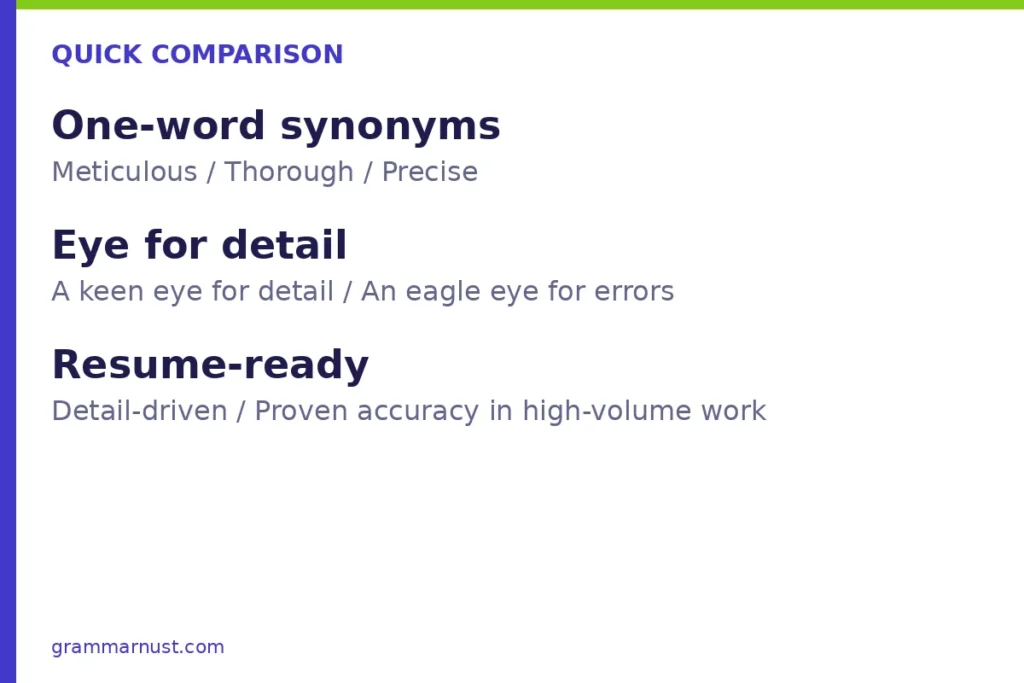
Single-word alternatives are useful when you want concise, polished writing. They work particularly well in resumes, professional recommendations, workplace feedback, and descriptions of an employee’s working style. However, each word carries a slightly different meaning, so choose according to the quality you want to highlight.
1. Meticulous
Meaning and tone: Meticulous describes someone who is extremely careful and precise about even the smallest parts of a task. It is one of the strongest all-purpose alternatives and works particularly well in professional writing. It communicates deliberate care rather than simply claiming that someone avoids mistakes.
Example: Her meticulous review of the financial statements helped identify several incorrect entries before submission.
This word is especially useful for accountants, editors, researchers, administrative professionals, and anyone responsible for reviewing important information. For its dictionary definition and usage, see Merriam-Webster’s definition of meticulous.
2. Thorough
Meaning and tone: Thorough describes someone who examines all relevant parts of a task carefully and completely. It emphasizes completeness and careful review rather than simply noticing small details. It is professional, straightforward, and suitable for everyday workplace communication.
Example: James conducted a thorough review of the contract and identified several missing clauses before approval.
Use this alternative when describing document reviews, research, inspections, audits, or project checks. It is particularly effective when you want to show that nothing important was skipped.
3. Precise
Meaning and tone: Precise means exact, specific, and accurate. It is a strong choice when small differences in measurements, calculations, instructions, or wording matter. The expression sounds professional and is especially appropriate for technical and analytical positions.
Example: Maria’s precise calculations helped the engineering team avoid costly measurement errors.
Use precise when the main strength is producing exact results. It works well in engineering, accounting, data entry, scientific research, editing, and quality inspection.
4. Careful
Meaning and tone: Careful describes someone who works thoughtfully and takes appropriate steps to avoid errors. It is less formal than meticulous but sounds natural in conversations, emails, and performance feedback.
Example: He is careful when reviewing customer information and always checks the details before updating an account.
This is a versatile alternative when you want to communicate reliability without sounding overly formal. It is also useful when describing an individual who takes time to verify important information.
5. Accurate
Meaning and tone: Accurate emphasizes correctness and freedom from mistakes. It describes the quality of the final work rather than the process used to produce it. This makes it particularly valuable in professional settings where correct information is essential.
Example: Her accurate reporting ensures that management receives dependable financial information every month.
Choose accurate when the outcome matters most, such as correct calculations, records, reports, customer information, or technical documentation.
6. Methodical
Meaning and tone: Methodical describes someone who follows a systematic approach and completes tasks in a deliberate sequence. It suggests that the person uses consistent steps to prevent important details from being missed.
Example: His methodical review process helps ensure that every application contains the required supporting documents.
Use this word when describing procedures, inspections, research, audits, or complex assignments. It is particularly appropriate when the ability to follow a reliable checking process is important.
7. Observant
Meaning and tone: Observant describes someone who notices things quickly, including small changes, unusual patterns, and subtle differences. Unlike accurate, which focuses on correctness, observant emphasizes the ability to recognize information that might otherwise go unnoticed.
Example: The observant editor noticed a formatting inconsistency that had appeared in several sections of the report.
This alternative is useful for proofreading, customer service, design, research, supervision, and roles requiring close observation.
8. Conscientious
Meaning and tone: Conscientious describes someone who takes responsibilities seriously and makes a genuine effort to complete work properly. It combines care, reliability, and a sense of responsibility. It is particularly effective in professional recommendations and performance evaluations.
Example: Daniel is a conscientious employee who checks his work carefully and follows established procedures.
Use this expression when you want to praise someone’s dependable approach to responsibilities rather than simply their ability to notice small errors.
The “Eye for Detail” Family (Entries 9–13)
The eye-for-detail family is particularly useful when you want to describe someone’s ability to notice small things. These expressions sound natural in everyday professional English and are often more descriptive than a generic claim about being detail-oriented.
They are especially suitable for editing, proofreading, design, quality inspection, administration, research, and positions involving document review.
9. Keen Eye for Detail
Meaning and tone: A keen eye for detail describes an exceptional ability to notice small elements, subtle differences, and potential mistakes. It is one of the clearest and most natural alternatives for describing someone’s observational ability. It works well in professional profiles, recommendations, and interviews.
Example: Emily has a keen eye for detail and regularly catches formatting errors before reports are distributed.
This is an excellent choice when you want to emphasize noticing what others might overlook. It also works naturally in a resume summary when supported by an example.
10. Sharp Eye for Detail
Meaning and tone: A sharp eye for detail emphasizes quick recognition of small errors, differences, and irregularities. It sounds confident and slightly more conversational than keen eye for detail while remaining appropriate for professional communication.
Example: His sharp eye for detail helped identify an incorrect product label during the final inspection.
Use this phrase when someone notices problems quickly, especially during visual inspections, proofreading, product reviews, or quality checks.
11. An Eye for the Finer Points
Meaning and tone: An eye for the finer points describes the ability to recognize subtle elements that contribute to the quality of a finished product or task. It sounds polished and slightly more expressive than standard resume language.
Example: Her eye for the finer points makes her an excellent editor of technical and academic documents.
This alternative works particularly well in creative industries, writing, design, editing, and professional recommendations. It is best when the person notices subtle improvements rather than only obvious mistakes.
12. Notices Subtle Discrepancies
Meaning and tone: This expression focuses on recognizing small differences between information, documents, figures, or expected results. It is descriptive and practical because it explains exactly what the person does.
Example: Priya notices subtle discrepancies in financial records and investigates them before reports are finalized.
Use this phrase in accounting, auditing, research, data management, compliance, and administrative work. It is particularly convincing when you can identify the type of discrepancies the person regularly catches.
13. Quick to Spot Inconsistencies
Meaning and tone: This phrase describes someone who can quickly recognize information that does not match or follow an established pattern. It is natural, direct, and useful in both professional conversations and written evaluations.
Example: Marcus is quick to spot inconsistencies in project documentation and brings them to the team’s attention.
Choose this expression when speed and recognition are both important. It works especially well for proofreading, data validation, research, and reviewing business documents.
Resume-Ready Phrases (Entries 14–20)
People searching for other ways to say strong attention to detail, another way to say strong attention to detail, other ways to say high attention to detail, another way to say high attention to detail, and other ways to say good attention to detail usually want professional wording that communicates confidence without sounding exaggerated.
The following expressions work well in resume summaries, skills sections, professional profiles, and job applications. Some describe a personal working style, while others emphasize a specific ability that can be supported with measurable accomplishments.
14. Detail-Oriented
Meaning and tone: Detail-oriented is a concise, widely recognized professional adjective describing someone who pays close attention to small elements of a task. It is one of the most familiar alternatives for resumes and professional biographies.
Example: Detail-oriented administrative professional with experience reviewing records, maintaining documentation, and verifying customer information.
Best use: Resume summaries, professional headlines, job applications, and LinkedIn profiles. Although common, it becomes more persuasive when followed by a specific accomplishment.
15. Strong Attention to Detail
Meaning and tone: This is the original expression with a stronger emphasis on the level of the skill. It remains professional, direct, and easy for recruiters to understand. There is no need to avoid it simply because other alternatives exist.
Example: Demonstrates strong attention to detail when reviewing invoices, reconciling transactions, and preparing monthly reports.
Best use: Resume skills sections, performance summaries, and job applications. Use it when you want familiar language that communicates the ability clearly.
16. Detail-Driven
Meaning and tone: Detail-driven describes a working approach guided by small but important elements of a task. It sounds modern and professional, particularly when describing work that requires careful checking and consistent execution.
Example: Detail-driven project coordinator who verifies documentation and checks deliverables against established requirements.
Best use: Resume summaries, professional profiles, and cover letters. It is especially useful when attention to small requirements is central to the role.
17. Error-Detection Ability
Meaning and tone: Error-detection ability describes the practical skill of recognizing mistakes before they affect the final result. It is more specific than a general claim about careful work and is particularly suitable for technical or administrative positions.
Example: Demonstrated error-detection ability when reviewing thousands of transaction entries and identifying incorrect records.
Best use: Resumes for accounting, proofreading, quality assurance, data entry, compliance, and document-control positions. Include the type of errors you can identify whenever possible.
18. Systematic Cross-Checking
Meaning and tone: Systematic cross-checking describes the practice of comparing information against another source or set of requirements to confirm that everything matches. It is a practical phrase that emphasizes verification rather than a general personality trait.
Example: Uses systematic cross-checking to verify inventory records against shipment documentation.
Best use: Technical resumes, compliance positions, financial roles, inventory management, and administrative applications. It is especially effective when the job requires checking information from multiple sources.
19. Consistent Accuracy
Meaning and tone: Consistent accuracy emphasizes producing correct results repeatedly rather than occasionally completing a task without mistakes. It communicates reliability and the ability to maintain quality across ongoing responsibilities.
Example: Maintained consistent accuracy when processing customer records and updating confidential account information.
Best use: Resume achievement statements, administrative applications, financial roles, and positions involving repetitive data or documentation tasks.
20. Close Inspection
Meaning and tone: Close inspection describes examining an item, document, process, or result carefully to identify small issues. It is a practical expression that highlights the actual activity behind attention to detail.
Example: Performs close inspection of product documentation to identify labeling errors before distribution.
Best use: Manufacturing, quality control, editing, product testing, construction inspection, and technical documentation. It is strongest when the role involves examining materials before approval.
Resume coverage note: If you need another way to say attention to detail on resume, select an expression that reflects the position’s responsibilities. When deciding how to say attention to detail on a resume, consider whether the employer needs someone who notices errors, verifies records, or checks technical requirements. A useful attention to detail synonym resume choice should communicate that specific ability. These attention to detail resume examples also show why describing an action is stronger than listing an unsupported adjective.
Skills note: Useful attention to detail skills examples include identifying incorrect figures, proofreading documents, comparing records against source information, checking product specifications, verifying customer details, and recognizing inconsistencies in reports. These examples demonstrate the skill more convincingly than simply listing it as a personal strength.
Full Sentences for Resumes and Cover Letters (Entries 21–26)
If you need another way to say attention to detail in a sentence, a complete statement is often more effective than a single synonym. Similarly, other ways to say i pay attention to detail should explain the action you take and the value it creates.
The following six sentences are ready to adapt for resumes, cover letters, professional summaries, and job applications. Each uses first-person language and describes an observable behavior instead of relying on a generic claim.
21. I catch discrepancies before they affect the final result.
Where to use it: Use this sentence in a resume summary, cover letter, or interview response when your work involves reviewing information and preventing avoidable problems.
It is particularly useful for finance, administration, data entry, and quality-control positions because it communicates both error recognition and prevention.
22. I verify names, dates, and figures before submitting work.
Where to use it: This sentence is appropriate for resumes and cover letters involving documentation, customer records, reporting, scheduling, or financial information.
It gives the reader specific examples of the information you check, making your claim more believable and easier to connect with the responsibilities of the position.
23. I compare each deliverable with the original brief to make sure no requirement is missed.
Where to use it: Use this sentence when applying for project coordination, content production, design, administration, or operations positions.
It demonstrates that you check completed work against the original instructions rather than assuming that a finished task automatically meets every requirement.
24. I maintain accurate records by checking each entry against its source.
Where to use it: This is a strong option for accounting, data management, healthcare administration, customer service, and records-management applications.
It connects careful information handling with a clear workplace responsibility. It also communicates a practical verification process rather than an unsupported personal quality.
25. I review customer-facing materials for small errors before publication.
Where to use it: Use this sentence in applications for marketing, communications, publishing, editing, sales support, or customer experience positions.
It shows that you understand the importance of checking materials before customers see them, including written content, product information, and promotional documents.
26. I flag inconsistencies early and explain the correction clearly to stakeholders.
Where to use it: This sentence works well in cover letters and resumes for project management, business operations, quality assurance, and team coordination roles.
It highlights two valuable behaviors: identifying problems early and communicating them clearly. If you need polite wording for raising an issue in a work email, see these other ways to say “please correct me if I’m wrong”.
Performance-Review and Praise Phrasing (Entries 27–31)
Managers often need alternatives that recognize an employee’s careful work without repeating the same expression in every evaluation. Good performance-review wording should identify a visible contribution, explain its value, and maintain a professional but encouraging tone.
The following phrases are useful for annual reviews, employee feedback, recommendation letters, team recognition, and professional appreciation. They focus on workplace behaviors rather than making vague claims about someone’s personality.
27. Prevents Avoidable Errors
Meaning and tone: This phrase recognizes someone who identifies potential mistakes and takes action to prevent them. It is direct, positive, and especially useful when an employee’s careful checking protects the team from unnecessary corrections or delays.
Example: Her careful review process prevents avoidable errors from reaching clients and improves the reliability of our final deliverables.
Best use: Performance evaluations, supervisor feedback, and recognition for employees whose checking process reduces problems.
28. Maintains Dependable Records
Meaning and tone: This expression highlights an employee’s ability to keep records complete, reliable, and easy to verify. It is particularly useful for describing administrative and financial responsibilities.
Example: He maintains dependable records, making it easier for colleagues to verify information and complete their work accurately.
Best use: Employee reviews, administrative recommendations, accounting evaluations, and documentation-related feedback.
29. Checks Work Against Requirements
Meaning and tone: This phrase recognizes an employee who compares completed assignments with instructions, specifications, or established expectations. It emphasizes compliance with requirements and prevents important elements from being overlooked.
Example: She checks work against requirements before approval, helping the department maintain consistent project standards.
Best use: Performance reviews for project coordinators, technical employees, editors, and quality-control professionals.
30. Identifies Discrepancies Early
Meaning and tone: This expression emphasizes an employee’s ability to recognize differences or incorrect information before they become larger problems. It sounds professional and highlights the practical value of early detection.
Example: Daniel identifies discrepancies early and communicates them promptly, helping the team resolve issues before deadlines.
Best use: Manager evaluations, project feedback, financial reviews, and recommendations for employees responsible for checking information.
31. Follows Details Through to Completion
Meaning and tone: This phrase recognizes someone who does not stop paying attention once a problem has been identified. Instead, the employee follows up, confirms the correction, and makes sure the issue is properly resolved.
Example: She follows details through to completion, ensuring that outstanding documentation issues are resolved before a project closes.
Best use: Performance reviews, leadership feedback, and recognition of employees who take responsibility for completing detailed work.
When praising a colleague, you can also explain how their careful work benefits the wider team. For more ways to express that contribution, explore these other ways to say “great asset to the team”.
Formal and High-Register Options (Entries 32–35)
Some professional situations call for more sophisticated vocabulary. The following expressions are suitable for formal recommendations, academic writing, detailed evaluations, and specialized professional communication.
These words are less common in everyday conversation, so use them when their precise meaning fits the situation. A sophisticated word is not automatically better than a familiar one.
32. Punctilious
Meaning and tone: Punctilious describes someone who pays extremely close attention to small details, rules, conventions, and proper procedures. It has a formal tone and can suggest an unusually high level of care.
Example: Her punctilious approach to reviewing legal documentation ensures that procedural requirements are carefully followed.
Best use: Formal recommendations, legal environments, academic writing, and professional descriptions where compliance with fine details matters.
33. Scrupulous
Meaning and tone: Scrupulous describes someone who is exceptionally careful, conscientious, and attentive to correctness or ethical standards. It is particularly suitable when accuracy and integrity are equally important.
Example: The auditor maintained scrupulous records and carefully documented every adjustment to the financial statements.
Best use: Compliance, auditing, research, legal writing, financial reporting, and formal performance evaluations.
34. Fastidious
Meaning and tone: Fastidious describes someone who pays very close attention to small details and expects work to meet exacting standards. It can be complimentary, although it sometimes suggests being excessively particular about minor matters.
Example: The fastidious editor examined every caption, reference, and formatting choice before approving the manuscript.
Best use: Creative work, editing, design, specialized craftsmanship, and formal descriptions of someone with exceptionally exacting habits.
35. Painstaking
Meaning and tone: Painstaking describes work performed with great care, patience, and attention to small elements. It emphasizes the effort invested in producing a complete and reliable result.
Example: His painstaking review of the historical records uncovered several important inconsistencies.
Best use: Academic writing, research, editing, restoration, investigations, and professional recommendations. It is particularly effective when a task requires considerable care and effort.
Which One Should You Use? A Quick Guide
The best alternative depends on where you are writing and what you want the reader to understand. A resume summary needs concise professional language, while a performance review should explain the employee’s contribution. A job interview answer should sound natural and include an example.
Use the following guide to choose the most appropriate phrase for each situation.
| Situation | Best phrase | Why |
|---|---|---|
| Resume summary line | Detail-oriented | Concise, professional, and immediately recognizable to recruiters. |
| Cover letter sentence | Meticulous | Communicates careful work while allowing you to explain a relevant accomplishment. |
| Job interview answer | Keen eye for detail | Sounds natural and gives you an opportunity to describe how you notice small problems. |
| Performance review written by a manager | Prevents avoidable errors | Connects the employee’s behavior with a practical workplace benefit. |
| LinkedIn or portfolio profile | Detail-driven | Creates a polished professional description without relying on the most common wording. |
For resumes: Avoid choosing a word simply because it sounds impressive. If the job description emphasizes reviewing records, use accurate, meticulous, or systematic cross-checking. If it emphasizes proofreading or spotting mistakes, keen eye for detail or error-detection ability may be more appropriate.
For interviews: Choose a phrase that you can explain through a real example. For instance, instead of saying you are meticulous, describe how you noticed an incorrect figure before a report was submitted and explain how you resolved it.
For performance reviews: Focus on the employee’s actual contribution. Explain whether their work prevented errors, improved records, identified discrepancies, or helped the team complete assignments correctly.
Mistakes to Avoid When Describing Attention to Detail
Choosing a strong alternative is only part of writing an effective resume or professional evaluation. The wording must also represent the actual skill accurately. Avoid these common mistakes when describing your ability or praising someone else’s work.
Treating Adjacent Traits as Direct Synonyms
Words such as organized, analytical, focused, and quality-focused describe neighboring strengths, but they do not automatically mean attention to detail.
For example, an organized employee may manage schedules and files effectively without necessarily noticing small errors. Similarly, an analytical employee may evaluate complex information without consistently checking every minor element.
You can include these qualities in a resume when they are relevant, but do not use them as direct replacements for attention to detail. Choose words such as meticulous, observant, or precise when you specifically mean careful recognition and handling of small details.
Calling Yourself a Perfectionist
Describing yourself as a perfectionist may sound positive at first, but some employers interpret it as an inability to prioritize, delegate, or finish work efficiently.
Instead of claiming that you strive for perfection, explain how you maintain accuracy while meeting deadlines.
Less effective: I am a perfectionist who never accepts mistakes.
Better: I review important deliverables carefully while maintaining agreed deadlines and project requirements.
Claiming the Skill Without Providing Evidence
Simply writing “excellent attention to detail” does not demonstrate how you use the skill. Recruiters and managers are more interested in examples that connect careful work with real responsibilities or outcomes.
Whenever possible, mention the documents you review, information you verify, mistakes you identify, or processes you follow.
Weak: I have strong attention to detail.
Stronger: I verify transaction records against source documents to identify discrepancies before monthly reporting.
Specific examples make your claim more credible because they demonstrate how the skill operates in a real working environment.
Listing the Same-Root Word Twice in Different Forms
Avoid treating two variations of the same basic word as separate alternatives. For example, detail-oriented and detail-conscious are closely related coinages, while careful and careful observer repeat the same underlying descriptor.
Adding similar expressions does not necessarily make a resume or article more informative. Choose alternatives that communicate genuinely different qualities, such as observation, precision, thoroughness, and verification.
Variety should improve meaning, not simply increase the number of words.
Frequently Asked Questions
What is the best synonym for “attention to detail” on a resume?
Meticulous is one of the strongest professional synonyms for attention to detail on a resume. It communicates exceptionally careful work and precision. Detail-oriented is another familiar option, while keen eye for detail works well when the position involves identifying small mistakes. Choose the expression that best matches the job responsibilities and support it with a specific accomplishment.
How do I say I have strong attention to detail without using the exact phrase?
You can say that you are meticulous, detail-oriented, observant, precise, or thorough. You can also describe what you do, such as verifying information before submission, catching discrepancies early, or reviewing documents against project requirements. Specific examples are generally more persuasive than simply replacing one adjective with another.
What is the difference between “meticulous”, “thorough” and “detail-oriented”?
Meticulous means extremely careful about small details and precision. Thorough emphasizes examining all relevant parts of a task completely. Detail-oriented describes a person whose working style consistently considers small but important elements. All three are professional, but meticulous emphasizes precision, thorough emphasizes completeness, and detail-oriented describes an overall work approach.
How can I show attention to detail in a sentence or resume bullet?
Describe a specific action that demonstrates careful work. For example: “Verified customer records against source documents to identify and correct inconsistencies before processing.” You can also mention proofreading, checking calculations, reviewing project requirements, or maintaining accurate documentation. Whenever possible, include a genuine result that demonstrates why the work mattered.
Is “attention to detail” a skill, and how do I list it?
Yes. Attention to detail is a transferable workplace skill used in many industries. You can list it in your resume’s skills section as “Attention to Detail,” “Meticulous Review,” or “Accuracy and Verification.” You should also demonstrate it through experience bullets that explain how you checked information, identified errors, or maintained reliable records.
What should a manager write in a performance review instead of “attention to detail”?
A manager can write that an employee “consistently catches discrepancies,” “prevents avoidable errors,” “maintains dependable records,” or “checks work against requirements.” The strongest feedback describes a specific behavior and its contribution to the team. For example, mention how the employee’s careful document reviews reduced corrections or helped prevent problems before delivery.
Conclusion
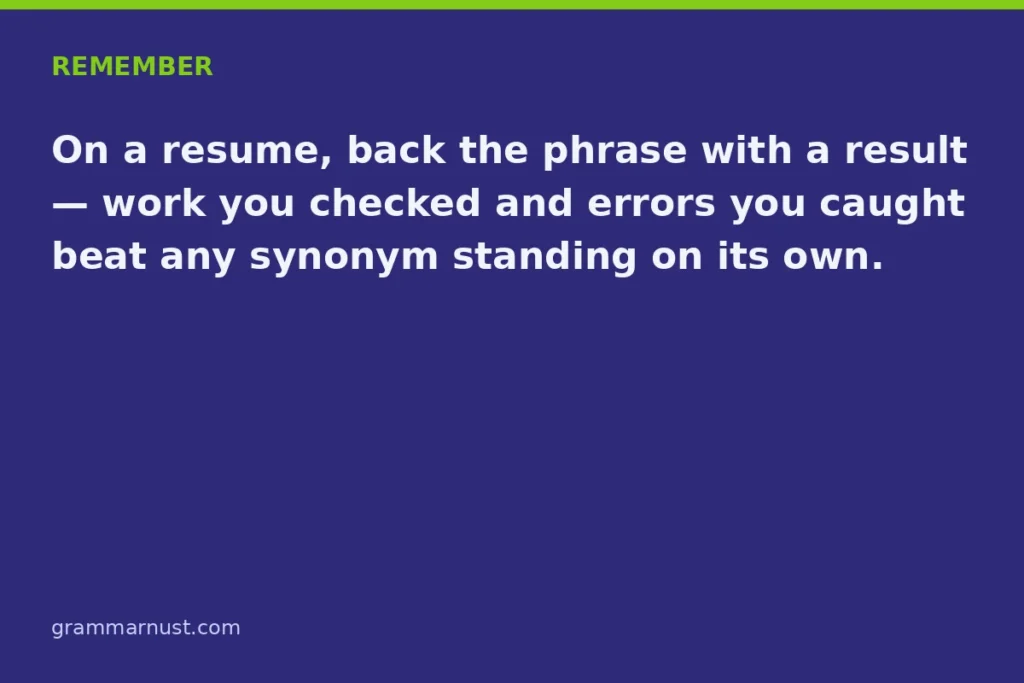
Choosing the right alternative to attention to detail depends on the message you want to communicate. Meticulous, thorough, precise, and conscientious are strong professional options, while keen eye for detail and sharp eye for detail emphasize the ability to notice small things others might miss. For resumes, expressions such as detail-oriented, detail-driven, and systematic cross-checking can make your skills more specific.
Remember that the strongest wording is supported by evidence. Instead of simply claiming excellent attention to detail, explain how you verify information, identify errors, review requirements, or maintain accurate records. The right alternative, combined with a practical example, makes your professional writing clearer, more credible, and more memorable.