30 Other Ways to Say “According To” (With Examples)
Quick Answer: The most useful all-purpose replacement for “according to” is “X states that,” because it names the source directly and works in essays, reports, and professional writing. Choose a more specific phrase when the source is reporting information, presenting evidence, expressing an opinion, quoting exact words, or establishing a rule.
Using the same phrase repeatedly can make even a well-written essay or report sound mechanical. Although “according to” is grammatically correct, varying your sentence structure helps your writing feel more natural, precise, and engaging.
There are many other ways to say according to, but not every alternative communicates the same meaning. Some phrases introduce information from a source, others highlight evidence or personal opinions, and a few describe compliance with rules rather than attribution. Choosing the wrong expression can change the meaning of your sentence.
This guide covers 35 genuinely distinct alternatives, organized by their purpose, tone, and context. Whether you are writing an academic essay, citing research, preparing a business document, or having a casual conversation, you will learn what to say instead of according to without sacrificing clarity or accuracy.
What Does “According To” Mean? (And What Are Other Ways to Say According To?)
“According to” is a prepositional phrase used to introduce information attributed to a particular source, person, authority, or document. It tells readers where a statement, opinion, or piece of information comes from.
For example:
- According to the research, regular exercise improves overall well-being.
- According to the manager, the meeting will begin at 10 a.m.
- According to the report, customer satisfaction has increased.
However, the phrase has more than one meaning. It can introduce a source, indicate conformity with a rule, or describe something that depends on a particular condition. Merriam-Webster’s definition of “according to” reflects these different uses.
Understanding these meanings helps you select an appropriate replacement instead of choosing a phrase simply because it sounds formal.
If you are researching an according to synonym, according to synonyms in english, or an according to synonym formal, consider these three common functions:
- Source attribution: Identifies who provided the information. Example: The author states that the policy needs revision.
- Rule alignment: Shows that something follows a rule, policy, standard, or instruction. Example: Employees must act in accordance with company policy.
- Dependency: Explains how something changes depending on a condition. Example: The delivery time varies according to the destination.
The first function is especially important in essays and research papers. When you introduce a source, your wording should accurately represent whether that source reports a fact, expresses an opinion, presents evidence, or makes an allegation.
Is “According To” Professional or Polite to Say?
Yes. “According to” is professional, polite, and grammatically correct in academic writing, workplace communication, business reports, and everyday conversations. It is a neutral expression that helps writers acknowledge information from another person or source.
For example:
- Professional: According to the project manager, the deadline has been extended.
- Academic: According to the researchers, the results require further investigation.
- Business: According to the latest report, revenue increased during the previous quarter.
The problem is not the phrase itself but its repetition. Starting several consecutive sentences with “according to” can make your writing predictable and unnecessarily repetitive.
Instead of replacing it with an unusual synonym every time, change the sentence structure. You can make the author, report, study, or researcher the subject of the sentence. This approach improves readability while keeping the original meaning intact.
In formal documents, prioritize precision over variety. A familiar expression that accurately identifies a source is better than an uncommon alternative that changes the meaning.
Quick Top Picks: The 8 Best Alternatives at a Glance
If you need a quick replacement, these eight options cover some of the most common writing and speaking situations. Each one also appears in the detailed sections below.
- X states that: A clear, professional way to introduce information directly from a source.
- As reported by: Best for information published in a news report or formal account.
- As noted by: Useful when highlighting an observation or specific detail from a source.
- As shown by: Ideal for introducing evidence, records, or observable results.
- In X’s view: A natural way to introduce someone’s opinion or interpretation.
- In the words of: Suitable for introducing someone’s exact words or a recognizable quotation.
- Per: A concise option for referring to instructions, policies, and requirements.
- Reportedly: Useful when describing information that has been reported but remains unconfirmed.
The right choice depends on what you want to communicate. The following 35 alternatives explain the differences and show how to use each one naturally.
True Attribution: The Closest Equivalents
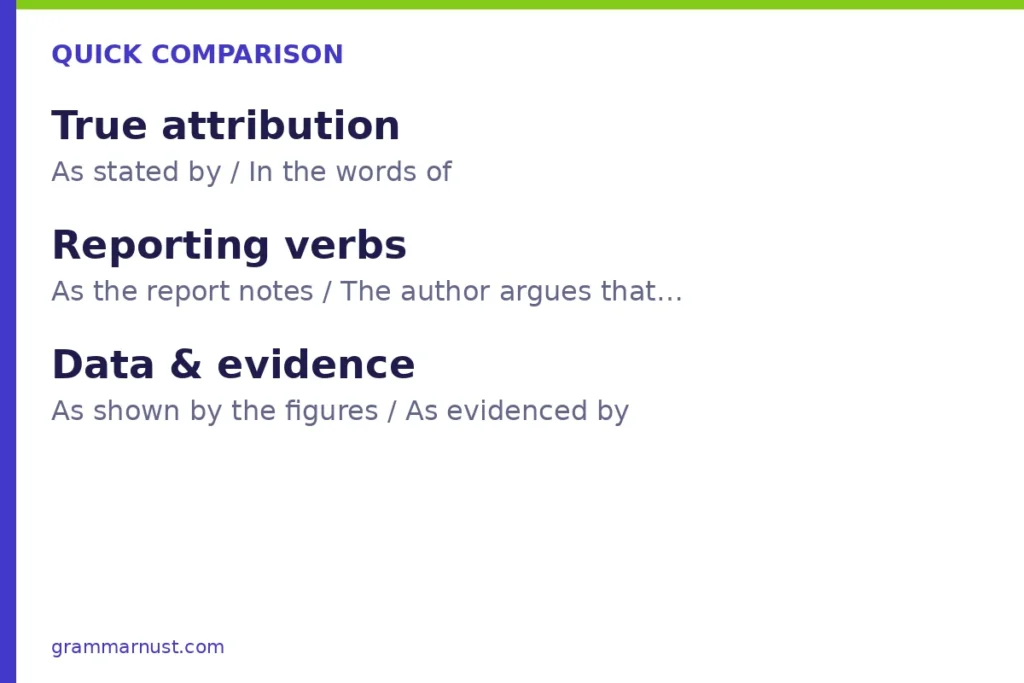
These four expressions are the closest structural alternatives to “according to” when you want to identify the person, publication, or document responsible for a statement. Each reporting verb has a slightly different emphasis, so choose the one that accurately describes the source’s contribution.
1. As stated by
Tone and use: Formal, direct, and authoritative. Use this phrase when a person or organization has explicitly made a statement. It works particularly well when referencing official announcements, written statements, or clearly expressed positions.
Example: As stated by the district superintendent, all schools will reopen on Monday.
2. As reported by
Tone and use: Professional and journalistic. This phrase emphasizes that information comes from a published report, news organization, or documented account. It is particularly useful when reporting developments or information gathered by another source.
Example: As reported by the local newspaper, the city plans to expand its public transportation network.
3. As noted by
Tone and use: Neutral, analytical, and slightly understated. Use it when a researcher, author, or professional draws attention to an observation or important detail. It is especially useful when acknowledging a supporting point without overstating its importance.
Example: As noted by the researchers, the study included participants from several age groups.
4. As described by
Tone and use: Formal and explanatory. This expression works when a source provides a description of an event, process, place, person, or situation. It emphasizes the source’s explanation rather than simply presenting a statement or opinion.
Example: As described by the architect, the building combines traditional materials with modern design features.
Reporting-Verb Rewrites: The Essay Technique
Students searching for other ways to say according to in an essay, according to synonym essay options, or how to say according to in an essay can benefit from changing the sentence structure. The most effective ways to say according to in an essay often involve making the source the grammatical subject. This also provides another way to say according to in an essay without repeatedly using the same introductory phrase.
Instead of writing “According to the author,” introduce the author directly and select a reporting verb that describes what the author actually does. These six constructions are especially useful in essays, literature reviews, research discussions, and analytical writing.
5. X reports that…
Tone and use: Factual and professional. Use this construction when a source presents information as part of a report, investigation, survey, or news update. It works best for findings and developments rather than personal opinions.
Example: The health department reports that the clinic will extend its operating hours next month.
6. X notes that…
Tone and use: Academic, neutral, and concise. This construction introduces a detail, observation, or supporting point that a writer considers relevant. It is useful when adding information without suggesting that the source is making a strong argument.
Example: The author notes that access to public transportation remains limited in rural communities.
7. X writes that…
Tone and use: Academic and literary. This expression is particularly appropriate when referencing a book, article, essay, journal entry, or other written material. It makes the connection between the information and its original writer clear.
Example: In her introduction, Rivera writes that education should encourage independent thinking and curiosity.
8. X argues that…
Tone and use: Analytical and persuasive. Use this construction when an author presents a position supported by reasoning, evidence, or interpretation. It is especially effective in argumentative essays because it distinguishes an author’s viewpoint from an established fact.
Example: The researcher argues that early intervention can improve educational outcomes for struggling students.
9. X states that…
Tone and use: Clear, neutral, and professional. This is one of the most versatile alternatives because it introduces information that a source explicitly communicates. It works well in academic papers, business reports, and formal presentations.
Example: The official report states that the proposed changes will take effect next January.
10. X points out that…
Tone and use: Analytical and explanatory. Use this construction when a source draws attention to an important detail, overlooked issue, or meaningful distinction. It is particularly useful when explaining why a particular piece of information matters.
Example: The editor points out that the two grammatical expressions have different meanings.
Changing your sentence structure is also a useful way to improve transitions between paragraphs. For more expressions that help essays flow naturally, explore our guide to other ways to say “with that being said”.
Data and Evidence Phrases
Writers looking for according to synonyms in research, an according to synonym academic writing option, or an according to synonym citation often need to distinguish between what a source says and what its evidence demonstrates. These expressions help connect a statement to research findings, numerical information, observations, and documented results.
11. As shown by
Tone and use: Analytical and evidence-focused. Use this expression when a conclusion is supported by visible information, records, survey results, charts, or other observable evidence. It directs readers toward the material that supports the statement.
Example: As shown by the attendance records, student participation increased during the spring semester.
12. As demonstrated by
Tone and use: Formal, academic, and confident. This phrase is appropriate when evidence, an experiment, or a documented example illustrates a particular point. Use it when the supporting material provides a meaningful demonstration rather than merely suggesting a possibility.
Example: As demonstrated by the experimental results, the revised procedure can produce more consistent measurements.
13. As evidenced by
Tone and use: Formal and research-oriented. This construction emphasizes that a conclusion is supported by specific evidence. It is useful in analytical reports, academic discussions, and professional evaluations where the relationship between evidence and interpretation matters.
Example: As evidenced by the dated photographs, the structural damage existed before the renovation began.
14. The figures from X suggest…
Tone and use: Statistical, analytical, and appropriately cautious. Use this construction when numerical information points toward a possible conclusion but does not necessarily establish it with certainty. The word “suggest” is valuable when interpreting trends without overstating what the numbers prove.
Example: The figures from the annual survey suggest that younger respondents use digital services more frequently.
A note about citing the text itself: If you are looking for other ways to say according to the text, consider expressions such as “the passage states,” “the author explains,” or “the text indicates.” Choose the wording that reflects what the passage actually communicates. When using a textbook, article, or other written source, include the appropriate in-text citation whenever your citation style requires one.
Remember that an attribution phrase does not replace a citation. In APA, MLA, Chicago, or another academic citation system, you may still need an author name, publication date, page number, or reference entry. The signal phrase identifies the source in your sentence; the citation provides the required publication details.
Opinion and Viewpoint Markers
Sometimes a source is not presenting an established fact or reporting a verified event. Instead, it is expressing a personal belief, interpretation, judgment, or perspective. These four alternatives make that distinction clear and help readers understand whose opinion they are reading.
15. In X’s view
Tone and use: Professional, concise, and neutral. This expression introduces someone’s opinion without presenting it as an objective fact. It works well in essays, reviews, opinion pieces, and discussions involving different viewpoints.
Example: In the committee’s view, the proposed changes require additional financial planning.
16. From X’s perspective
Tone and use: Thoughtful, explanatory, and professional. Use this phrase when you want to emphasize how a particular person or group understands a situation. It is particularly helpful when comparing different experiences or interpretations of the same issue.
Example: From the tenant’s perspective, the revised notice period provides more time to arrange alternative housing.
17. In the view of X
Tone and use: Formal and academic. This construction is suitable for essays, research discussions, and professional documents where you want to attribute an interpretation to a particular individual, organization, or group.
Example: In the view of the reviewers, the chapter on implementation provides the strongest analysis.
18. As X sees it
Tone and use: Conversational and interpretive. This expression introduces how someone personally understands or evaluates an issue. It is less formal than some academic alternatives but works well in commentary, interviews, and accessible explanatory writing.
Example: As Jordan sees it, the delay gives the development team more time to test the update.
Quoting Someone’s Exact Words
When you want to introduce a direct quotation or draw attention to the original wording of a source, ordinary reporting expressions may not be specific enough. These four alternatives make the connection to the speaker’s actual language clearer.
19. In the words of
Tone and use: Formal, expressive, and sometimes inspirational. Use this phrase when introducing a direct quotation or emphasizing a speaker’s memorable wording. It works particularly well in speeches, essays, presentations, and biographical writing.
Example: In the words of the principal, “Every student deserves an opportunity to succeed.”
20. As X puts it
Tone and use: Natural, conversational, and expressive. This phrase introduces a person’s distinctive way of explaining an idea. It can introduce an exact quotation or a close rendering of the source’s wording, depending on how the sentence is constructed.
Example: As the author puts it, the neighborhood is “a small community within a growing city.”
21. To quote X
Tone and use: Direct, clear, and formal. Use this construction when you want to signal that the following words are taken directly from a speaker, author, report, or document. It is especially useful when the exact wording is important to your explanation.
Example: To quote the official memo, “All applications must be submitted before 5 p.m. Friday.”
22. In X’s own words
Tone and use: Personal and explanatory. This expression emphasizes the original speaker’s language rather than the writer’s interpretation. It is useful in interviews, personal accounts, research discussions, and situations where preserving someone’s wording matters.
Example: In the scientist’s own words, the discovery was “promising, but still preliminary.”
When reproducing exact wording, use quotation marks and provide the required citation. Do not place quotation marks around a paraphrase or change a source’s wording while presenting it as a direct quotation.
Rules and Compliance: Alignment, Not Attribution
Important distinction: These are rule-alignment phrases, not source-attribution synonyms. “In accordance with,” “in line with,” and “based on” communicate alignment with a rule, policy, standard, or framework. They do not mean that a person or report said something. For example, you cannot replace “According to the report, sales increased” with “In accordance with the report, sales increased” and preserve the same meaning unless the report is itself a rule or standard being followed.
The following expressions belong in sentences about requirements, instructions, policies, legal provisions, and organizational procedures.
23. In accordance with
Tone and use: Highly formal, authoritative, and procedural. This phrase indicates that an action follows an established rule, agreement, regulation, or official requirement. It is particularly suitable for legal documents, company policies, and compliance statements.
Example: In accordance with the employee handbook, all travel expenses must be recorded within 10 business days.
24. In line with
Tone and use: Professional, neutral, and organizational. Use this expression when an action, decision, or policy is consistent with an established standard, expectation, or guideline. It is slightly less formal than “in accordance with.”
Example: In line with the department’s safety standards, all visitors must wear protective eyewear.
25. Per
Tone and use: Concise, businesslike, and sometimes legalistic. “Per” is useful when referring to instructions, contractual provisions, official requirements, or established policies. It is a single-word alternative in appropriate rule-related contexts.
Example: Per the contract, the supplier must notify the buyer before changing the delivery schedule.
Usage note: “As per” is widely flagged as redundant because “per” already communicates the intended relationship. Although “as per” appears in everyday and business English, choosing “per” is usually more concise in formal documents.
26. Under
Tone and use: Formal, legal, and authoritative. Use “under” when explaining obligations, permissions, or conditions established by a law, regulation, agreement, or policy. It emphasizes the authority or framework governing a particular situation.
Example: Under the state regulation, applicants must submit the completed form before the deadline.
Unverified Claims and Hearsay
Sometimes you need to communicate information that has been alleged, reported, or circulated without presenting it as a confirmed fact. These five expressions help distinguish verified information from claims, accusations, rumors, and secondhand reports.
Be particularly careful in journalism, research, and professional communication. The wording should communicate the level of certainty accurately, and serious claims should be attributed to an identifiable source whenever possible.
27. As claimed by
Tone and use: Neutral but cautious. This expression identifies a statement as a claim made by a particular person, company, or organization. It does not establish that the claim is true, making it useful when discussing statements that have not been independently verified.
Example: As claimed by the manufacturer, the protective coating can resist scratches under normal conditions.
28. As alleged by
Tone and use: Formal, cautious, and often legal. Use this expression when discussing accusations or allegations that have not been established as facts. It is especially important in news reporting and legal discussions because it avoids presenting an accusation as a proven event.
Example: As alleged by prosecutors, the financial records were altered before the audit.
29. Reportedly
Tone and use: Concise, journalistic, and cautious. This adverb introduces information that has appeared in reports but has not necessarily been independently confirmed. It is useful when the reporting source is established elsewhere in the surrounding context.
Example: The company will reportedly open a second location next spring after securing a new lease.
In formal writing, do not rely on “reportedly” as a substitute for identifying a source. When the information is important or potentially controversial, explain where the report originated and provide the appropriate citation.
30. By all accounts
Tone and use: Conversational to moderately formal. This phrase suggests that multiple observations or reports point toward the same conclusion. It is useful when describing a broadly shared impression, although it should not be used to imply unanimous agreement without supporting information.
Example: By all accounts, the annual conference attracted a larger audience than organizers expected.
31. Word has it that
Tone and use: Informal and conversational. Use this expression when introducing a rumor or piece of unconfirmed information circulating among people. It is suitable for casual conversation and storytelling but generally inappropriate for academic papers or formal reports.
Example: Word has it that the neighborhood café may move to a larger location later this year.
Casual Attribution for Conversation
If you are searching for an according to synonym informal, you probably want something that sounds natural in everyday conversation rather than something suitable for an academic paper. These four expressions introduce another person’s statement, opinion, or explanation in a relaxed way.
32. Like X said
Tone and use: Very casual and conversational. This phrase works when referring back to something a friend, colleague, or other speaker has already mentioned. It is common in everyday speech but usually too informal for academic essays and official documents.
Example: Like Maya said, we should double-check the final numbers before sending the report.
33. X reckons
Tone and use: Informal, conversational, and opinion-focused. “Reckons” means that someone thinks or believes something. It is common in some varieties of English and is understood in the United States, although it can sound regional or particularly casual.
Example: Sam reckons the new route will save us about ten minutes during the morning commute.
34. If X is to be believed
Tone and use: Conversational, conditional, and sometimes skeptical. Use this expression when you want to attribute a statement to someone while suggesting that the information may need further verification. Depending on context, it can sound doubtful or slightly sarcastic.
Example: If the vendor is to be believed, the replacement parts will arrive before the end of the week.
35. Going by what X said
Tone and use: Relaxed, conversational, and practical. This expression introduces a conclusion or expectation drawn from something another person has said. It is particularly useful when explaining how you reached an informal judgment or understanding.
Example: Going by what Lena said, the meeting should start around noon.
Which One Should You Use? A Quick Guide
The best alternative depends on your writing task, the type of information you are introducing, and the level of formality you need. A phrase that works in a casual conversation may sound inappropriate in an academic paper, while a formal compliance expression may be unsuitable for introducing someone’s opinion.
Use this table to choose an appropriate alternative for six common situations.
| Situation | Best phrase | Why it works |
|---|---|---|
| Essay paragraph | X notes that… | Introduces a source’s observation naturally and avoids repeating the same introductory phrase. |
| Research paper with data | The figures from X suggest… | Connects numerical evidence to an interpretation without claiming more certainty than the data supports. |
| Citing someone’s opinion | In X’s view | Makes it clear that the statement represents a particular person’s perspective rather than an established fact. |
| Company policy document | In accordance with | Communicates that an action follows an official policy, requirement, or organizational standard. |
| News report of an unconfirmed claim | Reportedly | Signals that information has been reported but is not necessarily independently verified. |
| Casual conversation | Going by what X said | Sounds natural when explaining a conclusion drawn from another person’s comments. |
A useful writing tip: Do not choose an alternative simply because it sounds more sophisticated. First identify whether you are attributing a statement, interpreting evidence, expressing an opinion, quoting someone, or referring to a rule. Then select the phrase that performs that specific job.
Mistakes to Avoid
Finding alternatives is only useful when you understand their meanings. Some expressions appear interchangeable at first but communicate different relationships between a statement, its source, and the evidence supporting it.
- Using “in accordance with” to mean “X said”: This is a common meaning error. “In accordance with” describes compliance with a rule or standard. It does not introduce someone’s statement. Write “The report states that sales increased” rather than using a compliance expression to introduce the report’s findings.
- Rotating “as [verb] by” constructions as if each creates a different meaning: Changing the reporting verb does not automatically create a genuinely different alternative. The verb should reflect what the source actually does. A statement, a report, an observation, and a description have different functions, so choose the verb according to its specific meaning rather than generating variations for the sake of variety.
- Writing “as per” repeatedly in formal documents: Although the expression is widely used, it can sound unnecessarily wordy. “Per” is generally more concise when referring to instructions or requirements. In longer sentences, explaining the actual policy or requirement may be even clearer.
- Attributing your own opinion with “according to me”: This expression sounds unnatural in standard professional and academic English. If you are presenting your own viewpoint, use “I believe,” “I think,” or “In my view.” Reserve source-attribution expressions for information that comes from another person or document.
- Citing a source in every single sentence: Repeating the same attribution throughout a paragraph makes writing difficult to read. Introduce the source clearly, develop the discussion with appropriate references, and provide citations according to your required style. However, never make it unclear which ideas belong to the source and which are your own.
Another useful habit is to avoid presenting uncertain information with excessive confidence. If you are discussing a claim, explain whether it has been verified and identify the source whenever possible. When inviting readers to question or clarify a statement, you can also use polite expressions from our guide to other ways to say “please correct me if I’m wrong”.
Frequently Asked Questions
What is the most formal synonym for “according to”?
“As stated by” is one of the most formal and direct alternatives when attributing an explicit statement to a person, organization, or document. “As reported by” is another suitable choice for published findings or news. In academic writing, constructions such as “The report states that” are often more natural than replacing one introductory phrase with another.
How do I say “according to” in an essay without repeating it?
Make the source the subject of your sentence and use an appropriate reporting verb. For example, replace “According to the author, education improves opportunity” with “The author argues that education improves opportunity.” You can also use “the researcher notes that” or “the study reports that” when those verbs accurately describe the source.
Is “as per” correct English, or should I avoid it?
“As per” is widely used in English, particularly in business communication, but it is often considered redundant because “per” already carries the intended meaning. For concise formal writing, use “per the agreement” or explain the relevant requirement directly. The expression is not automatically grammatically incorrect, but simpler wording is usually preferable.
What is the difference between “according to” and “in accordance with”?
“According to” can attribute information to a person, report, or other source. “In accordance with” means that something follows a rule, policy, agreement, or standard. For example, “According to the report, costs increased” attributes information, while “In accordance with company policy, employees must submit receipts” describes compliance.
How do I cite a source in research writing without always writing “according to”?
Use signal phrases that identify the source’s contribution, such as “the study found,” “the author argues,” “the researchers observed,” or “the report indicates.” You can also integrate parenthetical citations where appropriate. Follow your required citation style, including author names, publication dates, page numbers, and reference entries when necessary.
Can I start a sentence with an alternative to “according to”?
Yes. You can begin a sentence with expressions such as “As reported by the agency,” “In the words of the author,” or “From the researcher’s perspective.” You can also restructure the sentence to begin with the source itself, as in “The study demonstrates that…” Choose an opening that clearly communicates the relationship between the source and the information.
Conclusion
Choosing the right alternative to “according to” makes your writing clearer, more natural, and more precise. The best option depends on whether you are attributing information, discussing evidence, expressing an opinion, quoting someone, or referring to an established rule.
Use reporting verbs in essays, evidence-focused expressions in research, and conversational phrases when speaking informally. Remember that the 35 other ways to say according to are not all interchangeable. Match each expression to its actual meaning, and your writing will sound more professional without becoming unnecessarily complicated.