30 Other Ways to Say “Please Correct Me If I’m Wrong” (With Examples)
Quick Answer: The most polite all-purpose alternative is “Please correct me if I’m mistaken.” It sounds respectful, confident, and natural in professional and everyday conversations. If you want another way to say please correct me if i am wrong, this is a reliable please correct me if i am wrong alternative and a good choice when deciding what to say instead of correct me if i’m wrong.
If you frequently use the expression “Please correct me if I’m wrong,” you may want a few alternatives that sound more natural in different situations. The right wording can make an email more professional, a meeting more collaborative, or a casual conversation more comfortable.
There are many different ways to say correct me if i’m wrong, but not every variation communicates the same tone. Some expressions directly invite feedback, while others soften an opinion, request clarification, or encourage someone to interrupt when they notice an error. This guide covers 35 distinct alternatives, with practical examples and notes about when to use each one.
What Does “Please Correct Me If I’m Wrong” Mean?
The phrase “Please correct me if I’m wrong” means that you are sharing information, an opinion, or an interpretation while giving someone permission to point out an error. The correct me if i’m wrong meaning is closely connected to humility, open communication, and a willingness to accept constructive feedback.
However, the expression does not necessarily mean that you doubt your own facts. You might be confident about your information but still recognize that another person has additional knowledge or a different perspective. You are simply leaving an open door for clarification.
The please correct me if i am mistaken meaning is essentially the same: you believe your statement is accurate, but you are willing to reconsider it if someone provides better information. The word “mistaken” describes being wrong in what you believe or understand, as explained in the Cambridge Dictionary’s definition of mistaken.
People searching for please correct me if i am wrong synonyms or a correct me if i’m wrong synonym are usually looking for expressions that communicate one or more of these ideas:
- Humility: You recognize that your understanding may not be complete.
- Openness: You welcome additional information and constructive feedback.
- Respect: You give other people room to contribute without making them feel uncomfortable.
- Accuracy: You care more about getting the facts right than proving yourself correct.
- Collaboration: You encourage a conversation rather than presenting your statement as unquestionable.
For example, imagine you are discussing a project deadline with a coworker. You believe the final report is due Friday, but you are not responsible for scheduling it. Saying “Please correct me if I’m wrong, but I believe the report is due Friday” gives your colleague an opportunity to clarify the deadline without making the conversation uncomfortable.
The expression works particularly well when you want to contribute confidently while remaining approachable.
Is “Please Correct Me If I’m Wrong” Professional or Polite to Say?
Yes. “Please correct me if I’m wrong” is generally professional and polite. It communicates that you are willing to listen, consider another person’s perspective, and accept corrections when necessary. It is suitable for workplace discussions, emails, presentations, and conversations with colleagues.
However, the phrase is not automatically appropriate in every situation. Its effect depends on your tone, audience, and the statement that follows it.
In professional emails: It works when you are checking information, confirming an interpretation, or discussing something that may need clarification. For example, “Please correct me if I’m wrong, but I believe the revised agreement takes effect next month.”
In meetings: It can encourage coworkers to contribute additional information. For example, “Please correct me if I’m wrong, but we agreed to complete the first phase by Thursday.”
In casual conversations: It sounds friendly and approachable when you are discussing something you are not entirely certain about.
When it can sound less professional: Repeating the expression before every statement may make you seem unnecessarily hesitant. It can also sound confrontational if you use a sarcastic tone or follow it with an aggressive disagreement.
For important workplace documents, consider more specific alternatives such as “Please flag anything that looks off” or “I’d appreciate your correction on any errors.” These phrases explain exactly what kind of feedback you want.
Quick Top Picks: The 8 Best Alternatives at a Glance
If you do not have time to review all 35 options, these eight expressions are particularly useful. They cover professional writing, workplace discussions, and everyday conversations.
- “Please correct me if I’m mistaken.” Best for a polite, all-purpose alternative.
- “I’d welcome a correction.” Best for professional and collaborative communication.
- “Unless I’m mistaken…” Best for introducing a potentially uncertain statement.
- “As I understand it…” Best for sharing your interpretation without sounding overly certain.
- “Please flag anything that looks off.” Best for reports, drafts, and professional emails.
- “Please jump in if I’m off track.” Best for interactive meetings and presentations.
- “Set me straight if I’m wrong.” Best for relaxed conversations with colleagues or friends.
- “Happy to be corrected.” Best for short messages and informal discussions.
Direct Equivalents: Formal and Neutral (6 Alternatives)
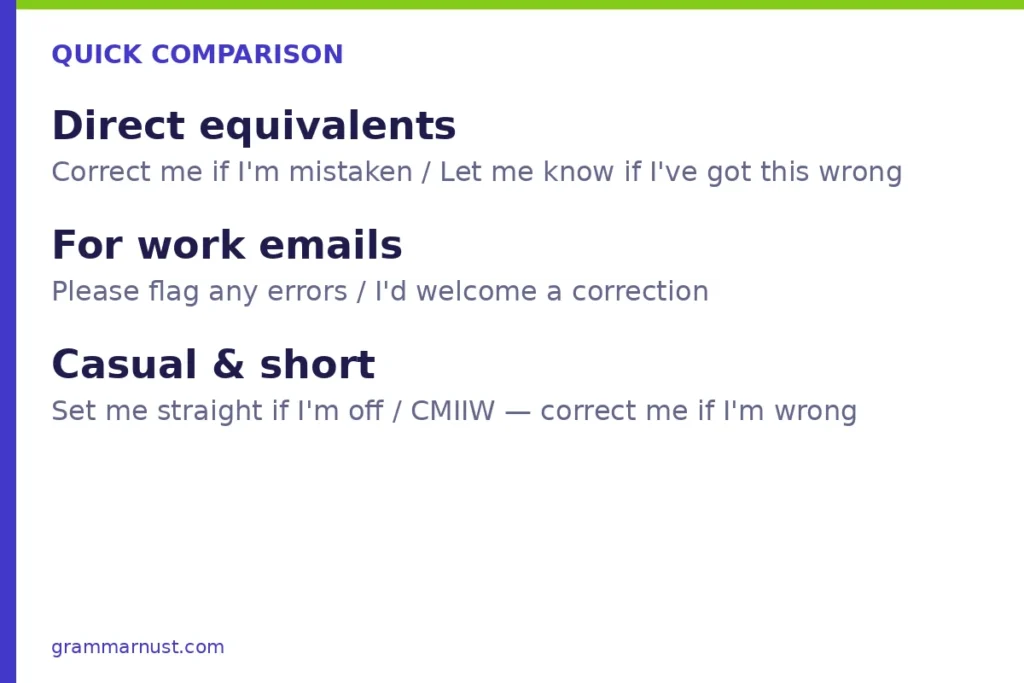
These expressions communicate almost the same message as the original phrase. They are useful when you want to invite correction directly without changing the meaning or making your statement unnecessarily complicated.
1. Please Correct Me If I’m Mistaken
Tone: Polite, respectful, and slightly more formal than the original expression.
This is one of the most natural alternatives when speaking with someone you respect or communicating in a professional environment. Replacing “wrong” with “mistaken” gives the sentence a softer tone without changing its basic meaning.
Example: “Please correct me if I’m mistaken, but I believe the updated policy begins on January 1.”
2. Don’t Hesitate to Correct Me
Tone: Welcoming, confident, and professional.
This expression removes the conditional structure and directly gives the other person permission to offer a correction. It is particularly useful when you want to encourage honest feedback rather than make someone feel uncomfortable about disagreeing with you.
Example: “Don’t hesitate to correct me if you have more recent information about the project timeline.”
3. I’d Welcome a Correction
Tone: Professional, appreciative, and collaborative.
This wording communicates that feedback is not merely acceptable but genuinely appreciated. It works especially well in business discussions, research conversations, and situations where accuracy is more important than defending an initial opinion.
Example: “I’d welcome a correction if my understanding of the company’s reporting process is incomplete.”
4. Correct Me If I Stand Wrong
Tone: Intended as a direct invitation, but not idiomatic in American English.
This wording is sometimes used as a literal variation of “correct me if I’m wrong,” but “stand wrong” is not a natural expression in standard American English. If you want to communicate the same idea, use “If my understanding is off, please correct me.” This sounds considerably more fluent and professional.
Example: “If my understanding is off, please correct me before I share the final project summary.”
5. Please Let Me Know If I’ve Misunderstood
Tone: Considerate, professional, and focused on clarification.
This alternative is particularly useful when discussing instructions, conversations, or decisions made by someone else. Instead of suggesting that the facts might be wrong, it acknowledges that you may have interpreted the information incorrectly.
Example: “Please let me know if I’ve misunderstood, but I thought the revised schedule was approved during yesterday’s meeting.”
6. If I’m Wrong, Please Say So
Tone: Direct, honest, and neutral.
This expression makes it clear that you want someone to speak up if your information is inaccurate. It is slightly more straightforward than some alternatives, making it appropriate for conversations where everyone is comfortable sharing honest opinions.
Example: “If I’m wrong, please say so, but I believe we have already completed the first stage of the process.”
Polite Hedge Openers: Soften the Claim Itself (6 Alternatives)
Sometimes you do not need to ask someone to correct you directly. Instead, you can soften the statement before presenting your opinion or information. These six constructions communicate uncertainty in different ways, including conditional language, memory, interpretation, and direct questions.
They are especially helpful when you want to sound thoughtful rather than overly cautious. If you also want to explore other phrases that soften and frame a claim, see our guide to other ways to say “with that being said”.
7. I May Be Wrong, But…
Tone: Cautious, conversational, and thoughtful.
This construction acknowledges that your statement may not be completely accurate before you introduce your point. It is useful during brainstorming sessions or discussions where people are encouraged to exchange ideas freely.
Example: “I may be wrong, but I think the customer requested a different delivery date.”
8. Unless I’m Mistaken…
Tone: Polished, measured, and moderately formal.
This conditional opener introduces information you believe to be correct while acknowledging the possibility of an error. It is a particularly good option for professional conversations, presentations, and written communication.
Example: “Unless I’m mistaken, the finance team is responsible for approving the revised budget.”
9. As I Understand It…
Tone: Professional, thoughtful, and diplomatic.
This expression presents your current understanding without suggesting that it is necessarily the final answer. It is particularly effective when discussing instructions, workplace responsibilities, or complicated decisions that may have more than one interpretation.
Example: “As I understand it, the new system will replace the existing reporting process next quarter.”
10. If Memory Serves…
Tone: Conversational, understated, and slightly informal.
Use this phrase when you are relying on your recollection rather than referring to confirmed information. It is a natural way to acknowledge that you might not remember every detail correctly without repeatedly apologizing for possible mistakes.
Example: “If memory serves, we discussed moving the product launch to the second week of June.”
11. Am I Right in Thinking…?
Tone: Polite, curious, and collaborative.
This question invites the other person to confirm your understanding or explain where it differs from theirs. It works particularly well when you want to check information rather than simply ask someone to identify an error.
Example: “Am I right in thinking that the final presentation needs to be submitted before Friday afternoon?”
12. I Stand to Be Corrected, But…
Tone: Formal, composed, and slightly traditional.
This idiomatic expression acknowledges that someone may have better information than you. It is suitable for thoughtful discussions, formal presentations, and situations where you want to express an opinion without appearing overly certain.
Example: “I stand to be corrected, but I believe this approach was recommended during the previous review.”
For Professional Emails and Reports (6 Alternatives)
If you are researching how to say please correct me if i am wrong professionally, focus on language that is clear, respectful, and specific. A please correct me if i am wrong professional alternative should make it easy for the recipient to identify what needs reviewing. These expressions also work when deciding how to use please correct me if i am wrong formal wording in business emails, reports, and shared documents.
When you are presenting information gathered from other people or sources, accuracy matters throughout the document. You can also use our guide to other ways to say “according to” to introduce sources and attribute information more carefully.
13. Please Flag Anything That Looks Off
Tone: Professional, approachable, and action-oriented.
This phrase is ideal when sending a draft, report, spreadsheet, or proposal for review. It encourages the recipient to identify anything that appears incorrect, incomplete, or inconsistent without requiring them to rewrite the entire document.
Example: “I’ve attached the revised report; please flag anything that looks off before we circulate it.”
14. I’d Appreciate Your Correction on Any Errors
Tone: Respectful, appreciative, and formal.
This expression directly communicates that you value the recipient’s attention to detail. It works well when requesting a review from a manager, editor, supervisor, or colleague with more expertise in the subject.
Example: “I’d appreciate your correction on any errors you identify in the financial summary.”
15. Please Review and Correct Me Where Needed
Tone: Clear, professional, and cooperative.
This wording is useful when asking someone to examine your explanation or interpretation and identify necessary changes. It works especially well when the recipient is familiar with the subject and can provide more accurate information.
Example: “Please review and correct me where needed before I submit the final version to the department.”
16. Feel Free to Amend Anything That’s Inaccurate
Tone: Collaborative, flexible, and professional.
This alternative is particularly appropriate for shared documents, reports, and drafts. Rather than simply inviting someone to point out an error, you give them permission to make the necessary changes directly.
Example: “I’ve shared the project overview with you, so feel free to amend anything that’s inaccurate.”
17. Comments and Corrections Are Welcome
Tone: Neutral, professional, and open-minded.
This is a useful option when sharing information with several people rather than addressing one individual. Its neutral wording creates room for suggestions, corrections, and constructive feedback without making the message sound overly personal.
Example: “The initial findings are included in the attached document; comments and corrections are welcome before publication.”
18. If Any of This Doesn’t Match Your Records, Please Let Me Know
Tone: Respectful, precise, and businesslike.
This expression is particularly useful when communicating with someone who has access to official records or updated information. It invites verification instead of assuming that your version of events is necessarily correct.
Example: “I’ve listed the payment dates below; if any of this doesn’t match your records, please let me know.”
For Meetings and Presentations (5 Alternatives)
In meetings and presentations, your wording should encourage people to participate without interrupting the natural flow of the discussion. Short, conversational expressions often work better than lengthy requests for correction.
These alternatives are especially useful when explaining a process, presenting research, discussing team responsibilities, or sharing information that other participants may know more about.
19. Please Jump In If I’m Off Track
Tone: Friendly, collaborative, and professional.
This expression encourages participants to interrupt politely if your explanation moves in the wrong direction. It is particularly useful during team meetings where everyone is expected to contribute to the discussion.
Example: “Please jump in if I’m off track, but I believe our next priority should be improving customer response times.”
20. Stop Me If I Get Any of This Wrong
Tone: Direct, conversational, and inviting.
This phrase is useful when explaining several details that someone else may be able to verify. It gives listeners permission to interrupt you before an incorrect assumption becomes part of the discussion.
Example: “Stop me if I get any of this wrong, but the new onboarding process starts with the HR department.”
21. Shout If I Misspeak
Tone: Relaxed, energetic, and informal.
This is a conversational expression that works well with familiar coworkers and friendly teams. It encourages people to point out inaccurate statements as soon as they hear them. Avoid it in highly formal presentations or meetings with unfamiliar senior stakeholders.
Example: “Shout if I misspeak, but I believe the second phase begins after the initial testing period.”
22. Challenge Me on This If It Doesn’t Sound Right
Tone: Confident, collaborative, and discussion-focused.
This alternative is particularly useful when presenting an opinion, recommendation, or proposed strategy. It tells your audience that you are interested in genuine discussion rather than expecting everyone to agree with your position.
Example: “Challenge me on this if it doesn’t sound right, but I think we should prioritize the smaller customer segments first.”
23. Keep Me Honest Here
Tone: Friendly, confident, and conversational.
This expression asks others to help ensure that your explanation remains accurate. It works well among colleagues who have an established working relationship and feel comfortable offering honest feedback.
Example: “Keep me honest here, but didn’t we agree to move the deadline to the end of the month?”
Casual and Friendly Versions (6 Alternatives)
When talking with friends, family members, or close coworkers, you do not always need formal language. Casual expressions can make it easier to admit that you might have misunderstood something while keeping the conversation relaxed.
These alternatives are suitable for everyday conversations, informal group discussions, and friendly messages. Some are more playful or direct, so consider your relationship with the other person before using them.
24. Set Me Straight If I’m Wrong
Tone: Friendly, straightforward, and informal.
This expression invites someone to explain the correct information if your understanding is inaccurate. It is a natural choice when speaking with friends or coworkers you know well.
Example: “Set me straight if I’m wrong, but I thought the restaurant closed at nine.”
25. Tell Me If I’m Getting This Wrong
Tone: Relaxed, approachable, and conversational.
This phrase works well when sharing an interpretation or trying to understand someone’s explanation. It sounds less formal than asking for a correction and encourages the other person to clarify things naturally.
Example: “Tell me if I’m getting this wrong, but you said the trip starts on Saturday morning, right?”
26. I’m Probably Wrong, But…
Tone: Very casual, self-deprecating, and tentative.
This opener is suitable for informal conversations when you want to share an idea without sounding overly confident. However, it can unnecessarily undermine your credibility if you use it when you actually have reliable information.
Example: “I’m probably wrong, but wasn’t that the same movie we watched last summer?”
27. Correct Me If I’m Way Off
Tone: Friendly, informal, and slightly humorous.
The expression “way off” suggests that your understanding could be significantly inaccurate. It works well when discussing guesses, impressions, or opinions with people who appreciate relaxed communication.
Example: “Correct me if I’m way off, but I think the new store is opening sometime next month.”
28. Don’t Let Me Ramble On If That’s Not Right
Tone: Warm, informal, and conversational.
This is a more playful way to acknowledge that you might be explaining something incorrectly. It is particularly useful when discussing a complicated subject and inviting someone to interrupt before you continue with an inaccurate explanation.
Example: “Don’t let me ramble on if that’s not right, but I think the entire process takes about two weeks.”
29. Call Me Out If That’s Not Right
Tone: Casual, direct, and confident.
This phrase encourages someone to point out an error without worrying about offending you. It is best reserved for friends, familiar coworkers, and informal conversations where direct feedback is welcome.
Example: “Call me out if that’s not right, but I think we already discussed this issue last Tuesday.”
Short Forms and Texting Shorthand (6 Alternatives)
Sometimes you only need a few words to invite someone to correct you. If you are looking for a correct me if i’m wrong abbreviation or a correct me if i’m wrong short version, these expressions work well in text messages, group chats, and online discussions.
Some options are abbreviations, while others are complete but concise expressions. Remember that CMIIW belongs in chats and informal messages, never in formal documents, business reports, or professional emails where standard wording is expected.
30. CMIIW
Tone: Informal, concise, and internet-friendly.
CMIIW stands for “Correct Me If I’m Wrong.” It is a texting and online communication abbreviation used before or after a statement when someone wants others to point out an error. It is particularly common in informal discussions, forums, and messages where participants recognize the shorthand.
However, not everyone knows what CMIIW means. Avoid using it when writing to unfamiliar recipients or communicating in formal professional settings.
Example: “CMIIW, but I think the updated version was released yesterday.”
31. Happy to Be Corrected
Tone: Polite, friendly, and concise.
This is an excellent short alternative because it communicates openness to feedback without making a lengthy request. It works well in emails, work chats, and online conversations where you want to sound confident but approachable.
Example: “Happy to be corrected, but I believe the meeting starts at 10 a.m.”
32. Open to Corrections
Tone: Neutral, professional, and straightforward.
This concise expression communicates that you are willing to receive corrections or suggestions. It works particularly well when sharing a document, draft, or preliminary explanation with a group of people.
Example: “Here’s my initial summary of the discussion; open to corrections before we finalize it.”
33. Flag It If It’s Off
Tone: Casual, direct, and action-oriented.
This is a useful expression for quick workplace messages and informal team chats. It asks the recipient to identify anything inaccurate without requiring a detailed explanation in the initial message.
Example: “I’ve added the updated figures to the spreadsheet, so flag it if it’s off.”
34. Tell Me If That’s Off
Tone: Friendly, simple, and conversational.
This short expression is appropriate when sharing a quick assumption or interpretation. It sounds natural in text messages and informal discussions, particularly when you are checking whether someone agrees with your understanding.
Example: “I thought we were meeting outside the main entrance, but tell me if that’s off.”
35. Correct Me Anytime
Tone: Warm, welcoming, and informal.
This phrase communicates that you are comfortable receiving corrections whenever someone notices an error. It is particularly useful in ongoing conversations or collaborative environments where people regularly exchange information.
Example: “I’m still learning how the system works, so correct me anytime if I misunderstand something.”
Which One Should You Use? A Quick Guide
The best expression depends on who you are speaking to, what information you are sharing, and how formal the situation is. A phrase that sounds natural in a group chat might feel too casual in an email to a senior colleague.
Use this comparison to choose an appropriate alternative for five common situations.
| Situation | Best Phrase | Why |
|---|---|---|
| Formal email to a senior colleague | Please correct me if I’m mistaken. | It sounds respectful, measured, and professional without being unnecessarily complicated. |
| Team meeting | Please jump in if I’m off track. | It encourages participation and allows colleagues to clarify information during the discussion. |
| Live presentation | I stand to be corrected, but… | It acknowledges that additional information may exist while maintaining a composed presentation style. |
| Casual chat with a friend | Set me straight if I’m wrong. | It sounds natural and friendly without making the conversation overly formal. |
| Text message | Happy to be corrected. | It is short, clear, and easy to understand without relying on unfamiliar abbreviations. |
A simple rule: Use “mistaken” or “I’d welcome a correction” when you need a professional tone. Choose “As I understand it” when you want to soften an explanation. Use “jump in if I’m off track” during interactive discussions, and save expressions such as “set me straight” for relaxed conversations.
Mistakes to Avoid When Asking Someone to Correct You
Inviting corrections is a useful communication habit, but the wrong wording or attitude can undermine your message. Avoid these four common mistakes.
Using the Phrase Sarcastically
“Correct me if I’m wrong” can sound like a challenge when delivered with an aggressive or sarcastic tone. For example, saying “Correct me if I’m wrong, but you clearly didn’t read the instructions” does not sound like a genuine invitation to correct information. It sounds confrontational.
Instead, use neutral wording and make your intention clear. Try “I may have misunderstood the instructions. Could you clarify what you meant?”
Adding It to Every Sentence
Repeatedly asking people to correct you can make your communication sound hesitant and unnecessarily repetitive. You do not need to qualify every statement, particularly when you are sharing information that you have already verified.
Use the expression only when there is a genuine possibility of misunderstanding or when another person’s knowledge could improve your explanation. Otherwise, communicate your information directly.
Using CMIIW in Formal Documents
Although CMIIW is useful in online conversations, it is not appropriate for formal reports, business proposals, academic papers, or professional correspondence with unfamiliar recipients. Some readers may not recognize the abbreviation, which can make your message less clear.
Write the complete expression or use a professional alternative such as “Please let me know if I’ve misunderstood” or “I’d appreciate your feedback on any inaccuracies.”
Inviting Corrections but Reacting Badly to Feedback
If you ask someone to correct you, you should be prepared to listen when they actually do. Becoming defensive, dismissing their information, or arguing without considering their explanation makes your invitation seem insincere.
When someone points out an error, acknowledge their contribution. A simple response such as “Thanks for clarifying that. I appreciate the correction” helps maintain a respectful and productive conversation.
If you are collecting other ways to say please correct me if i’m wrong for different situations, match the phrase to the setting: a formal line for emails, a hedge opener when you are unsure of a detail, and a short form like CMIIW only in chats with people who know the shorthand.
Frequently Asked Questions
What does “correct me if I’m wrong” mean?
“Correct me if I’m wrong” means that you are sharing information while inviting someone to point out an error if they notice one. It communicates humility, openness to feedback, and a willingness to prioritize accuracy. The phrase does not necessarily mean you doubt your information; it simply gives others permission to clarify or correct your statement.
How do I say “please correct me if I’m wrong” professionally in an email?
You can say “Please correct me if I’m mistaken,” “I’d appreciate your correction on any errors,” or “Please let me know if I’ve misunderstood.” These expressions sound respectful and professional. For example: “Please correct me if I’m mistaken, but I believe the revised deadline is June 15.” Choose wording that matches the purpose and formality of your email.
What does CMIIW mean?
CMIIW stands for “Correct Me If I’m Wrong.” It is an informal abbreviation used in text messages, online discussions, and group chats when someone wants others to identify a possible mistake. For example, “CMIIW, but the event starts at 6 p.m.” Avoid using it in formal emails, business reports, or professional documents.
What is a more polite alternative to “correct me if I’m wrong”?
“Please correct me if I’m mistaken” is one of the most polite and natural alternatives. Other respectful options include “I’d welcome a correction,” “Please let me know if I’ve misunderstood,” and “I’d appreciate your feedback if anything seems inaccurate.” These expressions invite clarification without sounding demanding or confrontational.
Is “correct me if I’m wrong” rude or confrontational?
No, the phrase is generally polite and respectful when used sincerely. However, it can sound confrontational if delivered sarcastically or followed by a statement intended to challenge someone. Your tone and context matter. When you genuinely want clarification, use a neutral voice and remain open to the other person’s response.
What is a short way to say “correct me if I’m wrong” in a text or chat?
CMIIW is a common short abbreviation for “Correct Me If I’m Wrong.” Other concise options include “Happy to be corrected,” “Open to corrections,” and “Tell me if that’s off.” For messages where the recipient may not recognize internet shorthand, “Happy to be corrected” is a particularly clear and friendly choice.
Conclusion
Knowing different ways to say correct me if i’m wrong helps you communicate with greater confidence, flexibility, and clarity. Whether you are writing a professional email, presenting an idea, participating in a meeting, or chatting with a friend, the right expression can make your message sound more natural and respectful.
Choose “Please correct me if I’m mistaken” for a polite all-purpose option, “I’d welcome a correction” for professional communication, and “Happy to be corrected” for shorter messages. Exploring other ways to say correct me if i’m wrong is not just about changing words; it is about choosing language that encourages honest feedback while keeping conversations productive and comfortable.