30 Other Ways to Say “First Come First Serve” (With Examples)
Quick answer: The best way to say “first come first serve” is “first come, first served.” Other professional alternatives include “places are allocated in order of application,” “priority is given to completed registrations,” and “available spaces are assigned according to the published queue.” The right choice depends on your audience and situation.
If you are looking for other ways to say first come first serve, you probably want to communicate that people who arrive, register, or complete a purchase earlier receive priority. However, the wording you choose can make your announcement sound more professional, welcoming, or straightforward.
For example, a business email might say, “Places will be allocated according to the order of completed registrations,” while an event poster could simply state, “Unreserved seats; join the line.” Both communicate a similar policy but suit different situations.
This guide covers 35 alternatives for business announcements, registration policies, event tickets, limited-stock sales, emails, signs, and everyday conversations. It also explains the correct expression, its meaning, and how to communicate a first-come-first-served policy without confusing your audience.
What Does “First Come First Serve” Mean?
The expression “first come, first served” means that people receive a service, opportunity, product, or place according to when they arrive or make a qualifying request. The person who comes first receives priority, while later arrivals are accommodated if something remains available.
The first come first served meaning is straightforward: earlier arrivals or requests receive attention before later ones. The expression is commonly used for event admissions, restaurant seating, appointment scheduling, product sales, registrations, and limited resources.
For example:
“Workshop registrations are accepted on a first come, first served basis.”
This means participants who successfully register earlier receive available places before people who register later. Once the workshop reaches capacity, additional applicants may be placed on a waiting list or declined.
First Come First Served or Serve: Which Is Correct?
“First come, first served” is the traditional and widely preferred form in edited English. The word “served” is a past participle that completes the implied passive meaning: those who come first will be served first.
“First come, first serve” is also used in modern English. Merriam-Webster recognizes it as a variant of the established expression. However, if you want the conventional form for a professional announcement, business document, or formal sign, choose “first come, first served.”
Compare these examples:
- Preferred: “Appointments are available on a first come, first served basis.”
- Common variant: “Appointments are available on a first come, first serve basis.”
Both are understandable, but the first version is the safer editorial choice. You can check the definition and usage variants in Merriam-Webster’s entry for first come, first served.
What Is the Short Form of First Come First Served?
The two abbreviations worth knowing are FCFS and FIFO.
- FCFS: Stands for “First Come, First Served.” It is the direct abbreviation of the expression and is commonly used in computing, scheduling, and operational policies.
- FIFO: Stands for “First In, First Out.” It describes a system in which the earliest item or request entering a queue is processed or removed first.
If you are searching for the first come first served basis short form, FCFS is the most direct option. FIFO is appropriate when describing a queue or processing method, but it is not always a natural replacement for a public-facing announcement.
For example, a computer system might process customer requests using a FIFO queue. A business announcement, however, would usually be clearer with “Requests are handled in the order received.”
Another Way to Say First Come First Served Basis
A simple alternative is “priority is determined by arrival or registration time.” Other options include “available places are allocated in the order received,” “the first eligible applicant secures the available place,” and “admission follows the queue.”
If you are looking for another way to say first in first served, you may also mean “first in, first out.” The latter is especially useful when describing a formal queue or processing system rather than an event announcement.
Is “First Come First Serve” Professional or Polite to Say?
Yes, the expression is generally professional, clear, and widely understood. However, learning how to say first come first serve professionally can help you communicate the same policy with a more polished tone, especially when dealing with customers, applicants, employees, or event participants.
A professional way to say first come first serve is to explain the actual allocation rule instead of relying on a short informal expression. For example, “Available appointments will be assigned according to the order of confirmed requests” sounds more specific in a business setting.
The original expression is not impolite. It simply emphasizes priority and availability rather than customer appreciation or personal attention. If your audience needs a clear rule, direct wording is usually better than a creative expression that could be misunderstood.
For example, compare these announcements:
- Direct: “First come, first served. No reservations are available.”
- Professional: “Appointments are assigned according to the order of confirmed bookings.”
- Friendly: “Reserve your place early to make sure you don’t miss out.”
Each version serves a different purpose. The first states the policy, the second explains the administrative process, and the third encourages early action.
When preparing a formal announcement, consider using clear transitions to connect your policy with the rest of your message. You can explore these other ways to say “with that being said” for smoother wording in professional announcements.
Quick Top Picks: The 8 Best Alternatives at a Glance
If you need a quick replacement, these eight expressions cover the most common situations. Each is included again in the detailed sections below.
- First come, first served: The classic and clearest expression for a general policy.
- First to claim an open slot gets it: Best for online bookings and available appointments.
- Completed submissions are placed in a timestamped queue: Best for formal application processes.
- A place is reserved only after written confirmation is issued: Best for professional registration policies.
- Please form one line at the entrance; staff will admit guests from the front: Best for event admission.
- The first completed checkout secures the item: Best for online sales and limited stock.
- If your preferred session is full, we can add you to the waitlist: Best for customer and booking emails.
- First dibs: Best for casual conversations and informal group announcements.
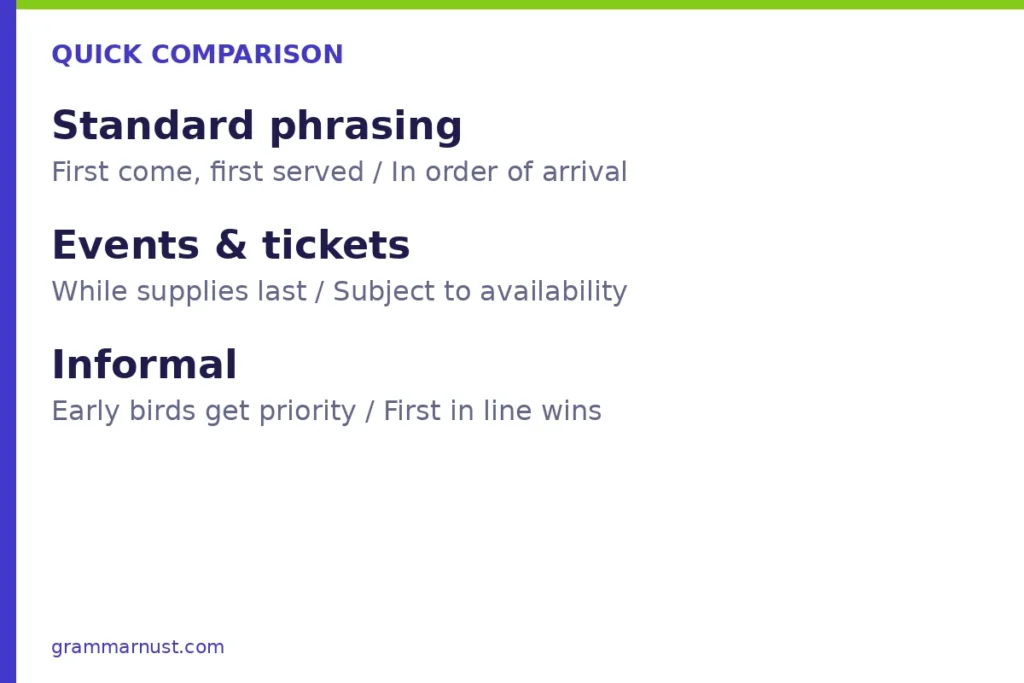
The Classics, Done Right
These five expressions are familiar ways to communicate priority, queue position, and service order. They work well when you want readers to understand the basic policy without lengthy explanations.
1. First Come, First Served
Tone and usage: This is the traditional, grammatically preferred expression. It is suitable for business announcements, public notices, event registrations, restaurant seating, and limited-availability services.
Example: “All available consultation appointments will be offered on a first come, first served basis.”
It is the safest option when you want to communicate the rule without changing its meaning. You can use it in formal and informal situations because most English-speaking readers recognize it immediately.
2. First In, First Out (FIFO)
Tone and usage: FIFO is a technical expression used in inventory management, computing, data processing, and queue systems. It means that the first item or request entering a system is the first one processed or removed.
Example: “Customer service requests are processed using a first-in, first-out (FIFO) queue.”
FIFO is a useful alternative when describing an established operational process. However, it may sound technical to general customers, so spell out the policy when writing public announcements.
3. First in Line
Tone and usage: This is a short, familiar expression that emphasizes physical or virtual queue position. It works well for ticket counters, customer service desks, waiting lists, and informal event announcements.
Example: “Customers who are first in line will have the opportunity to purchase the available tickets.”
It is particularly effective when people can see or understand the queue. In situations where requests arrive online, explain how the line is determined so participants know what gives someone priority.
4. First to Claim an Open Slot Gets It
Tone and usage: This direct construction is useful for digital bookings, available appointments, online registrations, and shared resources. It emphasizes the action of claiming an opening rather than simply arriving early.
Example: “The first person to claim an open appointment slot gets it.”
It is especially useful when several people can view the same availability calendar. Make sure your system clearly confirms successful claims so users do not assume that simply opening a booking page reserves a place.
5. Take a Number and Wait Your Turn
Tone and usage: This familiar expression is appropriate for service counters, waiting rooms, customer support desks, and other numbered queue systems.
Example: “Please take a number and wait your turn; customers will be called in ticket order.”
Unlike a general arrival policy, this wording explains how people enter and move through a queue. It works particularly well when a numbered ticket determines service priority.
Formal and Professional Policy Wording
For registrations, applications, admissions, and customer services, professional wording should explain exactly how priority is determined. The following alternatives are useful when a business or organization needs a clear allocation policy rather than a casual announcement.
6. Completed Submissions Are Placed in a Timestamped Queue
Tone and usage: Formal and administrative. This construction works for online applications, official registrations, and systems that record submission times.
Example: “Completed submissions are placed in a timestamped queue for allocation.”
It is particularly useful when an organization needs a transparent record of when each request was received. Specify that incomplete submissions do not qualify if applicants could otherwise misunderstand when their position begins.
7. Only Complete, Eligible Applications Qualify for an Available Place
Tone and usage: Formal and policy-focused. This wording is useful for admissions, grant applications, training programs, and membership opportunities with eligibility requirements.
Example: “Only complete, eligible applications qualify for an available place in the program.”
It clarifies that submitting an early request is not enough if the applicant has not met the published requirements. Pair it with a separate allocation rule when you need to explain how eligible applications are prioritized.
8. A Place Is Reserved Only After Written Confirmation Is Issued
Tone and usage: Professional and precise. This phrase is suitable for appointment scheduling, business services, event registration, and formal reservations.
Example: “A place is reserved only after written confirmation is issued by our registration team.”
It prevents misunderstandings about whether an inquiry, application, or preliminary request guarantees a place. It is especially helpful when customers expect an immediate reservation after contacting your organization.
9. Offers Remain Open Until the Stated Acceptance Deadline
Tone and usage: Formal and procedural. This expression works for admissions, invitations, course enrollment, and organizations that provide applicants with a specific period to accept an offer.
Example: “Offers remain open until the stated acceptance deadline, after which unclaimed places may be reassigned.”
This wording makes the acceptance process transparent. It also helps distinguish between receiving an offer and actually securing a place.
10. Unconfirmed Inquiries Do Not Reserve Capacity
Tone and usage: Direct, professional, and customer-focused. It is useful for service businesses, appointment systems, event organizers, and limited-capacity programs.
Example: “Please note that unconfirmed inquiries do not reserve capacity or guarantee availability.”
This construction is particularly important when people contact an organization to ask about availability but do not complete the booking process. It prevents an inquiry from being mistaken for a confirmed reservation.
11. Declined Places Are Offered to the Next Eligible Person on the Waitlist
Tone and usage: Formal and transparent. This expression is suitable for admissions, workshops, conferences, membership programs, and appointment services that maintain a waiting list.
Example: “Any declined places will be offered to the next eligible person on the waitlist.”
It explains what happens when someone gives up an allocated place. To make the process fair, organizations should explain how the waiting list is ordered and whether eligibility requirements still apply.
12. Applicants Must Complete Verification Before Claiming a Place
Tone and usage: Administrative and policy-oriented. This construction is useful for professional programs, regulated services, memberships, and applications requiring identity or credential checks.
Example: “Applicants must complete the required verification process before claiming an available place.”
It establishes a clear prerequisite and avoids promising admission to people whose documents or qualifications have not yet been checked. If allocation depends on verification completion time, state that rule separately.
For Events, Tickets and Bookings
Event organizers need wording that explains seating, admission, ticket availability, and queue arrangements. These alternatives are useful for conferences, concerts, workshops, community events, and other activities where places are limited.
13. Unreserved Seats Are Claimed When Guests Enter
Tone and usage: Neutral and informative. This wording works for events with general admission and no assigned seating.
Example: “All seating is unreserved, and guests may claim any available seat when they enter.”
It makes clear that purchasing a ticket does not guarantee a particular chair. It is particularly useful when attendees need to understand the difference between admission and seat selection.
14. Please Form One Line at the Entrance; Staff Will Admit Guests From the Front
Tone and usage: Polite and practical. This expression is appropriate for ticketed events, exhibitions, public attractions, and busy entrances.
Example: “Please form one line at the entrance; staff will admit guests from the front as capacity allows.”
It gives visitors a specific instruction rather than simply telling them that admission is first come, first served. It also helps prevent confusion when several smaller lines form around the entrance.
15. Guests Who Check In First May Choose From the Available Seating
Tone and usage: Friendly and informative. This construction is useful for workshops, conferences, dining events, and gatherings with flexible seating arrangements.
Example: “Guests who check in first may choose from the available seating before the program begins.”
It connects seating preference to the check-in process rather than ticket purchase alone. If there are reserved or accessible seats, identify those exceptions in the announcement.
16. Standby Guests Are Called in the Order Listed When Cancellations Open Places
Tone and usage: Professional and organized. This phrase works for sold-out events, appointment systems, workshops, and activities with a standby list.
Example: “Standby guests will be contacted in the order listed whenever cancellations create available places.”
It explains how people waiting for an opening will be contacted. This is more informative than simply telling guests that cancellations may become available.
17. A Ticket Guarantees Admission, but Seating Is Unassigned and Selected After Entry
Tone and usage: Clear and customer-friendly. This wording is appropriate for concerts, theaters, community events, and general-admission venues.
Example: “Your ticket guarantees admission, but seating is unassigned and selected after entry.”
It separates the right to enter from the opportunity to choose a seat. This distinction can prevent complaints from ticket holders who expect a reserved seating arrangement.
18. Any Seat Left Empty at the Posted Cutoff Will Be Released to the Standby Queue
Tone and usage: Formal and operational. This expression is useful for conferences, restaurants, workshops, and events where registered guests may fail to arrive.
Example: “Any seat left empty at 9:15 a.m. will be released to the standby queue.”
Including a specific cutoff time makes the rule easier to understand. It also gives registered participants a clear arrival expectation and explains how waiting guests may receive an opportunity to attend.
For Sales and Limited Stock
Retailers and online businesses often need to communicate purchase priority without sounding overly aggressive. These alternatives explain how checkout, payment, promotional eligibility, and remaining inventory affect availability.
19. The First Completed Checkout Secures the Item
Tone and usage: Direct and customer-friendly. This phrase is useful for online stores, limited product releases, and special offers.
Example: “The first completed checkout secures the item, so please finish your purchase to confirm availability.”
It clarifies that adding a product to a shopping cart does not necessarily reserve it. This distinction is important when several customers are trying to purchase the same limited-stock item.
20. Inventory Is Reserved Only After Payment Is Approved
Tone and usage: Professional and transactional. This wording is appropriate for e-commerce stores, retail promotions, and businesses that cannot hold inventory for unpaid orders.
Example: “Inventory is reserved only after payment is approved; unpaid carts do not hold stock.”
It establishes a clear payment condition and helps prevent disputes when customers leave items in their carts without completing checkout. Make sure the wording reflects your actual payment and inventory policy.
21. The First 50 Confirmed Purchases Receive the Launch Price
Tone and usage: Promotional and specific. This construction is suitable for product launches, limited discount campaigns, and introductory pricing offers.
Example: “The first 50 confirmed purchases will receive the special launch price of $25.”
Unlike a general availability statement, it explains exactly who qualifies for the promotional price. Always state the qualifying purchase action and quantity limit to avoid misleading customers.
22. A Cart Does Not Lock In the Sale Price; the Price Is Confirmed at Checkout
Tone and usage: Clear and commercially precise. This alternative is helpful for online stores running temporary promotions or selling products with fluctuating availability.
Example: “Adding an item to your cart does not lock in the sale price; the discount is confirmed when checkout is completed.”
It explains the difference between selecting an item and completing a purchase. Customers can understand why an item or promotional price might no longer be available when they return to finish their order.
23. The Offer Is Available to Completed Purchases Until the Advertised Quantity Is Gone
Tone and usage: Promotional and transparent. This is a scarcity-plus-order expression, not a standalone synonym for first come, first served.
Example: “The offer is available to customers who complete their purchases first, until the advertised quantity is gone.”
This construction combines two conditions: purchase completion determines priority, and the stated quantity limits availability. It is more informative than saying “limited stock” without explaining how customers receive priority.
Ready-to-Paste Email Announcement Lines
If you are looking for another way to say first come first serve in email, choose wording that clearly explains the booking or registration process. Emails often need more detail than signs because recipients may want to know what action confirms their place and what happens if they miss an opportunity.
24. Your Place Is Secured Only After Written Confirmation
Tone and usage: Polite and professional. Use this sentence when recipients need to complete a booking process before receiving a confirmed place.
Example: “Please note that your place is secured only after you receive written confirmation from our team.”
This wording is useful for appointments, training sessions, business events, and registration announcements. It makes the confirmation requirement clear without sounding demanding.
25. If Your Preferred Session Is Full, We Can Add You to the Waitlist
Tone and usage: Friendly and customer-focused. This sentence is appropriate when an event or service has limited availability and you want to offer an alternative to people who miss out.
Example: “If your preferred session is full, we can add you to the waitlist and contact you if a place becomes available.”
It acknowledges that not everyone will receive their preferred option while offering a practical next step. Explain how waitlist positions are determined if several people request the same opening.
26. Please Complete the Form and Payment to Secure Your Booking
Tone and usage: Direct but courteous. This sentence works for paid workshops, appointments, training courses, and reservation-based services.
Example: “Please complete the registration form and submit your payment to secure your booking, as unfinished requests cannot be held.”
It tells recipients exactly what they need to do instead of leaving them uncertain about whether submitting an inquiry is enough. It is particularly helpful when the organization requires both registration and payment.
27. Please Accept Your Offer by Friday So We Can Release Unclaimed Places
Tone and usage: Formal and time-sensitive. This sentence is appropriate for admissions, invitations, membership offers, and professional training programs.
Example: “Please accept your offer by Friday at 5 p.m. so we can release any unclaimed places to other eligible participants.”
It establishes a clear deadline and explains why a timely response matters. Include the correct date, time, and time zone whenever recipients may be located in different regions.
28. Each Participant May Reserve One Place, and Additional Requests Will Be Waitlisted
Tone and usage: Professional and policy-focused. Use this construction when an event or service needs to limit duplicate reservations or distribute available places fairly.
Example: “Each participant may reserve one place, and additional requests will be considered after everyone on the main registration list has been accommodated.”
This wording is especially helpful for free events, community programs, and limited-capacity sessions. It explains the reservation limit while giving people a reasonable expectation of how additional requests will be handled.
If you have already sent an announcement with unclear booking instructions, you may need to correct or replace it. These other ways to say “Please Disregard My Previous Email” can help you make that correction politely.
Short Versions for Signs and Posters
Signs and posters need short, readable wording. A good sign should communicate the basic instruction immediately, especially when visitors are standing in a queue or trying to understand how to claim an available place.
29. Queue Here; No Holds
Tone and usage: Direct and practical. This four-word instruction is useful for retail counters, service desks, and registration entrances.
Example: “Queue Here; No Holds” displayed beside a customer service counter tells visitors where to wait and explains that places are not reserved in advance.
For a formal policy, add a sentence underneath explaining how the queue determines service priority.
30. Check In to Claim
Tone and usage: Short and action-oriented. This phrase is suitable for event entrances, workshops, appointment desks, and registration stations.
Example: “Check In to Claim” on an event sign tells visitors that they must complete the check-in process to claim an available place.
It is especially useful when simply arriving at the venue does not automatically guarantee admission or seating.
31. Unreserved Seating; Join the Line
Tone and usage: Informative and practical. This four-word-style notice is useful for concerts, general-admission events, community gatherings, and venues without assigned seats.
Example: “Unreserved Seating; Join the Line” explains that seats are not assigned and visitors should follow the admission queue.
It works best when staff are available to organize entry and prevent visitors from creating separate, competing lines.
Casual and Idiomatic Alternatives
In conversations, social media posts, and friendly group announcements, a formal allocation policy may sound unnecessary. These expressions communicate early action and priority in a more relaxed way.
However, some idioms encourage people to act quickly without establishing a binding allocation rule. If fairness or a specific queue order matters, add a clear explanation of the actual policy.
32. First Dibs
Tone and usage: Casual and familiar. “First dibs” means having the first opportunity to choose or claim something. It works well among friends, coworkers, and informal groups.
Example: “The first three volunteers get first dibs on the available shifts.”
It is short and friendly, but it may sound too informal for a formal admissions policy, contract, or customer-facing business document.
33. Early Birds Get First Pick
Tone and usage: Friendly and encouraging. This expression is suitable for community events, informal promotions, group activities, and social media announcements.
Example: “Early birds get first pick of the available workshop sessions, so sign up when registration opens.”
It communicates an advantage for people who act early without sounding overly strict. If you are using it for a formal offer, explain whether early registration alone or completed registration determines priority.
34. You Snooze, You Lose
Tone and usage: Playful and informal. This idiom suggests that people who delay may miss an opportunity because someone else acts first.
Example: “Only a few seats are available for game night, so you snooze, you lose!”
It is best reserved for friendly messages, social posts, and informal promotions. Avoid using it in sensitive customer communications because it can sound dismissive or unnecessarily competitive.
35. Beat the Crowd
Tone and usage: Casual and promotional. This expression encourages people to arrive or register early to avoid delays and improve their chances of getting an available place.
Example: “Beat the crowd and register before the community workshop begins filling up.”
It creates a sense of urgency without sounding like a strict policy. However, it does not independently guarantee that participants will be accommodated in arrival order, so provide the actual registration rule when that matters.
Which One Should You Use? A Quick Guide
The best alternative depends on where you are communicating and what your audience needs to understand. A phrase that works for a casual group chat may not be suitable for an official application policy or retail sign.
Use this comparison to select the most appropriate expression.
| Situation | Best Phrase | Why It Works |
|---|---|---|
| Event tickets | Please form one line at the entrance; staff will admit guests from the front. | Explains the admission procedure and establishes a clear queue. |
| Online sale | The first completed checkout secures the item. | Clarifies when a purchase actually reserves inventory. |
| Job or course applications | Completed submissions are placed in a timestamped queue. | Provides a transparent way to determine application priority. |
| Shop sign | Queue Here; No Holds. | Short, readable, and easy for customers to understand. |
| Casual group chat | First dibs. | Friendly, familiar, and appropriate for informal arrangements. |
How to Choose the Right Professional Wording
When writing a formal policy or announcement, consider these points before selecting your wording:
- Explain what determines priority: Clarify whether arrival time, completed registration, payment confirmation, or check-in determines someone’s position.
- Identify eligibility requirements: If applicants must meet certain conditions, explain them before promising a place.
- Clarify when a place is secured: Tell readers whether they need written confirmation, successful payment, or a completed registration.
- Explain what happens when capacity is reached: Mention whether later requests are declined or placed on a waiting list.
- Keep the wording appropriate for the audience: Use formal policy language for applications and simple instructions for signs.
These details make an announcement more useful than a short expression alone. They also help prevent disputes when multiple people want the same limited opportunity.
Mistakes to Avoid When Using First Come First Served Alternatives
Choosing a different expression does not automatically make an announcement clearer. The most important thing is to communicate the actual allocation rule without creating unrealistic expectations.
Writing “First Come First Serve” Without the -D
Although “first come, first serve” is a recognized variant, “first come, first served” is the conventional form and the safer choice in formal and edited writing.
Less preferred: “Appointments are available on a first come, first serve basis.”
Preferred: “Appointments are available on a first come, first served basis.”
Using the conventional form helps maintain consistency across professional announcements, websites, and business documents.
Using Scarcity Lines That Never Promise an Order
Expressions such as “while supplies last,” “limited availability,” and “until capacity is reached” communicate scarcity. They do not necessarily explain who receives priority.
For example, “Tickets are available while supplies last” does not explicitly establish whether purchases are processed by checkout time, payment confirmation, or another rule.
If your intention is to communicate a first-come-first-served policy, state the order as well as the availability limit.
Clearer: “Tickets are assigned to completed purchases in checkout order until the available quantity is exhausted.”
Using Casual Idioms in Formal Policy Documents
Phrases such as “first dibs,” “you snooze, you lose,” and “beat the crowd” can work well in friendly messages, but they are not ideal for formal applications, admissions, contracts, or customer service policies.
These expressions can sound vague or overly casual when readers need to understand their rights and responsibilities.
Instead, use direct wording such as “Available places are allocated according to the order of completed applications.”
Burying the Rule So Late That Latecomers Feel Cheated
One of the most frustrating communication mistakes is hiding the allocation policy in a paragraph that customers or participants may overlook.
If a workshop has limited seats, explain the rule near the registration link. If a store has limited promotional inventory, make the purchase conditions visible before checkout.
For example, a clear event announcement could state:
“Registration is limited to 30 participants. Completed registrations receive confirmation, and any remaining requests may be added to the waitlist.”
When people understand the policy before acting, they are less likely to feel that the process was unfair or misleading.
Whichever wording you choose, each alternative way to say first come first serve in this guide works as a first come first served synonym in the right setting: the formal lines serve as a first come first served basis alternative (and a first come first served basis synonym) for policies and emails, while the shorter sign and casual forms show how to say first come first serve nicely without sounding abrupt.
Frequently Asked Questions
Is it “first come, first serve” or “first come, first served”?
“First come, first served” is the traditional and preferred form in edited English. “First come, first serve” is also recognized as a variant, but the version with “served” is generally the safer choice for professional writing, formal announcements, and business documents. Both communicate that earlier arrivals receive priority.
How do you say “first come, first serve” professionally in an email?
You can write, “Available places will be allocated according to the order of completed registrations.” Another option is, “Appointments will be assigned based on the time each confirmed request is received.” These alternatives sound professional because they explain the allocation process clearly rather than relying on an informal expression.
What is the short form of “first come, first served basis”?
FCFS is the direct abbreviation for “first come, first served.” FIFO, meaning “first in, first out,” is another related abbreviation used for queue and processing systems. FCFS is more appropriate when referring specifically to a first-come-first-served policy, while FIFO describes the order in which items or requests are processed.
What does FIFO mean, and when should I use it?
FIFO stands for “First In, First Out.” It describes a system where the earliest item or request entering a queue is processed or removed first. It is commonly used in inventory management, computing, customer service, and scheduling. Use FIFO when explaining a technical or operational process rather than a general public announcement.
How do I announce first come, first served for an event or sale?
For an event, write: “Available seats will be assigned to guests as they check in, subject to capacity.” For a sale, write: “The first completed purchases will secure available items until stock is exhausted.” Include important details such as payment requirements, registration deadlines, seating arrangements, and waiting-list procedures.
What can I write on a sign instead of “first come, first serve”?
You can write “Queue Here; No Holds,” “Check In to Claim,” or “Unreserved Seating; Join the Line.” These short expressions are easy to read on signs and posters. If the order of service matters, add a brief explanation stating that visitors will be admitted or served from the front of the queue.
Conclusion
Choosing the right wording can make a registration policy, sales announcement, event notice, or business email easier to understand. Although “first come, first served” remains the clearest traditional expression, there are many alternatives that communicate the same general priority while matching different situations.
For professional communication, consider phrases such as “completed submissions are placed in a timestamped queue” or “a place is reserved only after written confirmation.” For events and signs, use short instructions that explain how admission works. In casual conversations, expressions such as “first dibs” can sound more natural.
Ultimately, the best other ways to say first come first serve are the ones that clearly explain who receives priority, what action secures a place, and when availability ends. Keep your wording simple, transparent, and appropriate for your audience.