25 Other Ways to Say “Thank God” (With Examples)
Instead of saying “thank God,” you can say “thank goodness,” “thank heavens,” “phew,” or “what a relief” to express gratitude, relief, or happiness when something turns out well. The best alternative depends on whether you want a casual, professional, secular, or faith-friendly expression.
People use “thank God” after receiving good news, avoiding a problem, overcoming a difficult situation, or realizing that something worked out better than expected. Although it is a familiar expression, repeating it in every conversation can make your language sound less varied.
Learning different ways to say thank god helps you communicate more naturally in everyday conversations, professional emails, text messages, and personal discussions. Some alternatives emphasize relief, others recognize good fortune, and a few express religious gratitude more directly.
Below, you’ll find 30 unique alternatives, including classic expressions, workplace-friendly phrases, faith-based options, and informal sayings. Each expression includes a tone explanation and a practical example so you can choose the right words for your situation.
What Does “Thank God” Mean?
“Thank God” is a common English expression used to communicate relief, gratitude, or happiness when something positive happens. People often say it after receiving reassuring news, escaping a difficult situation, or discovering that something they were worried about has turned out well.
The expression has a religious origin because it directly refers to God. However, many English speakers also use it as an everyday exclamation without intending to make a formal religious statement.
For example, imagine that your flight was delayed, but you received confirmation that it would still depart on time. You might respond, “Thank God! I thought I was going to miss my connection.”
The expression can communicate several related feelings:
- Relief: Something you were worried about has turned out well.
- Gratitude: You feel thankful for a positive event or outcome.
- Good fortune: Something fortunate happened unexpectedly.
- Happiness: You are pleased that a difficult situation has improved.
- Faith: You are expressing religious appreciation for what happened.
Understanding these meanings makes it easier to choose appropriate thank god synonyms. Not every alternative communicates exactly the same emotion. For example, “phew” emphasizes relief, while “thank my lucky stars” focuses more on good fortune.
Is “Thank God” Professional or Polite to Say?
“Thank God” is generally acceptable in everyday conversation, but it is not always the best expression for professional communication. Because it references religion, some people prefer neutral alternatives in workplaces, formal emails, business meetings, and conversations involving people with different beliefs.
Whether the expression sounds appropriate depends on your audience, workplace culture, relationship with the listener, and communication setting.
Consider these situations:
- With friends and family: “Thank God” is usually natural and conversational, particularly when sharing good news or expressing relief.
- With close coworkers: It can sound perfectly normal during informal conversations, depending on the workplace culture.
- In professional meetings: Neutral alternatives such as “That’s reassuring” or “I’m glad we resolved this” may be more appropriate.
- In formal emails: A clear, professional statement usually communicates the same feeling without introducing religious language.
- In religious communities: Faith-based expressions may be entirely natural when they match the speaker’s beliefs and the audience’s expectations.
Using “thank God” is not automatically impolite or offensive. The important thing is to recognize that not everyone shares the same religious background. Choosing language that suits the situation helps keep communication comfortable and respectful.
Quick Top Picks: The 8 Best Alternatives at a Glance
If you need another way to say thank god without reading through every option, start with these eight expressions. They cover different situations, from casual conversations and close calls to religious discussions and professional communication.
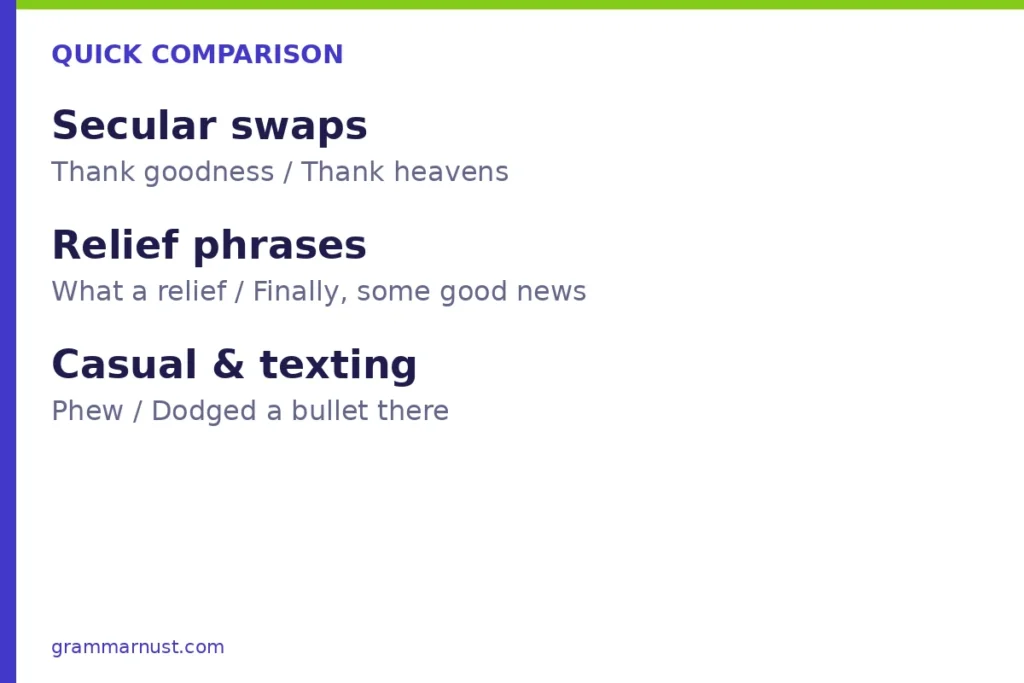
- Thank Goodness: A familiar, secular-friendly expression of relief.
- Thank Heavens: A traditional expression of gratitude and relief.
- Phew: A short, informal reaction after avoiding trouble.
- What a Relief: A natural way to describe the end of worry or uncertainty.
- Thank My Lucky Stars: An expression of gratitude for good fortune.
- Praise God: A faith-friendly expression of religious gratitude.
- I’m Glad It Worked Out: A natural response to a successful outcome.
- I’m Glad We Caught This Early: A calm expression suitable for workplace situations.
These thank god synonym phrases are useful because they do more than replace individual words. They let you communicate the specific emotion behind your reaction, whether that is relief, happiness, luck, or faith.
Classic Relief Phrases Anyone Can Use
If you’re looking for other ways to say thank goodness, these classic expressions are a good starting point. They include familiar thank goodness synonyms that communicate relief without requiring a direct religious reference. Another way to say thank goodness may be more suitable when you want to sound natural in everyday conversations or communicate with people from different backgrounds.
1. Thank Goodness
Tone and use: “Thank goodness” is one of the closest and most natural alternatives to “thank God.” It communicates happiness and relief when something positive happens or a worrying situation ends well. Although it has a similar traditional construction, it generally sounds less explicitly religious and works in many everyday situations.
For a dictionary explanation of this expression, see the Cambridge Dictionary entry for “thank goodness”.
Example: “Thank goodness the mechanic found the problem before we left for our road trip.”
2. Thank Heavens
Tone and use: This is a traditional expression that communicates gratitude when something turns out well. It sounds slightly more expressive or old-fashioned than “thank goodness,” making it suitable for conversations where you want to emphasize how fortunate the outcome feels. It is common in spoken English and informal writing.
Example: “Thank heavens everyone arrived home safely after the storm.”
3. Phew
Tone and use: “Phew” is a short exclamation used when tension disappears after a stressful or uncertain moment. It is especially appropriate when you have narrowly avoided a problem. Unlike a full sentence, this expression communicates your emotional reaction immediately, making it particularly useful in casual conversations and text messages.
Example: “Phew! I thought I had deleted the entire presentation, but I found the backup.”
4. What a Relief
Tone and use: This expression directly communicates that a stressful situation has ended or improved. It works in personal conversations, workplace discussions, and written messages because it focuses on the positive emotional result rather than religious gratitude. You can naturally expand it with expressions such as “That’s a huge relief,” “That’s a relief to hear,” or “I’m so relieved.” These are variations of the same relief expression, not separate alternatives.
Example: “What a relief! The doctor confirmed that the test results were normal.”
5. Thankfully
Tone and use: “Thankfully” is an adverb that introduces a positive outcome after a situation involving uncertainty, difficulty, or potential trouble. It is especially useful in professional writing, storytelling, reports, and everyday conversations. Unlike a short exclamation, it fits naturally into a complete sentence and helps explain how events turned out well.
Example: “Thankfully, the delivery arrived before the store closed.”
6. I’m Grateful for That
Tone and use: This expression emphasizes sincere appreciation for a positive outcome, helpful circumstance, or fortunate event. It sounds thoughtful and slightly more personal than “thank goodness.” Use it when you want to communicate genuine gratitude rather than simply reacting to good news. It works in both casual and respectful conversations.
Example: “I’m grateful for that extra time because it allowed me to finish everything properly.”
7. That Was Close
Tone and use: “That was close” is a familiar expression used after narrowly avoiding an accident, mistake, missed opportunity, or other undesirable situation. It communicates relief without directly mentioning gratitude. The phrase is especially natural when something almost went wrong but ultimately turned out fine.
Example: “That was close! We almost missed the last train home.”
Luck and Fortune Phrases
Sometimes, the best response to a positive outcome is to acknowledge how lucky you were. These alternatives emphasize fortune, favorable timing, or an unexpected opportunity. If you’re searching for thank heavens synonyms, this group offers several options that communicate good fortune without necessarily expressing religious gratitude.
8. Thank My Lucky Stars
Tone and use: This traditional idiom means feeling grateful or fortunate because something good happened. It is especially appropriate when you narrowly avoid trouble or receive an unexpected opportunity. The phrase is more expressive than a simple “thank goodness” and is generally used in casual or conversational English.
Example: “I thank my lucky stars that I checked my passport before leaving for the airport.”
9. Luckily
Tone and use: “Luckily” is a conversational adverb that describes a favorable result, especially when something could have gone wrong. It is shorter and more straightforward than many traditional expressions. Use it when explaining how a situation worked out in your favor without making the sentence sound overly emotional.
Example: “Luckily, I had saved another copy of the document on my computer.”
10. Fortunately
Tone and use: “Fortunately” communicates that circumstances turned out favorably despite possible difficulties. It is a slightly more formal alternative to “luckily” and works especially well in professional conversations, reports, emails, and explanatory writing. It emphasizes the positive outcome rather than the emotional reaction.
Example: “Fortunately, the company resolved the payment issue before the scheduled deadline.”
11. By a Stroke of Luck
Tone and use: This expression describes an unexpectedly fortunate event that helps prevent a problem or creates a positive opportunity. It is more descriptive than a simple exclamation and works particularly well when telling a story about an unexpected coincidence. It can also add personality to casual written communication.
Example: “By a stroke of luck, we found an available hotel room just before the festival began.”
12. We Got Lucky
Tone and use: This is a relaxed, conversational expression that acknowledges a favorable result. It is particularly useful when several people benefit from an unexpected opportunity or narrowly avoid an unpleasant situation. The wording is direct and friendly, making it suitable for conversations with friends, relatives, and familiar coworkers.
Example: “We got lucky because the rain stopped just before the outdoor ceremony started.”
Faith-Friendly Alternatives
Some speakers prefer religious expressions because they want to acknowledge their faith rather than simply describe a fortunate event. These alternatives preserve that spiritual meaning while providing different ways to express gratitude. If you’re searching for other ways to say thank you God, consider whether you want a conversational expression, a statement of praise, or a direct prayer.
For example, another way to say thank God for life in a personal prayer could be, “Thank You, God, for the gift of life and another opportunity to begin again.” The following expressions are suitable for speakers who are comfortable using religious language. Choose wording that reflects your own beliefs and the audience you are addressing.
13. Praise God
Tone and use: “Praise God” is a direct expression of religious appreciation and happiness. People commonly use it when receiving good news, experiencing a positive change, or celebrating an important personal event. It carries a stronger faith-based meaning than secular alternatives and is most appropriate when religious language fits the conversation.
Example: “Praise God, my brother has recovered and is finally coming home.”
14. God Is Good
Tone and use: This expression communicates appreciation for a positive experience through a statement of faith. It is often used when something meaningful happens after a difficult period. The phrase sounds warm, sincere, and personal, making it suitable for conversations with family, friends, or people who share similar religious beliefs.
Example: “God is good; after months of searching, I finally found the right opportunity.”
15. Thank You, Lord
Tone and use: This is a direct expression of gratitude addressed to God. It is particularly appropriate in prayer, personal reflection, and religious conversations. Compared with the everyday exclamation “thank God,” this wording sounds more intentional and devotional because it directly addresses the Lord rather than simply reacting to a positive event.
Example: “Thank You, Lord, for protecting our family and bringing everyone home safely.”
16. What a Blessing
Tone and use: This expression recognizes a positive event as something meaningful, valuable, or spiritually significant. It is suitable when discussing good health, family, unexpected opportunities, or a difficult situation that has improved. Although it can be used in everyday English, it often carries a gentle religious or spiritual feeling.
Example: “What a blessing to have my entire family together for the holidays.”
17. By God’s Grace
Tone and use: This phrase acknowledges a favorable outcome as something made possible through divine grace. It is particularly appropriate when discussing recovery, personal achievements, overcoming challenges, or reaching an important milestone. It sounds more reflective and faith-centered than casual expressions of relief.
Example: “By God’s grace, we overcame the difficult circumstances and completed the project successfully.”
Glad It Worked Out: Outcome Phrases
Some situations call for an expression that focuses on the final result rather than the emotion behind it. These alternatives are especially useful when discussing plans, repairs, examination results, travel arrangements, and personal challenges that ended positively.
They also work when responding to someone else’s experience. If you want to follow up with a person after an event or difficult situation, you can use a natural question such as those explained in our guide to other ways to say “How Did It Go?”.
18. I’m Glad It Worked Out
Tone and use: This is a warm, natural expression that communicates happiness when a situation reaches a successful conclusion. It is appropriate for both personal and professional conversations because it focuses on the outcome rather than religious beliefs. Use it when someone shares good news about a challenge, plan, or important decision.
Example: “I’m glad it worked out after all the problems you experienced during the moving process.”
19. It All Came Together
Tone and use: This phrase describes a situation in which different efforts, plans, or circumstances eventually produce a successful result. It is especially useful when something initially seemed uncertain or difficult. The expression communicates satisfaction with the outcome and recognizes that things eventually worked in the right direction.
Example: “It all came together just in time for the company’s annual presentation.”
20. We Made It Through
Tone and use: “We made it through” communicates relief and appreciation after successfully overcoming a challenging experience. It is particularly suitable for situations involving stress, difficult projects, unexpected changes, or personal hardships. The phrase emphasizes perseverance and the fact that the difficult period is finally behind you.
Example: “We made it through the busiest week of the year without missing a single deadline.”
21. It Turned Out Better Than Expected
Tone and use: This expression is useful when the final result is more positive than you originally anticipated. It works in conversations about plans, repairs, interviews, events, and unexpected changes. Rather than simply celebrating good news, it highlights the difference between your initial expectations and the successful result.
Example: “The renovation turned out better than expected, even though we had several unexpected delays.”
Workplace-Safe and Professional Alternatives
Knowing how to say thank god professionally can help you communicate relief without making your message sound overly casual or introducing religious language into a mixed workplace. Professional alternatives should be clear, respectful, and appropriate for meetings, emails, business conversations, and communication with clients.
Instead of relying on emotional exclamations, choose phrases that acknowledge a favorable outcome, recognize useful information, or communicate satisfaction with a successful resolution. The following options work particularly well when speaking with colleagues, managers, customers, or business partners.
22. I’m Glad We Caught This Early
Tone and use: This expression communicates appreciation when a potential problem is identified before it becomes more serious. It is useful in project management, quality control, business operations, and team discussions. The wording sounds constructive because it acknowledges the positive result while emphasizing the importance of early action.
Example: “I’m glad we caught this early because we still have enough time to correct the issue before launch.”
23. I’m Pleased We Resolved It Before the Deadline
Tone and use: This is a polished alternative for situations where a task, issue, or complication has been successfully handled within the required timeframe. It communicates satisfaction without sounding overly emotional. Use it in professional emails, project updates, and conversations where completing work on schedule is important.
Example: “I’m pleased we resolved it before the deadline, so the client can receive the final report as scheduled.”
24. It’s Reassuring to Know We’re on Schedule
Tone and use: This expression communicates comfort after receiving confirmation that a plan is progressing as expected. It is especially useful when dealing with deadlines, project milestones, deliveries, and business arrangements. The wording sounds calm and professional while still showing that the positive update has removed some uncertainty.
Example: “It’s reassuring to know we’re on schedule despite the unexpected changes last week.”
25. I Appreciate the Confirmation
Tone and use: This phrase is appropriate when someone provides information that confirms a positive outcome. It expresses appreciation for the update rather than making a personal or religious exclamation. It works particularly well in formal emails, client correspondence, business discussions, and professional messages where a respectful tone is important.
Example: “I appreciate the confirmation that all the required documents have been approved.”
26. We Avoided Further Disruption
Tone and use: This is a calm, professional expression for situations where a potential complication has been prevented or contained. It is particularly useful in business operations, customer service, project management, and technical discussions. The wording acknowledges a favorable result without sounding overly emotional or informal.
Example: “The replacement equipment arrived this morning, so we avoided further disruption to the production schedule.”
Casual and Texting Alternatives
When texting friends or chatting with family, you can use shorter and more expressive alternatives. These thank god synonyms slang and informal expressions are useful when reacting quickly to good news, a close call, or an unexpected situation that turned out well.
Some of these phrases are idiomatic rather than direct synonyms. They communicate the same general feeling of relief or good fortune, but their meaning depends on the situation. They are best reserved for relaxed conversations rather than formal emails or professional messages.
27. Dodged a Bullet
Tone and use: This informal idiom describes narrowly avoiding a serious problem, unpleasant experience, or unwanted consequence. It is particularly useful after a close call when you realize that a situation could have been much worse. The phrase is expressive and conversational, making it popular in casual discussions and text messages.
Example: “I definitely dodged a bullet by checking the contract before signing it.”
28. Crisis Averted
Tone and use: This short expression communicates that a potentially difficult situation has been successfully prevented or resolved. It can sound humorous, dramatic, or casually reassuring depending on the context. It is especially effective in texts when you want to tell someone that a problem has been handled and there is no longer anything to worry about.
Example: “Crisis averted! I found the missing keys right before we had to leave.”
29. We’re in the Clear
Tone and use: This expression means that a problem, risk, or difficult situation has passed. It is friendly and informal, making it useful when communicating with people who already understand the situation. It can also be used after receiving confirmation that everything is safe, approved, or back to normal.
Example: “We’re in the clear now that the payment has gone through successfully.”
30. Saved by the Bell
Tone and use: This familiar idiom describes being rescued from an uncomfortable or difficult situation by a timely event or interruption. It often has a humorous tone and is especially suitable for casual conversations. Use it when something unexpected happens at exactly the right moment and helps you avoid an unwanted outcome.
Example: “I was about to miss the deadline, but the manager extended it by one day, so I was saved by the bell.”
Which One Should You Use? A Quick Guide
The best expression depends on what happened, how you feel about the outcome, and who is listening. A phrase that sounds perfectly natural in a conversation with a friend may feel too informal in a business email. Similarly, a religious expression may be meaningful in one setting but unnecessary in another.
Use this comparison table to choose an appropriate expression for common situations.
| Situation | Best Phrase | Why It Works |
|---|---|---|
| Good news at work | I’m pleased we resolved it before the deadline. | Professional and positive without sounding overly emotional. |
| A close call | Phew! | Short, natural, and clearly communicates immediate relief. |
| Texting a friend | Crisis averted! | Informal, expressive, and easy to use in a quick message. |
| Speaking to a religious audience | Praise God. | Directly communicates faith-based gratitude. |
| A formal email | I appreciate the confirmation. | Polite, neutral, and suitable for professional correspondence. |
Here are a few additional considerations when selecting an expression:
- For immediate relief: Choose “Phew” or “What a Relief” when you have just discovered that something is okay.
- For unexpected good fortune: Use “Thank My Lucky Stars” or “By a Stroke of Luck” when circumstances unexpectedly work in your favor.
- For sincere religious gratitude: Choose “Praise God,” “Thank You, Lord,” or “By God’s Grace” when you want to acknowledge your faith.
- For professional communication: Use “I’m pleased we resolved it” or “It’s reassuring to know we’re on schedule.”
- For informal messages: Choose “Crisis Averted,” “Dodged a Bullet,” or “We’re in the Clear.”
Remember that the closest synonym is not necessarily the best choice. A good alternative should communicate the same underlying feeling while matching the tone of your conversation.
Mistakes to Avoid When Using Alternatives to “Thank God”
Knowing different expressions is useful, but choosing the wrong one can sometimes create confusion or make your message sound unnatural. Keep these common mistakes in mind when deciding what to say instead of thank god.
1. Using Religious Language in Every Professional Email
Although “thank God” is familiar and commonly understood, it may not be the most suitable wording for formal workplace communication. A neutral expression is often safer when writing to clients, senior managers, new business contacts, or people whose religious preferences you do not know.
Instead of writing, “Thank God the issue has finally been resolved,” consider “I’m glad the issue has been resolved.” The second sentence communicates the positive result without introducing unnecessary religious language.
2. Thanking God When You Actually Mean to Thank a Person
One important distinction is the difference between expressing relief about an outcome and appreciating someone’s help. If a colleague worked hard to solve your problem, saying “Thank God” does not directly acknowledge that person’s effort.
In that situation, use a phrase that recognizes the individual. For more ideas, explore our guide to other ways to say “It Means a Lot to Me”. It can help you express personal appreciation more clearly and sincerely.
3. Using Slang in Professional Settings
Expressions such as “Dodged a Bullet,” “Crisis Averted,” and “Saved by the Bell” are perfectly natural in relaxed conversations. However, they may sound too informal in business correspondence, official reports, or conversations with unfamiliar clients.
Choose professional wording that describes the outcome clearly. For example, “We avoided further disruption” is generally more appropriate than “We dodged a bullet” in a formal project update.
4. Assuming Every Alternative Has Exactly the Same Meaning
Different expressions emphasize different emotions. “Fortunately” highlights favorable circumstances, “Phew” communicates immediate relief, and “Praise God” directly expresses religious gratitude. Replacing one phrase with another without considering its meaning can make a sentence sound unnatural.
Before choosing an alternative, think about what you actually want to communicate. Are you relieved, grateful, fortunate, or expressing faith? Selecting the right emotional meaning makes your communication more accurate.
5. Choosing an Expression That Does Not Match Your Audience
Not every listener will interpret religious, traditional, or slang expressions in the same way. For example, “Thank heavens” is widely understood as an everyday expression, but it still contains religious imagery. If you want completely neutral wording, “Thankfully” or “What a Relief” may be better choices.
Always consider the relationship, setting, and communication style before using an alternative. The goal is to sound natural and respectful, not simply to replace one expression with another.
Frequently Asked Questions
What can I say instead of “thank God” at work?
At work, you can say “I’m glad we resolved this,” “It’s reassuring to know we’re on schedule,” or “I appreciate the confirmation.” These expressions communicate relief and appreciation without introducing religious language. They are appropriate for professional meetings, workplace conversations, business emails, and communication with clients or colleagues.
Is “thank goodness” more polite than “thank God”?
“Thank goodness” is generally more neutral because it does not directly reference God. Both expressions are commonly understood and can be polite in everyday conversation. However, “thank goodness” may be a more comfortable choice in mixed-company settings, professional environments, or conversations where you want to avoid explicitly religious wording.
What is a secular way to say “thank God”?
Some natural secular alternatives include “Thank goodness,” “Phew,” “What a Relief,” “Thankfully,” and “Luckily.” These expressions communicate relief or gratitude without directly referring to a religious belief. Choose one based on the situation: “Phew” works for close calls, while “Thankfully” is especially useful in complete sentences and professional writing.
What does “thank my lucky stars” mean?
“Thank my lucky stars” is an idiom that means feeling grateful or fortunate because something good happened. People often use it after avoiding trouble, receiving unexpected help, or experiencing a favorable outcome. It is a figurative expression about good fortune rather than a literal reference to stars or astronomy.
Is it okay to say “thank God” to someone of a different faith?
Yes, saying “thank God” is not automatically inappropriate when speaking to someone of a different faith. Many people understand it as an everyday expression of relief. However, it is considerate to recognize that religious preferences vary. In professional or unfamiliar settings, neutral alternatives such as “Thank goodness” or “What a relief” can be more inclusive.
What can I text instead of “thank God”?
You can text “Thank goodness!”, “Phew!”, “Crisis averted!”, “We’re in the clear!”, or “We got lucky!” These expressions are short, friendly, and natural when reacting to good news or a close call. For a religious message, “Praise God!” is another option if that wording reflects your beliefs and the recipient is comfortable with it.
Conclusion
Choosing the right expression can make your conversations sound more natural, thoughtful, and appropriate for different situations. Whether you prefer classic phrases such as “thank goodness,” casual reactions such as “phew,” or faith-friendly expressions such as “Praise God,” there are plenty of alternatives available.
The best other ways to say thank god depend on your intended meaning and audience. Use secular expressions for neutral communication, professional phrases in workplace settings, and religious alternatives when expressing personal faith. By choosing words that match the situation, you can communicate relief, gratitude, and happiness without repeating the same expression every time.