30 Other Ways to Say “I’m Happy for You” (With Examples)
Quick answer: The warmest all-purpose alternative to “I’m happy for you” is “What wonderful news!” It sounds genuine, positive, and natural when someone shares an achievement, exciting milestone, engagement, graduation, or other good news.
Finding the right words can make someone’s special moment even more meaningful. Whether you’re searching for other ways to say im happy for you, other ways to say i’m happy for you, or simply a more personal response, the best expression depends on your relationship with the person and the occasion.
There are plenty of options beyond the usual phrase. Some happy for you synonym choices express excitement, while others communicate pride, admiration, encouragement, or heartfelt support. This guide explores happy for you synonyms in english, including professional expressions, casual texts, and thoughtful messages for important milestones. If you’re wondering what to say instead of i’m happy for you, these different ways to say i’m happy for you will help you choose words that feel natural rather than rehearsed.
What Does “I’m Happy for You” Mean?
“I’m happy for you” means that you feel pleased about another person’s success, good fortune, achievement, or positive experience. It communicates that their happiness matters to you, even when the event doesn’t directly involve you.
For example, when your friend gets a promotion, you might say you’re happy for them because you recognize their effort and appreciate how much the opportunity means. When someone announces an engagement, the expression communicates excitement about their relationship and future together.
People looking for an im happy for you synonym often want something that communicates more than basic happiness. The right alternative can highlight a particular emotion or acknowledge what the person accomplished.
Consider these differences:
- Congratulations: Recognizes an achievement or important milestone.
- I’m so proud of you: Communicates admiration for someone’s effort and progress.
- You deserve it: Suggests that the person has earned their success.
- What wonderful news: Expresses an immediate positive reaction.
- I love this for you: Communicates personal excitement and affection.
These are all other ways to say happy for you, but they don’t communicate exactly the same thing. Another way to say i am happy for you should reflect what the person has experienced and how you genuinely feel about it.
For a meaningful message, think about whether you want to celebrate the achievement, acknowledge the person’s hard work, or simply share their excitement. That small distinction makes your response feel more personal.
Is “I’m Happy for You” Professional or Polite to Say?
Yes. “I’m happy for you” is generally polite, friendly, and appropriate in professional conversations. You can use it when a coworker gets promoted, accepts a new position, completes an important project, or receives recognition for their work.
However, the expression can sometimes feel slightly casual in formal business communication. In those situations, a more specific congratulatory message may sound more polished.
For example:
- Casual workplace message: “I’m really happy for you. Congratulations on the promotion!”
- Professional email: “Congratulations on your well-deserved promotion. Wishing you continued success in your new role.”
- Message to a manager: “It’s wonderful to hear about your new position. Congratulations on this achievement.”
- Message to a colleague: “Kudos to you for such a fantastic accomplishment.”
The key is to match your language to the relationship. A friendly coworker may appreciate a warm, conversational message, while a senior executive or professional contact may prefer a more formal expression.
Quick Top Picks: The 8 Best Alternatives at a Glance
If you need a quick response, these eight expressions cover different situations without sounding repetitive. Each one communicates genuine positivity while emphasizing a slightly different feeling.
- “Congratulations!” — A classic choice for achievements and milestones.
- “Thrilled for you!” — Perfect for sharing someone’s excitement.
- “I’m so proud of you!” — Best when you want to recognize someone’s effort.
- “You deserve it!” — Ideal for someone who has worked hard for success.
- “What wonderful news!” — A natural reaction to almost any positive announcement.
- “My heart is so full hearing your news.” — A heartfelt option for someone close to you.
- “Way to go!” — A short, upbeat expression for casual conversations.
- “Congratulations on the well-earned promotion.” — A polished workplace expression.
Keep these choices in mind as you explore the complete list. The following 35 alternatives are organized by purpose, making it easier to find a phrase that fits the moment.
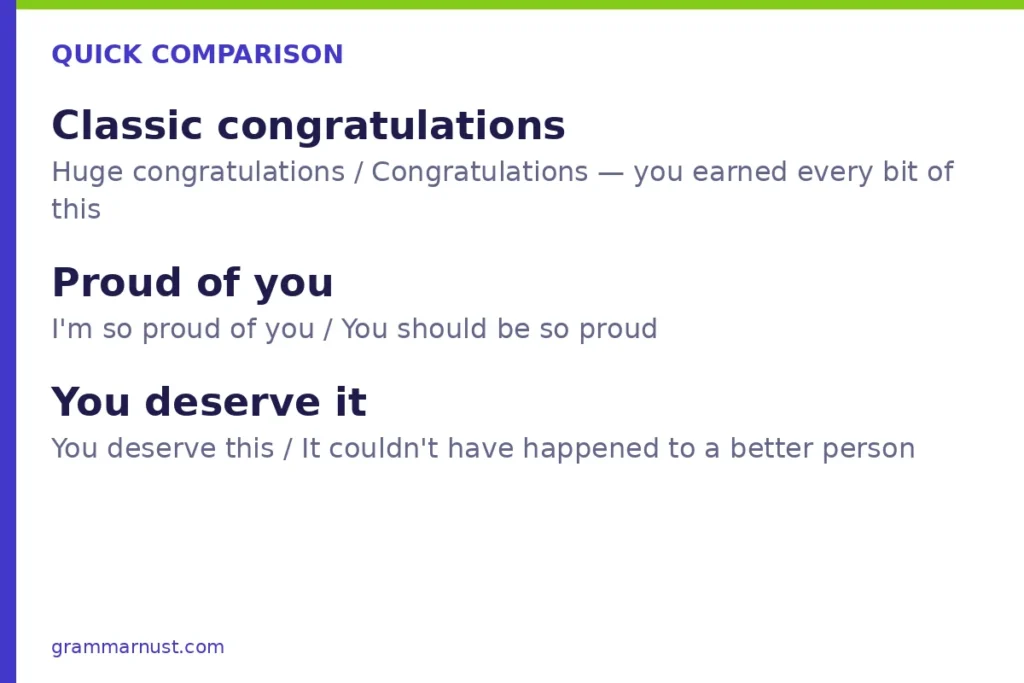
Classic Congratulations
Sometimes the simplest expression is the most effective. Traditional congratulations work well for professional achievements, academic milestones, engagements, anniversaries, and other occasions worth celebrating. These phrases communicate recognition without requiring an elaborate message.
The word “congratulations” itself refers to an expression of pleasure or recognition in response to someone’s good fortune or achievement. You can explore its definition in the Merriam-Webster dictionary.
1. Congratulations!
Tone: Classic, sincere, and versatile.
This is one of the easiest alternatives because it works in almost any celebratory situation. Whether someone graduates, gets married, earns a promotion, or reaches a personal goal, a simple congratulations acknowledges the importance of their moment.
Example: “Congratulations! You worked so hard to finish your degree, and I’m glad to see your efforts pay off.”
2. Many Congratulations!
Tone: Warm, enthusiastic, and slightly formal.
This expression adds a little more emphasis than a simple congratulations. It works particularly well in greeting cards, emails, and thoughtful messages for significant milestones. It’s also suitable when congratulating someone you know professionally but want to address warmly.
Example: “Many congratulations on your engagement! Wishing you both a beautiful future together.”
3. Hats Off to You!
Tone: Appreciative and admiring.
“Hats off to you” recognizes someone’s accomplishment while showing respect for the effort behind it. It’s particularly effective when a person has overcome difficulties, completed a demanding project, or achieved something that deserves recognition.
Example: “Hats off to you for finishing that marathon. Your dedication throughout the training was incredible.”
4. Kudos to You!
Tone: Positive, confident, and professional-friendly.
“Kudos to you” is a great choice when someone deserves recognition for doing something particularly well. It works in workplace conversations, team celebrations, and friendly messages. Unlike a generic expression of happiness, it specifically acknowledges the person’s contribution.
Example: “Kudos to you for managing such a successful product launch. Your leadership made a real difference.”
5. Here’s to Your Success!
Tone: Celebratory and encouraging.
This phrase sounds especially natural in a toast, celebration, or message marking the beginning of an exciting new chapter. It acknowledges what someone has accomplished while expressing optimism about what comes next.
Example: “Here’s to your success and all the exciting opportunities waiting for you in your new career!”
6. So Excited to See You Two Begin This Next Chapter!
Tone: Romantic, affectionate, and celebratory.
This expression is particularly appropriate when someone announces an engagement or wedding. Rather than offering a generic congratulatory response, it acknowledges the couple’s relationship and the new chapter they’re entering together.
Example: “So excited to see you two begin this next chapter! Your engagement is wonderful news, and I can’t wait to celebrate with you.”
If you’re also preparing a special message for a couple celebrating their relationship, explore these other ways to say happy wedding anniversary for more thoughtful expressions.
Big-Feeling Lines
When someone shares life-changing news, an ordinary response might not capture how exciting the moment feels. If you’re searching for other ways to say i’m so happy for you, other ways to say so happy for you, or so happy for you synonyms, these expressions communicate stronger enthusiasm. They’re also useful when exploring other ways to say i’m excited for you or finding an excited for you synonym that sounds more personal.
These alternatives focus on sharing someone’s excitement rather than simply acknowledging an achievement. Use them when the news genuinely makes you smile or when you want your response to match the person’s enthusiasm.
7. Thrilled for You!
Tone: Highly enthusiastic and genuinely excited.
This is a stronger expression than ordinary congratulations. It’s ideal for major announcements, such as a dream job, a long-awaited opportunity, or an exciting personal milestone. It communicates that you’re sharing the person’s excitement.
Example: “Thrilled for you! I know how much you’ve wanted this opportunity, and I’m so glad it finally worked out.”
8. I Can’t Stop Smiling About This!
Tone: Personal, expressive, and heartfelt.
This phrase communicates genuine excitement through a personal reaction. It’s especially effective when you’re close to the person and want them to know their news has made your day better, too.
Example: “I can’t stop smiling about this! You finally got accepted into your dream university, and that’s absolutely amazing.”
9. This Is Such Fantastic News!
Tone: Energetic, positive, and conversational.
Use this expression when you want to react immediately to an exciting announcement. It puts the focus on the news itself and works well in texts, phone conversations, emails, and face-to-face interactions.
Example: “This is such fantastic news! Getting your first book published is a huge achievement.”
10. I’m Celebrating Right Along With You!
Tone: Supportive, enthusiastic, and inclusive.
This expression makes someone feel that their milestone matters to you. It is especially useful when you cannot attend their celebration but still want to communicate that you’re emotionally involved in the moment.
Example: “I’m celebrating right along with you! I wish I could be there tonight, but I’ll definitely raise a glass in your honor.”
Proud-of-You Lines
Sometimes the best response focuses less on the good news and more on the person’s journey. When someone has worked hard, overcome challenges, or spent years pursuing a goal, expressing pride can make your message especially meaningful.
These alternatives are particularly appropriate for family members, close friends, students, and people whose progress you’ve witnessed firsthand.
11. I’m So Proud of You!
Tone: Deeply supportive and affectionate.
This phrase is one of the most meaningful ways to recognize someone’s achievement. It communicates admiration for their determination, effort, and personal growth. It’s particularly appropriate when you’ve seen how much they have sacrificed to reach their goal.
Example: “I’m so proud of you! You kept working toward your degree even when things got difficult, and you finally made it.”
12. I Knew You Could Do It!
Tone: Encouraging, familiar, and reassuring.
This expression is ideal when someone has finally accomplished something they previously doubted they could achieve. It reminds them that you believed in their abilities, even when they struggled with confidence.
Example: “I knew you could do it! You’ve prepared for this exam for months, and your hard work finally paid off.”
13. You Made It to Graduation—Every Late Night Paid Off!
Tone: Proud, personal, and celebratory.
This occasion-specific expression works beautifully for someone graduating from high school, college, or another educational program. Instead of offering a generic congratulatory message, it recognizes the effort that went into reaching the finish line.
Example: “You made it to graduation—every late night paid off! I hope you take a moment to appreciate everything you’ve accomplished.”
14. Watching You Reach This Goal Has Been Amazing.
Tone: Thoughtful, personal, and appreciative.
This is a wonderful choice when you have witnessed someone’s progress over time. It acknowledges the journey instead of focusing only on the final achievement. Use it for a friend, sibling, partner, or anyone whose determination you genuinely admire.
Example: “Watching you reach this goal has been amazing. I remember when you first started working toward it, and seeing you succeed makes me incredibly proud.”
You-Deserve-It Lines
When someone has worked hard for an opportunity, it can be especially meaningful to remind them that their success is earned. These expressions recognize dedication, persistence, talent, and the effort behind a positive outcome.
They’re particularly useful for promotions, career achievements, awards, business milestones, and personal goals that required considerable patience.
15. You Deserve It!
Tone: Warm, affirming, and straightforward.
This phrase tells someone that their success is appropriate and deserved. It’s a natural response when a person has spent a long time working toward a goal or finally receives recognition for their contributions.
Example: “You deserve it! Nobody has worked harder for that promotion, and I’m glad your efforts are being recognized.”
16. Well Deserved!
Tone: Concise, confident, and appreciative.
“Well deserved” is a short but meaningful expression. It works especially well in professional emails, social media comments, and congratulatory messages. It communicates that the person’s achievement is a fair reward for their effort.
Example: “Well deserved! Your dedication to the team has been impressive, and this recognition couldn’t come at a better time.”
17. You Earned Every Bit of This.
Tone: Sincere, respectful, and encouraging.
Use this expression when you want to emphasize that someone’s achievement came through their own work. It’s especially meaningful for people who have faced setbacks or spent considerable time developing their skills.
Example: “You earned every bit of this opportunity. You’ve put in the work, stayed focused, and never stopped improving.”
18. It Couldn’t Have Happened to a Better Person.
Tone: Affectionate, complimentary, and personal.
This phrase goes beyond recognizing an achievement. It expresses appreciation for the person’s character and suggests that their positive outcome feels particularly fitting because of who they are.
Example: “It couldn’t have happened to a better person. You have always supported everyone around you, and I’m delighted to see something wonderful happen for you.”
19. All That Hard Work Paid Off.
Tone: Encouraging, realistic, and appreciative.
This is an excellent choice when you know someone has invested significant time and energy into reaching a goal. It acknowledges the connection between their effort and the positive result without sounding overly formal.
Example: “All that hard work paid off! You’ve spent months building your business, and seeing it grow must feel incredible.”
Good-News Reactions
Sometimes you don’t need an elaborate congratulatory message. A natural reaction to someone’s announcement can communicate excitement just as effectively. These expressions are useful when responding to unexpected good news, personal milestones, exciting opportunities, or announcements you weren’t expecting.
20. What Wonderful News!
Tone: Warm, genuine, and universally appropriate.
This expression is one of the safest alternatives for almost any positive announcement. It works whether someone has found a new job, passed an exam, purchased a home, or received an exciting opportunity. It’s particularly useful when you want to sound enthusiastic without overdoing it.
Example: “What wonderful news! I’m so glad your application was accepted, and I hope you enjoy every moment of this opportunity.”
21. I Love This for You!
Tone: Friendly, affectionate, and conversational.
This popular expression communicates excitement while making the other person’s experience feel special. It’s especially natural among friends and family members. It works best when you already have a comfortable relationship with the person.
Example: “I love this for you! Moving to your dream city is such an exciting step, and I know you’re going to enjoy it.”
22. Good for You!
Tone: Casual, approving, and encouraging when delivered warmly.
“Good for you!” can be a simple way to recognize someone’s success. It works well in everyday conversations, particularly when the person has accomplished something they have been working toward. However, your delivery matters because the same words can sometimes sound sarcastic.
Example: “Good for you! You finally signed up for the photography course you’ve been talking about, and I hope you love it.”
23. This Calls for a Celebration!
Tone: Festive, enthusiastic, and inviting.
Use this expression when someone’s news is worth celebrating together. It doesn’t just acknowledge the achievement; it also suggests making time to enjoy the moment. It’s particularly effective for birthdays, engagements, promotions, and major personal milestones.
Example: “This calls for a celebration! Getting your first major client is a huge milestone for your business.”
24. Your New Baby Is Already Bringing So Much Joy!
Tone: Tender, affectionate, and family-oriented.
This is a thoughtful alternative when someone announces the arrival of a baby. It focuses on the happiness surrounding the growing family rather than using a generic congratulatory response. You can make it even more personal by mentioning the baby’s name if the parents have shared it.
Example: “Your new baby is already bringing so much joy! Congratulations to you both, and wishing your growing family plenty of beautiful memories together.”
Warm and Heartfelt Lines
When someone close to you shares important news, a thoughtful response can mean more than an enthusiastic reaction. These alternatives work well when you want to communicate affection, emotional connection, and genuine appreciation.
They are especially suitable for close friends, siblings, partners, and family members experiencing meaningful life changes.
25. My Heart Is So Full Hearing Your News.
Tone: Deeply affectionate and emotional.
This expression is ideal for moments that feel especially meaningful, such as a loved one’s engagement, personal achievement, or long-awaited success. It communicates that their happiness has touched you personally.
Example: “My heart is so full hearing your news. After everything you’ve been through, seeing you finally find this kind of happiness means so much.”
26. Welcome to the World, Little One!
Tone: Sweet, loving, and celebratory.
This phrase is especially appropriate when congratulating new parents. It welcomes the baby while celebrating the family’s new chapter. You can follow it with a personal message about wishing the parents health, happiness, and beautiful memories together.
Example: “Welcome to the world, little one! Sending so much love to your family and wishing you all countless precious moments together.”
27. I’m Grateful You Shared This Moment With Me.
Tone: Personal, appreciative, and sincere.
This is a lovely response when someone chooses to share their exciting news with you personally. It acknowledges the trust and connection between you while showing that their milestone matters to you.
Example: “I’m grateful you shared this moment with me. Watching you achieve something you’ve wanted for so long is truly special.”
28. Your Good News Means a Lot to Me.
Tone: Gentle, heartfelt, and emotionally connected.
This expression is useful when you want to explain that someone’s happiness genuinely matters to you. It works particularly well in a personal note, thoughtful text, or conversation with someone you care about.
Example: “Your good news means a lot to me. Thank you for letting me be part of such a special moment in your life.”
If you want more ways to communicate how meaningful someone’s actions or news are, explore these other ways to say it means a lot to me for additional heartfelt expressions.
Playful, Casual and Short Texts
If you’re searching for happy for you synonyms slang or short, informal messages, you probably don’t need a long congratulatory paragraph. A quick, energetic response can feel more natural between close friends, siblings, and people who regularly communicate through text.
These options are playful without being dismissive. They’re especially useful for group chats, social media comments, and everyday conversations where a little personality makes the message more memorable.
29. Way to Go!
Tone: Upbeat, friendly, and encouraging.
This classic expression is short enough for a text message but still communicates genuine recognition. It works for both small accomplishments and major milestones, particularly when you want to sound enthusiastic without writing a lengthy response.
Example: “Way to go! You finally completed that challenging certification. Time to celebrate!”
30. Look at You Go!
Tone: Playful, affectionate, and enthusiastic.
This phrase adds personality to your congratulations. It’s a fun way to acknowledge someone’s progress or unexpected success, especially when you’re speaking to someone you know well.
Example: “Look at you go! First the promotion, and now your own office. You’re making some serious moves!”
31. You Did the Thing!
Tone: Funny, informal, and celebratory.
This playful expression works when someone finally completes something they’ve been discussing or working toward for a long time. It sounds especially natural between friends who understand the effort behind the accomplishment.
Example: “You did the thing! You finally launched your online store, and I couldn’t be more excited to see where it goes.”
32. Yesss! You Nailed It!
Tone: Energetic, casual, and enthusiastic.
This is an excellent response to an achievement that deserves an immediate burst of excitement. It’s suitable for texts, social media comments, and conversations with close friends. The extra letters in “Yesss” make the message feel more expressive and playful.
Example: “Yesss! You nailed it! I knew your presentation would impress everyone in the room.”
Professional and Workplace Lines
When considering how to say i’m happy for you professionally, focus on expressions that recognize someone’s achievement while maintaining a respectful workplace tone. A good professional message should be positive, specific, and appropriate for your relationship with the recipient.
For a coworker’s promotion, a new job, or a career milestone, avoid language that sounds overly familiar unless you already have a friendly relationship. The following alternatives work well in business emails, LinkedIn comments, team chats, and professional conversations.
33. Congratulations on the Well-Earned Promotion.
Tone: Professional, respectful, and appreciative.
This is an excellent way to congratulate a colleague who has received a promotion. The phrase acknowledges that their new position reflects their contributions and effort. It’s appropriate for workplace emails, messages to managers, and professional networking conversations.
Example: “Congratulations on the well-earned promotion. Your commitment and leadership have made a meaningful contribution to the team, and I wish you continued success.”
34. It’s Wonderful to Hear About Your New Role.
Tone: Polished, friendly, and professional.
This expression is particularly useful when a coworker or professional contact announces a new job. It sounds positive without being overly casual and gives you an opportunity to acknowledge their career development.
Example: “It’s wonderful to hear about your new role. Congratulations on this exciting career move, and I hope your new position brings many opportunities for growth.”
35. Wishing You Continued Success in Your New Position.
Tone: Formal, courteous, and encouraging.
This is a suitable option for professional emails, farewell messages, and communications with someone moving to another organization or department. It acknowledges the person’s new opportunity while expressing positive wishes for their future career.
Example: “Congratulations on your new position. Wishing you continued success as you take on this exciting opportunity and begin the next stage of your professional journey.”
Which One Should You Use? A Quick Guide
The best alternative depends on the occasion, your relationship with the person, and the kind of message you want to communicate. A close friend may appreciate a playful response, while a coworker might prefer something more polished.
Use this guide to choose an appropriate expression for five common situations.
| Situation | Best Line | Why |
|---|---|---|
| Friend’s promotion | “You deserve it!” | It recognizes the effort behind the achievement and makes your friend feel appreciated. You can add a personal sentence about how hard they worked to reach this milestone. |
| Engagement or wedding | “So excited to see you two begin this next chapter!” | It acknowledges the couple’s relationship and expresses enthusiasm about their future together. It’s especially suitable for an engagement announcement or wedding congratulations. |
| New baby | “Welcome to the world, little one!” | It’s warm and personal, and it welcomes the newest member of the family. Add a thoughtful wish for the parents to make your message even more meaningful. |
| Graduation or passed exam | “You made it to graduation—every late night paid off!” | It recognizes the time, preparation, and determination behind the achievement instead of simply acknowledging the final result. |
| Coworker’s new job | “It’s wonderful to hear about your new role.” | It sounds professional and friendly without being overly personal. You can follow it with a sentence wishing them success in their new position. |
Remember that the relationship matters just as much as the occasion. A message to your best friend can be expressive and playful, while a note to a professional contact should generally be more measured.
Mistakes to Avoid When Congratulating Someone
Even a positive expression can sound awkward if you use it in the wrong context. The goal isn’t simply to find a different phrase. It’s to communicate your feelings in a way that makes the other person feel recognized and appreciated.
Here are four common mistakes to avoid.
Rotating Adjectives Until Your Message Sounds Copied
Replacing one emotion word with another doesn’t necessarily make your message more meaningful. A string of similar expressions can sound as though you selected a phrase from a thesaurus rather than responding naturally.
For example, repeatedly switching between “thrilled,” “delighted,” “ecstatic,” and “overjoyed” without adding personal meaning can make your message feel repetitive.
Better approach: Choose one expression that reflects your actual reaction and add a specific detail about the person’s achievement.
Instead of simply saying, “Thrilled for you!” try: “Thrilled for you! I remember how many interviews you went through before finding the right opportunity.”
Saying “Good for You!” in a Flat or Sarcastic Tone
“Good for you!” can communicate genuine encouragement, but the delivery makes a difference. If you say it without warmth or enthusiasm, the person may interpret it as sarcasm, indifference, or even resentment.
Better approach: Add a personal detail or an enthusiastic follow-up to make your intention clear.
For example, “Good for you! I know you’ve been working toward this for months, and I’m glad it finally happened.”
Making the Moment About Yourself
When someone shares exciting news, avoid immediately shifting the conversation toward your own experiences. Even if you’ve accomplished something similar, this is their moment to celebrate.
For example, responding to someone’s promotion with “That’s great! I got promoted last year, too” can unintentionally take attention away from their achievement.
Better approach: Focus on their news first. Ask questions, acknowledge their effort, and give them space to enjoy the moment. You can share your own experience later if it naturally fits the conversation.
Using “Charmed for You” Instead of a Natural Expression
Be careful with expressions that sound similar but communicate a different meaning. “Charmed for you” is not a natural English expression for celebrating someone’s success. Being “charmed by you” describes being impressed, attracted, or won over by someone, rather than sharing their happiness about an achievement.
Better approach: Use a clear expression such as “Thrilled for you!” or “What wonderful news!” when you want to celebrate someone’s positive experience.
The simplest rule is to choose words that sound natural when spoken aloud. If a phrase feels forced, a straightforward congratulations is usually better.
Frequently Asked Questions
What can I say instead of “I’m happy for you” when someone gets promoted?
You can say “You deserve it!”, “Well deserved!”, or “Congratulations on the well-earned promotion.” These expressions recognize the person’s professional achievement while acknowledging their hard work. For a close friend, “I knew you could do it!” is another warm option. For a manager or colleague, choose a more polished expression that recognizes their contributions.
How do I say “I’m happy for you” professionally, to a coworker?
Use a respectful and specific expression such as “Congratulations on your achievement,” “It’s wonderful to hear about your new role,” or “Wishing you continued success in your position.” You can also mention a quality or contribution that makes the achievement meaningful. Keep the message friendly, concise, and appropriate for your workplace relationship.
What should I text a friend who just got engaged or had a baby?
For an engagement, try “So excited to see you two begin this next chapter! Wishing you a lifetime of love and happiness.” For a new baby, you could write “Welcome to the world, little one! Sending so much love to your growing family.” Adding the couple’s names or the baby’s name makes your text feel more personal and thoughtful.
Is “good for you” always sincere, or can it sound sarcastic?
“Good for you” can be completely sincere, but its meaning depends on your tone, facial expression, and context. Said warmly, it communicates encouragement and approval. Delivered flatly or with an exaggerated tone, it can sound sarcastic or dismissive. If you’re unsure how the person will interpret it, choose a clearer expression such as “That’s wonderful news!”
How do I make “I’m happy for you” sound genuine, not flat?
Make your message more personal by mentioning something specific about the person’s achievement. Instead of offering a generic response, acknowledge their effort, excitement, or journey. For example, “I’m so proud of you! I remember how much work you put into preparing for this opportunity.” A sincere detail often makes a simple congratulatory message much more meaningful.
What are short ways to say “I’m happy for you” in a text message?
Some short options include “Way to go!”, “You deserve it!”, “Thrilled for you!”, “Look at you go!”, “What wonderful news!”, and “Yesss! You nailed it!” Choose a phrase that matches your relationship with the recipient. For a coworker, “Congratulations!” is a safe option, while close friends may appreciate something more playful.
Conclusion
Finding the right words to celebrate someone’s success doesn’t have to be difficult. The best expression depends on the occasion, your relationship, and the emotion you want to communicate. Sometimes a simple “Congratulations!” is perfect, while other moments call for something more personal, playful, or heartfelt.
These 35 alternatives give you plenty of options for promotions, engagements, new babies, graduations, and everyday achievements. When choosing other ways to say im happy for you, focus on sincerity rather than complicated vocabulary. A thoughtful message that recognizes someone’s effort and shares their excitement will always feel more meaningful than a phrase chosen simply to sound different.
Most importantly, celebrate the person, acknowledge their moment, and let your words reflect how genuinely pleased you are for them.