30 Other Ways to Say “Did You Know” (With Examples)
Quick Answer: The most natural all-purpose replacement for “Did You Know?” is “Here’s something interesting,” because it introduces useful or surprising information in a friendly, conversational way without sounding overly formal.
If you are looking for a did you know synonym, another way to say did you know, or what to say instead of did you know, the best expression depends on your audience and purpose. A good did you know alternative phrase should create curiosity, introduce information naturally, and encourage the reader or listener to pay attention.
Whether you are writing a professional email, creating a social media caption, preparing a classroom lesson, or starting an interesting conversation, changing your opening words can make your message more engaging. This guide explores 35 unique alternatives, including classic fact-introducers, curiosity questions, professional openers, educational phrases, and casual conversation starters.
Each expression includes a short explanation of its tone, guidance on when to use it, and a natural example sentence. You will also find practical suggestions for choosing the right opener without sounding repetitive or using a phrase that does not fit your situation.
What Does “Did You Know” Mean?
The did you know meaning is straightforward: it is a question used to introduce information that someone might not already know. People commonly use it before sharing an interesting fact, surprising discovery, useful detail, or piece of trivia.
For example, someone might say, “Did you know that the human body has 206 bones in adulthood?” The question creates curiosity before presenting the information. Rather than simply stating a fact, the speaker invites the listener to become interested in what comes next.
A fact is information presented as true or accurate. You can explore the definition through Merriam-Webster’s definition of fact.
People use phrases like did you know in several situations:
- Everyday conversations: Sharing an interesting discovery with friends or family.
- Educational settings: Introducing a new subject or encouraging students to think about a topic.
- Social media: Starting a caption, trivia post, or short educational video.
- Blog articles: Presenting an unusual detail that makes readers want to continue.
- Professional communication: Drawing attention to useful information, findings, or relevant details.
Other words for did you know depend on the intended meaning. If you want to create curiosity, you might say “Have you ever wondered?” If you want to share an unexpected discovery, “Believe it or not” may work better. For professional communication, “Were you aware that?” is often more appropriate.
Did you know in other words is not always a direct question. It can also be a statement, an invitation to think, or a short announcement that prepares someone for new information.
The goal is not simply to replace one expression with another. It is to choose an opening that matches the information, audience, and tone of your message.
Is “Did You Know” Professional or Polite to Say?
Yes. “Did you know?” is generally polite, friendly, and appropriate in everyday communication. It is especially effective when introducing interesting information, asking a genuine question, or encouraging someone to learn something new.
However, its suitability depends on the setting. In casual conversations, blogs, educational content, and social media posts, it sounds natural. In a formal business report or an important professional email, it may feel slightly conversational.
Consider these examples:
- Casual: Did you know that our local museum offers free admission on certain days?
- Professional: It is worth noting that the museum offers complimentary admission on selected days.
- Educational: Have you ever wondered how museums preserve historical objects?
All three introduce information, but each creates a different impression. The first is friendly, the second is formal, and the third encourages learning.
When choosing an alternative, consider whether you want to inform, surprise, educate, or invite someone into a conversation. The right opener should make the information easier to receive, not make a simple message sound unnecessarily complicated.
Quick Top Picks: The 8 Best Alternatives at a Glance
If you need a quick replacement, these eight expressions are versatile choices. They cover different communication styles, from friendly conversations to formal writing and educational content.
- Here’s Something Interesting: Best all-purpose opener for sharing an interesting detail.
- Turns Out: Best for revealing an unexpected discovery or correcting an assumption.
- Have You Ever Wondered: Best for creating curiosity and introducing an explanation.
- Did You Realize: Best for highlighting something a reader might have overlooked.
- Were You Aware That: Best for professional emails and presentations.
- It Is Worth Noting That: Best for formal reports and informative writing.
- Fun Fact: Best for short trivia posts and social media captions.
- You Know What’s Interesting?: Best for relaxed conversations with friends.
The following 35 alternatives are organized by their purpose and setting, making it easier to find the right phrase for your specific situation.
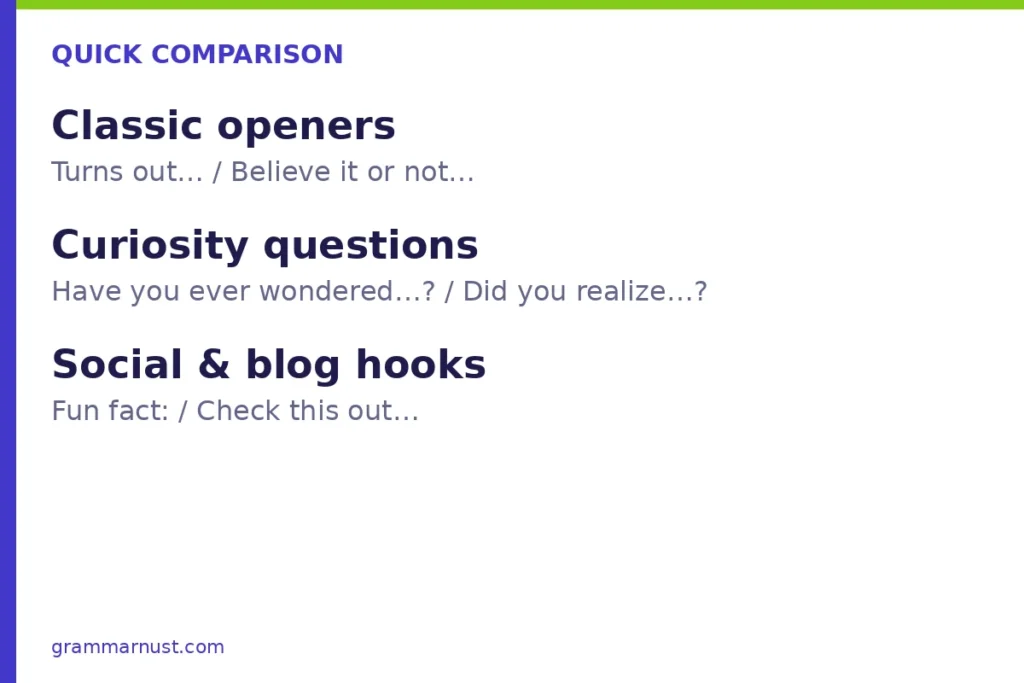
Classic Fact-Introducers (Entries 1–7)
Classic fact-introducers are versatile expressions that work in conversations, blog posts, presentations, and everyday writing. They help introduce information without requiring you to begin every sentence with the same question.
These options are particularly useful when you want to share an unexpected detail, reveal something interesting, or encourage someone to pay attention to what comes next.
1. Here’s Something Interesting
Tone and usage: Friendly, natural, and conversational. This is one of the most versatile alternatives because it introduces information without sounding overly formal or dramatic. It works well in conversations, articles, presentations, and informal messages.
Example: Here’s something interesting: our neighborhood library provides free access to digital magazines with a library card.
Use this expression when the information is genuinely relevant or interesting to your audience. It is an excellent choice when you want a smooth transition into a new topic.
2. Believe It or Not
Tone and usage: Playful, expressive, and slightly dramatic. This phrase suggests that the information might be unexpected or difficult to believe. It is particularly useful for unusual facts, entertaining stories, and surprising discoveries.
Example: Believe it or not, the small family business started with just one employee and a single storefront.
Use it when you want to create a moment of surprise. Avoid using it for ordinary information because the expression works best when the detail genuinely stands out.
3. Turns Out…
Tone and usage: Casual, direct, and discovery-focused. “Turns out” introduces information that reveals something previously unknown or corrects an assumption. It is especially natural in storytelling and informal explanations.
Example: Turns out, the building we visited was originally designed as a public library.
This opener is useful when sharing something you recently discovered or explaining how a situation was different from what someone expected.
4. Not Many People Know This, But…
Tone and usage: Intriguing and curiosity-driven. This expression suggests that the upcoming information is less widely known. It works particularly well in educational articles, trivia content, storytelling, and social media posts.
Example: Not many people know this, but the original design included a separate entrance for library deliveries.
Use this phrase only when the information is genuinely uncommon or overlooked. If the fact is widely known, the introduction may sound exaggerated or misleading.
5. Here’s the Thing
Tone and usage: Conversational, confident, and slightly emphatic. This phrase introduces an important point, explanation, or observation. It can also help redirect someone’s attention toward information that changes how they understand a situation.
Example: Here’s the thing: the simplest solution is not always the most effective one.
It works well in discussions, blog introductions, presentations, and informal explanations. It is more appropriate for sharing an important insight than presenting an isolated trivia fact.
6. Get This:
Tone and usage: Energetic, informal, and attention-grabbing. This expression creates anticipation and signals that something surprising or entertaining is coming. It is particularly suitable for friendly conversations and engaging storytelling.
Example: Get this: the restaurant we almost walked past turned out to be the place everyone recommended.
Use it when speaking with friends, creating casual content, or telling an interesting story. Avoid it in formal reports and serious professional communication because it can sound too relaxed.
7. As It Happens…
Tone and usage: Natural, slightly polished, and conversational. This phrase introduces a relevant fact, coincidence, or piece of information that connects with the current discussion. It is useful when the information adds an unexpected connection to what someone has just said.
Example: As it happens, the architect who designed the new building also worked on the city’s central library.
Choose this alternative when you want to introduce a useful discovery without making the information sound overly dramatic.
Curiosity Questions (Entries 8–13)
Questions are among the most effective did you know questions because they encourage readers and listeners to think before receiving the answer. Instead of immediately presenting information, you create a small moment of curiosity.
These expressions are especially useful for educational discussions, blog introductions, presentations, trivia games, and conversations where you want people to participate rather than simply listen.
8. Have You Ever Wondered…?
Tone and usage: Thoughtful, curious, and inviting. This question encourages someone to consider something they may have encountered without fully understanding. It works especially well before an explanation of how or why something happens.
Example: Have you ever wondered why the Moon appears to change shape throughout the month?
Use this opener in educational content, science articles, classroom discussions, and informative blog posts. It is particularly effective when the answer provides an explanation rather than just a single isolated fact.
9. Did You Realize…?
Tone and usage: Friendly, informative, and slightly thought-provoking. This expression draws attention to a detail that someone may have overlooked. It works well when highlighting an interesting observation or making someone reconsider something familiar.
Example: Did you realize that changing the order of two simple steps can make this process much easier?
Choose this phrase when you want to emphasize an overlooked detail rather than introduce completely unfamiliar information. It is suitable for conversations, educational writing, and informative presentations.
10. What Do You Think Happens When…?
Tone and usage: Interactive, engaging, and educational. This question encourages the audience to predict an outcome before you reveal the explanation. It is especially useful for teaching, demonstrations, quizzes, and discussions.
Example: What do you think happens when warm air comes into contact with a cold window?
This alternative works well when you want people to participate actively. Instead of immediately giving away the information, you create an opportunity for the audience to think about the answer.
11. Can You Imagine That…?
Tone and usage: Expressive, enthusiastic, and conversational. This phrase encourages someone to picture an unusual situation or surprising possibility. It works particularly well in storytelling and discussions about extraordinary events.
Example: Can you imagine that the entire project was completed using only the original team and existing equipment?
Use this expression when the information is impressive, unusual, or difficult to visualize. It creates a sense of excitement without requiring a lengthy introduction.
12. What Would You Say If You Learned…?
Tone and usage: Engaging, suspenseful, and interactive. This opener invites the audience to consider new information before hearing the complete explanation. It works well in presentations, educational discussions, and storytelling.
Example: What would you say if you learned that the old photograph was taken at the very location where we are standing?
Choose this alternative when you want to build anticipation or encourage a reaction. It is more expressive than a straightforward fact-introducer, so it is best for informal or engaging settings.
13. Have You Considered…?
Tone and usage: Thoughtful, respectful, and professional. This expression introduces an idea or detail that someone may not have examined before. Unlike more dramatic curiosity questions, it encourages reflection and careful consideration.
Example: Have you considered how the revised schedule might affect the team’s overall workload?
Use it in discussions, workplace meetings, educational settings, and persuasive writing. It is particularly effective when you want to introduce a relevant observation rather than simply share entertaining trivia.
Formal and Professional Openers (Entries 14–19)
When learning how to say did you know professionally, the most important consideration is the audience and purpose of your message. A formal way to say did you know should introduce information respectfully, avoid unnecessary excitement, and make the relevance of the information clear.
These alternatives are suitable for professional emails, business reports, presentations, research summaries, workplace discussions, and academic writing. They help you communicate information without making your message sound overly casual.
14. Were You Aware That…?
Tone and usage: Polite, professional, and informative. This expression is a strong alternative when you want to check whether someone knows a particular fact. It sounds more formal than the original phrase while remaining approachable.
Example: Were you aware that the updated software includes an additional security feature?
Use it in business emails, professional conversations, meetings, and presentations. It is particularly useful when sharing relevant information with colleagues or clients.
15. It May Be Useful to Know That…
Tone and usage: Courteous, practical, and professional. This expression introduces information that could help the reader understand a situation or make a decision. It focuses on usefulness rather than entertainment.
Example: It may be useful to know that the revised application process requires an additional supporting document.
Choose this phrase when the information has practical value. It is suitable for workplace emails, instructions, business communication, and formal announcements.
16. It Is Worth Noting That…
Tone and usage: Formal, objective, and informative. This phrase highlights a detail that deserves attention because it adds context, clarifies a situation, or supports an explanation.
Example: It is worth noting that the final proposal includes several changes requested during the previous meeting.
Use this alternative in reports, presentations, professional documents, and academic writing. It is especially useful when introducing supporting information without interrupting the main discussion.
17. For Context, Consider This…
Tone and usage: Professional, explanatory, and analytical. This phrase prepares the reader for information that makes a larger issue easier to understand. It is particularly helpful when introducing background details or explaining a decision.
Example: For context, consider this: the department was handling twice as many requests during the previous quarter.
Choose this expression for business reports, presentations, strategic discussions, and professional explanations. It works best when the following information provides useful background.
18. The Available Evidence Indicates That…
Tone and usage: Academic, objective, and evidence-focused. This expression introduces a conclusion supported by research, documentation, or other relevant evidence. It is more appropriate for factual discussions than casual trivia.
Example: The available evidence indicates that the revised procedure addresses the problems identified during the initial review.
Use it in research summaries, analytical reports, formal presentations, and academic writing. Only use this phrase when the information is genuinely supported by evidence.
19. One Relevant Detail Is That…
Tone and usage: Neutral, clear, and professional. This phrase introduces a specific detail that contributes to a broader explanation. It is useful when you want to draw attention to one important point without making it sound surprising or entertaining.
Example: One relevant detail is that the agreement allows both parties to request revisions before final approval.
Choose this alternative for business emails, project documentation, professional discussions, and reports where clarity is more important than creating excitement.
Social Media and Blog Hooks (Entries 20–25)
Writers looking for ways to introduce a fun fact need expressions that capture attention quickly without making every caption or article sound identical. Effective fun fact introductions create curiosity, establish a clear topic, and give readers a reason to continue.
These did you know trivia phrases are especially useful for Instagram captions, Facebook posts, Pinterest descriptions, short-form videos, blog introductions, and educational content. Choose an opener that matches the platform and the information you are sharing.
20. Fun Fact:
Tone and usage: Short, friendly, and instantly recognizable. This is a simple way to introduce a piece of interesting information without creating a long question. It works especially well in social media captions, trivia posts, newsletters, and educational content.
Example: Fun fact: a group of flamingos is commonly called a flamboyance.
Use it when sharing a short, interesting detail that can stand on its own. It is particularly effective when the information is entertaining, surprising, or easy to remember.
21. The Surprising Part Is…
Tone and usage: Intriguing, conversational, and suspenseful. This phrase creates anticipation by suggesting that the most interesting part of the information has not yet been revealed.
Example: The surprising part is that the entire presentation was created using only the original research notes.
Use it in storytelling, blog articles, social media captions, and short videos. It is especially effective when your content contains an unexpected detail that changes the reader’s understanding of the topic.
22. One Detail That Often Gets Overlooked…
Tone and usage: Informative, thoughtful, and curiosity-driven. This expression promises to highlight something that people may miss when looking at a topic from a broader perspective.
Example: One detail that often gets overlooked is how much natural light can change the appearance of a room.
Choose this alternative for informative articles, educational posts, home improvement content, professional blogs, and detailed explanations. It works best when the upcoming information adds genuine value.
23. Wait Until You See Why…
Tone and usage: Exciting, playful, and attention-grabbing. This phrase builds anticipation by suggesting that an explanation or discovery will make the topic more interesting.
Example: Wait until you see why this simple design change made the entire workspace feel more welcoming.
Use it in short videos, social media captions, storytelling, and blog introductions. Avoid relying on it too often, especially when the information that follows is relatively ordinary.
24. The Backstory Is More Interesting Than You Think…
Tone and usage: Storytelling-focused, engaging, and slightly mysterious. This expression encourages readers to discover the history or background behind something familiar.
Example: The backstory is more interesting than you think: the old theater originally served as a community meeting hall.
This is a strong choice for historical articles, travel blogs, cultural content, brand stories, and social media posts. It works particularly well when background information makes an ordinary subject more meaningful.
25. A Small Detail With a Big Impact…
Tone and usage: Thought-provoking, informative, and engaging. This phrase introduces a seemingly minor detail that has an important effect on the larger topic.
Example: A small detail with a big impact: adding clear labels to storage boxes can make everyday organization much easier.
Use it for practical tips, educational content, lifestyle articles, design posts, and business blogs. It is particularly effective when you want readers to appreciate the importance of something they might otherwise overlook.
For seasonal social media content, you can also introduce a surprising holiday detail before sharing a caption. For example, Sunday posts can open with an interesting fact before moving into a warm greeting. Explore these other ways to say “Happy Sunday” for additional caption inspiration.
Classroom and Educational Openers (Entries 26–30)
Teachers can use alternatives to “Did you know?” to introduce new subjects, encourage classroom participation, and make lessons more interactive. The best educational openers help students connect what they already understand with information they are about to learn.
These expressions work for elementary classrooms, middle school lessons, high school discussions, presentations, reading activities, and educational worksheets.
26. Let’s Start With an Observation…
Tone and usage: Educational, collaborative, and thoughtful. This expression invites students to examine something before discussing its meaning. It encourages observation and critical thinking rather than immediately giving away the answer.
Example: Let’s start with an observation: the shadows in this picture are pointing in different directions.
Use this phrase in science lessons, reading activities, geography discussions, and classroom demonstrations. It is particularly useful when students can discover information by examining an example.
27. Today’s Learning Point Is…
Tone and usage: Clear, structured, and teacher-friendly. This expression introduces an important piece of information that students should understand or remember. It creates a smooth transition into a new lesson or topic.
Example: Today’s learning point is that plants need suitable light, water, and nutrients to grow.
Use it at the beginning of a lesson, during a classroom presentation, or when introducing a key concept. It works especially well when the information is part of a structured learning objective.
28. Before We Begin, Consider This Question…
Tone and usage: Interactive, thoughtful, and educational. This phrase encourages students to think about a question before receiving the explanation. It can help activate prior knowledge and prepare learners for a new topic.
Example: Before we begin, consider this question: why do some materials allow light to pass through while others block it?
Choose this opener for classroom discussions, science experiments, reading comprehension, and group activities. It works particularly well when you want students to participate rather than passively receive information.
29. Here’s a Connection You May Not Have Noticed…
Tone and usage: Explanatory, engaging, and discovery-focused. This expression helps students recognize relationships between ideas, subjects, or events that they might not have connected previously.
Example: Here’s a connection you may not have noticed: the geometry we study in class is also used when architects design buildings.
Use it when connecting mathematics with art, history with geography, science with everyday life, or reading with real-world experiences. It helps students understand why different subjects matter beyond the classroom.
30. Let’s Test That Assumption…
Tone and usage: Analytical, interactive, and encouraging. This expression invites students to examine whether an initial belief is correct. It promotes curiosity, reasoning, and evidence-based thinking.
Example: Let’s test that assumption: do all objects that look heavy actually sink when placed in water?
Use this opener during experiments, classroom debates, problem-solving activities, and critical-thinking exercises. It is particularly useful when students can investigate a question and compare their predictions with the results.
For seasonal lessons, teachers can introduce Halloween history, traditions, and related trivia to make classroom discussions more engaging. These other ways to say “Trick or Treat” can also provide useful vocabulary and language activities for Halloween-themed lessons.
Casual Conversation Starters (Entries 31–35)
Sometimes you do not need a formal introduction or a carefully structured question. A simple, friendly opener can make sharing interesting information feel more natural.
These alternatives are suitable for conversations with friends, family members, coworkers you know well, and people you are comfortable speaking with. They are especially useful when you want to introduce something you recently discovered or bring an interesting detail into an everyday discussion.
31. You Know What’s Interesting?
Tone and usage: Friendly, relaxed, and conversational. This expression introduces a thought or observation as though you are sharing something naturally during a discussion.
Example: You know what’s interesting? We have both been using the same productivity app without realizing it.
Use it when chatting with friends, sharing discoveries, or introducing a topic that connects with an existing conversation. It sounds natural without being overly dramatic.
32. Guess What?
Tone and usage: Playful, enthusiastic, and informal. This short question builds anticipation and encourages the other person to pay attention. It is especially useful when sharing exciting discoveries, unusual information, or something unexpected.
Example: Guess what? I found the exact book we were discussing at the local library.
Choose it for friendly conversations, text messages, and casual storytelling. It works best when the information creates excitement or gives the listener a reason to respond.
33. I Just Came Across Something…
Tone and usage: Personal, natural, and discovery-focused. This phrase suggests that you recently encountered information worth sharing. It makes the introduction feel spontaneous rather than rehearsed.
Example: I just came across something interesting about how different cultures celebrate the beginning of spring.
Use it when sharing an article, discovery, interesting observation, or piece of information you recently encountered. It works well in everyday conversations and informal messages.
34. The Funny Thing Is…
Tone and usage: Relaxed, expressive, and slightly humorous. This phrase introduces an unexpected detail, coincidence, or observation that makes a situation more interesting.
Example: The funny thing is, we had both planned to visit the same restaurant without telling each other.
Choose this alternative when the information has a humorous or unexpected angle. It is particularly useful in storytelling and conversations with people you know well.
35. Here’s Something I Didn’t Expect…
Tone and usage: Personal, engaging, and conversational. This expression introduces information that surprised you personally. It creates a natural sense of discovery and encourages the listener to find out what happened.
Example: Here’s something I didn’t expect: the small neighborhood bookstore had an entire section dedicated to rare travel journals.
Use it when sharing personal discoveries, interesting experiences, or unexpected details. It works well in casual discussions, personal blogs, and social media storytelling.
A Different Job: FYI Markers (Not Fact-Introducers)
Some expressions look like alternatives to “Did You Know?” because they introduce information. However, they perform a different communication function. FYI markers announce updates, reminders, or practical information rather than introducing an interesting fact.
Two common examples are:
- Just So You Know: A casual way to communicate a reminder or useful update. Example: “Just so you know, the store closes at 8 PM today.”
- For Your Information: A neutral or professional way to share relevant information. Example: “For your information, the submission deadline has been extended until Friday.”
These expressions are useful when the reader needs to know something that affects them. However, they do not automatically create curiosity or introduce trivia.
Compare their purpose:
- Fact-introducer: “Here’s something interesting: the museum was originally built as a railway station.”
- FYI marker: “The museum will close earlier than usual on Thursday.”
The first sentence introduces an interesting detail. The second communicates a practical update.
Use each expression for its intended purpose. Choosing the right opener makes your writing clearer and prevents readers from confusing an interesting discovery with an ordinary announcement.
Which One Should You Use? A Quick Guide
The best alternative depends on where you are communicating and what you want the audience to do with the information. A professional email requires a different tone from an Instagram caption, while a classroom lesson benefits from questions that encourage participation.
Use this guide to select an appropriate opener for five common situations.
| Situation | Best opener | Why |
|---|---|---|
| Work email or report | It Is Worth Noting That… | It introduces relevant information in a neutral, professional way without making the message sound overly casual. |
| Social media post | Fun Fact: | It is short, recognizable, and suitable for captions, trivia posts, and educational content. |
| Classroom lesson | Have You Ever Wondered…? | It encourages students to think about a question before the teacher explains the answer. |
| Blog introduction | Here’s Something Interesting | It creates a natural transition into a new topic and works across different writing styles. |
| Casual chat with a friend | You Know What’s Interesting? | It sounds relaxed and personal, making it suitable for sharing everyday discoveries. |
A useful writing tip: Do not select an expression simply because it sounds more impressive. Think about the information that follows. If you are sharing an unexpected discovery, choose a curiosity-based opener. If you are explaining a relevant business detail, use professional wording. If you are teaching a lesson, choose a phrase that encourages students to participate.
Mistakes to Avoid When Introducing a Fact
Even a good alternative can sound awkward when it is used in the wrong context. The purpose of changing your wording is to make communication clearer and more engaging, not to make every sentence sound like a headline.
Avoid these common mistakes when introducing interesting information.
Using an FYI Marker to Introduce Trivia
An update marker is not automatically a good fact-introducer. Expressions intended to communicate reminders or practical updates can make an interesting discovery sound like an ordinary announcement.
For example, introducing an unusual historical detail with a routine update phrase may weaken the sense of curiosity you want to create.
Instead, choose an expression such as “Believe it or not,” “Here’s something interesting,” or “Not many people know this, but…” when the purpose is to introduce trivia.
Starting Every Paragraph With “Did You Know?”
Repeating the same opener throughout an article, presentation, or social media series can make the content feel predictable. Even interesting information may lose its impact when every paragraph follows an identical structure.
Vary your introductions according to the information. Use curiosity questions for explanations, conversational statements for discoveries, and formal expressions for professional details.
Variety should feel natural. You do not need a different opener in every sentence, but changing the structure when appropriate makes longer content easier to read.
Using a Playful Trivia Opener in a Formal Report
Expressions such as “Get this” and “Believe it or not” are suitable for casual communication, but they may sound unprofessional in business reports, research summaries, or official documents.
For formal writing, choose alternatives such as:
- It is worth noting that…
- The available evidence indicates that…
- One relevant detail is that…
- For context, consider this…
These expressions communicate information more objectively and keep the tone appropriate for professional readers.
Repeating the Same Opener With the Words Flipped
Changing the word order does not automatically create a genuinely different expression. For example, “You may be surprised to learn” and “It may surprise you that” communicate essentially the same idea.
Similarly, rearranging a phrase about something interesting or something that might interest the reader does not necessarily provide a new alternative.
Instead of counting sentence variations as separate expressions, choose openers that perform different functions. Include a mixture of curiosity questions, discovery statements, formal introductions, and casual conversation starters.
Creating Curiosity Without Delivering Useful Information
A strong introduction should lead to information that deserves the reader’s attention. If you promise something surprising but follow it with an ordinary or unrelated statement, readers may feel disappointed.
Make sure the information is accurate, relevant, and appropriate for the audience. An engaging opener should support the content rather than compensate for a lack of substance.
If you are collecting other ways to say did you know for a specific project, start from the situation rather than the phrase: pick a formal opener for reports, a curiosity question for lessons, and a relaxed starter for everyday conversation. Keeping a short list of other ways to say did you know for each setting means you always have a fresh opener ready, so no two posts, lessons, or emails ever have to begin the same way.
Frequently Asked Questions
What does “did you know” mean, and when do people use it?
“Did you know?” is a question used to introduce information that someone may not already be aware of. People use it before sharing interesting facts, surprising discoveries, helpful information, and trivia. It is common in everyday conversations, educational materials, social media posts, presentations, and blog articles because it encourages curiosity and invites the audience to pay attention.
What is a formal or professional way to say “did you know” in an email or report?
Professional alternatives include “Were you aware that,” “It is worth noting that,” “It may be useful to know that,” and “One relevant detail is that.” These expressions sound more polished in business communication. Choose the wording according to the information you are sharing, and make sure the detail is relevant to the recipient or report.
How do I introduce a fun fact without saying “did you know”?
You can introduce a fun fact with phrases such as “Here’s something interesting,” “Believe it or not,” “Fun fact,” “Turns out,” or “Not many people know this, but.” These alternatives work well in conversations, blog posts, presentations, and social media captions. Choose a phrase that matches the level of surprise and the tone of your content.
What are good “did you know” hooks for social media posts?
Good social media hooks include “Fun Fact,” “The Surprising Part Is,” “Wait Until You See Why,” “One Detail That Often Gets Overlooked,” and “The Backstory Is More Interesting Than You Think.” Keep the opening short, introduce genuinely interesting information, and make sure the rest of the post delivers on the curiosity created by the hook.
Is “just so you know” the same as “did you know”?
No. “Just so you know” usually introduces a reminder, update, or useful piece of information that someone needs to be aware of. “Did you know?” is generally used to introduce an interesting fact or encourage curiosity. For example, a store-hours reminder suits an update marker, while an unusual detail about the store’s history suits a fact-introducer.
How can teachers use alternatives to “did you know” in the classroom?
Teachers can use questions and observation-based expressions to encourage students to think actively. Phrases such as “Have you ever wondered,” “Let’s start with an observation,” “Before we begin, consider this question,” and “Let’s test that assumption” work well in lessons. They encourage participation, activate prior knowledge, and help students connect new information with concepts they already understand.
Conclusion
Choosing the right alternative to “Did You Know?” can make conversations, articles, professional emails, and educational content more engaging. Expressions such as “Here’s something interesting,” “Turns out,” and “Have you ever wondered?” are excellent for creating curiosity, while “Were you aware that?” and “It is worth noting that” work better in professional settings.
The best approach is to match your opener with your audience and the information you want to share. Use different expressions naturally, avoid unnecessary repetition, and make sure the fact that follows is accurate and relevant. With these 35 alternatives, you have plenty of ways to introduce interesting information without relying on the same phrase every time.